Multiple Choice
Identify the
choice that best completes the statement or answers the question.
|
|
|
1.
|
Which of the following angles, in degrees, is coterminal with, but not equal to,
  radians?
|
|
|
2.
|
Determine the equation of a circle with centre at the origin and radius
8.
|
|
|
3.
|
Which graph represents an angle in standard position with a measure of
135°?
|
|
|
4.
|
Identify the point on the unit circle corresponding to an angle of  radians in standard position.
|
|
|
5.
|
If the angle q is 1600° in standard position, in
which quadrant does it terminate?
A. | quadrant III | C. | quadrant II | B. | quadrant IV | D. | quadrant I |
|
|
|
6.
|
The amplitude and period (in degrees) of  are A. | amplitude = 
period =  | C. | amplitude = 
period =
 | B. | amplitude = 2
period =  | D. | amplitude = –2
period =  |
|
|
|
7.
|
Which graph represents the function y =  sin (  q) q), where q is in radians?
|
|
|
8.
|
Which function is represented by the graph shown below, where q is in radians?
|
|
|
9.
|
Which function is represented by the graph shown below, where x is in
degrees? A. | y = sin( x) x) | C. | y = cos( x) x) | B. | y = cos(x)
 | D. | y
= sin(x) sin(x) |
|
|
|
10.
|
What is the amplitude of the sinusoidal function 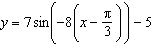 ? A. |  | C. | –5 | B. | –8 | D. | 7 |
|
|
|
11.
|
Given the trigonometric function  , which is the x-coordinate at
which the function is undefined?
|
|
|
12.
|
Solve  , to the nearest tenth of a degree, if necessary, on the
interval  . A. | x = 53.1°, x = 126.9° | C. | x = 36.9°, x =
323.1° | B. | x = 126.9°, x = 233.1° | D. | x = 53.1°, x = 306.9° |
|
|
|
13.
|
Which equation is a reciprocal identity?
|
|
|
14.
|
Which equation is a quotient identity?
|
|
|
15.
|
Which expression is equivalent to  ?
|
|
|
16.
|
Simplify  .
|
|
|
17.
|
 is equivalent to
|
|
|
18.
|
What is the general solution, in degress, to the equation  ?
|
|
|
19.
|
What is the general solution, in radians, to the equation 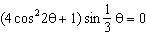 ? A. |  where where  | C. |  where where  | B. | no solution | D. |  where where  |
|
|
|
20.
|
What is the general solution, in radians, to the equation  ? A. |  , where , where  | C. | no solution | B. |  , where , where  | D. |  , where , where  |
|
Short Answer
|
|
|
1.
|
A 3-m ladder is leaning against a vertical wall such that the angle between the
ground and the ladder is  . What is the exact height that the ladder reaches up the
wall?
|
|
|
2.
|
Explain how you could graph the function  given a table of values
containing ordered pairs for the function  .
|
|
|
3.
|
A Ferris wheel of diameter 18.5 m rotates at a rate of 0.2 rad/s. If passengers
board the lowest car at a height of 3 m above the ground, determine a sinusoidal function that models
the height, h, in metres, of the car relative to the ground as a function of the time,
t, in seconds.
|
|
|
4.
|
Prove the identity  .
|
|
|
5.
|
What is the solution for  for  ?
|
Problem
|
|
|
1.
|
Two wires are connected to a tower at the same point on the tower. Wire #1 makes
an angle of 45° with the ground and wire #2 makes an angle of 60° with the
ground.
a) Represent this situation with a diagram.
b) Which wire is longer?
Explain.
c) If the point where the two wires connect to the tower is 35 m above the ground,
determine exact expressions for the lengths of the two wires.
d) Determine the length of
each wire, to the nearest tenth of a metre.
e) How do your answers to parts b) and d)
compare?
|
|
|
2.
|
Consider the graph of 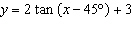 . a) Describe the
transformations from the function  . b) Graph the two functions on the same set of
axes over the interval  . c) Given that  , explain where the
function 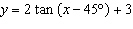 has vertical asymptotes.
|
|
|
3.
|
A sinusoidal function has an amplitude of 2, a period of 180°, and a
maximum at (0, 4).
a) Represent this function with an equation using a sine
function.
b) Represent this function with an equation using a cosine function.
c)
Explain how these two functions are related.
|