Multiple Choice
Identify the choice that best
completes the statement or answers the question.
|
|
|
1.
|
Which statement is true?
A. | The English language and the French language are disjoint sets. | B. | Hockey equipment and
lacrosse equipment are disjoint sets. | C. | Band instruments and orchestral instruments are
disjoint sets. | D. | Linear equations and quadratic equations are disjoint
sets. |
|
|
|
2.
|
Which pair of sets represents one set being a subset of another but is not
equal?
A. | N, the set of natural numbers, and I, the set of
integers | B. | T, the set of all triangles, and C, the set of all
circles | C. | N, the set of natural numbers, and P, the set of positive
integers | D. | none of the above |
|
|
|
3.
|
Given the following situation:
• the universal set U = {positive
integers less than 20}
• X = {4, 5, 6, 7, 8}
• P = {prime numbers of
U}
• O = {odd numbers of U}
Which set represents the odd, prime
numbers of set U?
A. | {0, 3, 5, 7, 11, 13, 17, 19} | B. | {3, 5, 7, 11, 13, 17, 19} | C. | {2, 3, 5, 7, 11, 13,
17, 19} | D. | {1, 2, 3, 5, 7, 11, 13, 17, 19} |
|
|
|
4.
|
Given the following situation:
• the universal set U = {positive
integers less than 20}
• X = {4, 5, 6, 7, 8}
• P = {prime numbers of
U}
• O = {odd numbers of U}
Which is the complement of
P?
A. | the even numbers of U | B. | the universal set excluding the set of
X | C. | the positive integers greater than 20 | D. | the non-prime numbers of
U |
|
|
|
5.
|
There are 28 students in Mr. Connelly’s Grade 12 mathematics class. The
number of students in the yearbook club and the number of students on student council are shown in
the Venn diagram. Use the diagram to answer the following questions. 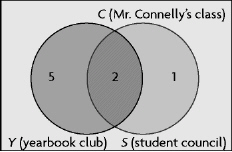 How many students are on the student council but not in the yearbook club?
|
|
|
6.
|
Consider the following Venn diagram of foods we eat raw or cooked: 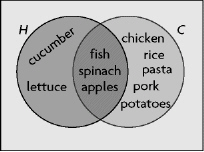 Determine n( H È
C).
|
|
|
7.
|
Consider the following two sets:
• C = {–10, –8,
–6, –4, –2, 0, 2, 4, 6, 8, 10}
• B = {–9, –6, –3,
0, 3, 6, 9, 12}
Determine n(C Ç
B).
|
|
|
8.
|
What is a contrapositive statement?
A. | a conditional statement in which the hypothesis and the conclusion are
switched | B. | a statement that is formed by negating both the hypothesis and the conclusion of a
conditional statement | C. | a statement that is formed by negating both the
hypothesis and the conclusion of the converse of a conditional statement | D. | a statement that is
formed by inverting both the hypothesis and the conclusion of a conditional
statement |
|
|
|
9.
|
Which statement is the converse of the conditional statement below?
“If
a bird has wings, then the bird can fly.”
A. | If a bird does not have wings, then the bird cannot fly. | B. | If the bird cannot
fly, then the bird does not have wings. | C. | If a bird can fly, then the bird has
wings. | D. | If a bird does not have wings, then the bird can fly. |
|
|
|
10.
|
Which statement is the inverse of the conditional statement below?
“If
a balloon is filled with helium, then the balloon will float upwards.”
A. | If a balloon floats upwards, then the balloon is filled with
helium. | B. | If a balloon is not filled with helium, then the balloon will not float
upwards. | C. | If a balloon is not filled with helium, then the balloon will float
downwards. | D. | If a balloon does not float upwards, then the balloon is not filled with
helium. |
|
Short Answer
|
|
|
1.
|
Tania recorded the 16 possible sums that can occur when you roll two four-sided
dice.
• S = {all possible sums}
• L = {all sums less than
4}
• G = {all sums greater than 4}
• F = {all sums equal to
4}
List the subsets using set notation.
|
|
|
2.
|
If the statement below is biconditional, rewrite it in biconditional form. If
the statement is not biconditional, provide a counterexample.
“If you make unleavened bread,
then you make bread without yeast.”
|
|
|
3.
|
Write the contrapositive of the conditional statement below. Verify the
contrapositive or disprove it with a counterexample.
“If the height and radius of a
cone and cylinder are the same, then the cone is one third the volume of the cylinder.”
|
Problem
|
|
|
1.
|
a) Draw a Venn diagram to represent these sets:
• the universal
set U = {natural numbers from 1 to 50 inclusive}
• T = {multiples of
3}
• S = {multiples of 6}
• N = {multiples of 19}
b) List
the disjoints sets, if there are any.
c) Is each statement true or false?
Explain.
i) T Ì S
ii) S
Ì T
iii) N Ì
N
iv) T¢ = {even numbers from 1 to 50}
v)
In this example, the set of natural numbers from 51 to 100 is { }.
|
|
|
2.
|
Consider this universal set:
A = {A, B, C, D, E, F, G, H, I, J, K, L,
M, N, O, P, Q, R, S, T, U, V, W, X, Y, Z}
a) List the following subsets:
•
C = {letters that are consonants}
• V = {letters that are vowels}
b)
Represent the universal set and subsets in a Venn diagram.
c) Are C and
V are disjoints sets? Explain.
|