Multiple Choice
Identify the choice that best
completes the statement or answers the question.
|
|
|
1.
|
Which line of the table shows the correct values for i and n?
Compound Interest Rate per Annum
(%) |
Compounding Frequency
|
Term
| Interest Rate per Compounding Period,
i (%) | Number of Compounding Periods, n | 5.4 | semi-annually | 3 years | 0.018 | 6 | 3.7 | weekly | 6 months | 0.000 711... | 104 | 0.9 | monthly | 4.5 years | 0.0075 | 48 | 2.25 | quarterly | 7 years | 0.005 625 | 28 | | | | | |
A. | Line 1 | B. | Line 2 | C. | Line
3 | D. | Line 4 |
|
|
|
2.
|
Determine the future value and the total interest earned for the
investment.
Principal (P) ($)
| Compound
Interest Rate per Annum (%) |
Compounding Frequency
|
Term
| 35 000 | 3.7 | quarterly | 7 years | | | | |
A. | $45 239.99; 10 239.99 | B. | $46 245.18; $11 245.18 | C. | $45 293.23; $10
293.23 | D. | $44 669.12; $9669.12 |
|
|
|
3.
|
Use the Rule of 72 to estimate the investment’s doubling time and then
determine the actual doubling time.
Principal (P)
($)
| Compound Interest Rate per Annum (%) |
Compounding
Frequency
|
Term
| 5000 | 4.5 | monthly | 5 years | | | | |
A. | 16 years; 15.43 years | B. | 16 years; 15.57 years | C. | 16 years; 15.89
years | D. | 16 years; 15.73 years |
|
|
|
4.
|
Determine the future value of annual payments of $5000 into an account that pays
3.95% interest, compounded annually, for 40 years.
A. | $469 563.75 | B. | $507 128.85 | C. | $493
041.94 | D. | $483 650.66 |
|
|
|
5.
|
Regular semi-annual payments of $400 are deposited into an account paying 6.15%
interest, compounded semi-annually. If the final value of the account is $46 000, how long was the
money invested?
A. | 26.84 years | B. | 25.33 years | C. | 24.96
years | D. | 24.17 years |
|
|
|
6.
|
This portfolio was started 10 years ago. What is the current value of the
portfolio?
• Quarterly deposits of $650 into an account earning 3.25%, compounded
quarterly
• A $15 000 investment averaging 4.5%, compounded annually
A. | $54 463.50 | B. | $53 871.69 | C. | $55
492.65 | D. | $54 129.57 |
|
|
|
7.
|
This portfolio was started 17 years ago. What is the portfolio’s current
rate of return?
• A 17-year $25 000 bond earning 7.25%, compounded semi-annually
•
Quarterly deposits of $300 into an account averaging 4.7%, compounded quarterly
A. | 152.5% | B. | 161.4% | C. | 153.0% | D. | 159.7% |
|
|
|
8.
|
This portfolio was started 4 years ago. What is the portfolio’s current
rate of return?
• Annual deposits of $3000 into an account earning 4%, compounded
annually
• A 4-year $700 GIC averaging 4.5%, compounded semi-annually
A. | 6.73% | B. | 6.52% | C. | 6.16% | D. | 6.90% |
|
|
|
9.
|
Kristina took out a bank loan for $60 000 that must be repaid with regular
monthly payments of $1100. The bank charges her an interest rate of 3.0%, compounded monthly. How
much interest will Kristina pay?
A. | $4900.00 | B. | $9473.68 | C. | $3800.00 | D. | $4586.13 |
|
|
|
10.
|
Catherine wants to travel to England. The trip costs $3000 and she can afford
monthly payments of $150. She can finance her trip using one of her two credit cards.
• Card
1 charges 12.7%, compounded daily.
• Card 2 charges 18.1%, compounded daily, but she gets 3%
cash back on all purchases.
What is the least amount of interest Catherine can pay?
A. | $473.75 | B. | $300.00 | C. | $391.02 | D. | $563.75 |
|
|
|
11.
|
Garrick is purchasing equipment for his job as a builder. The equipment costs
$1000 and he wants to make monthly payments of $125. He has two different credit cards that he can
use to finance the purchase.
• Card A charges 9.9%, compounded daily, but it also charges a
fee of $65 for all purchases over $1000 that is immediately added to the balance.
• Card B
charges 13.3%, compounded daily.
What is the least amount of interest Garrick can pay?
A. | $125.00 | B. | $109.01 | C. | $44.01 | D. | $53.24 |
|
|
|
12.
|
Cormac wants to pay off all his debts in 4 years. He has two credit cards on
which he makes monthly payments:
• Card A has a balance of $3002.91 and an interest rate of
17.6%, compounded daily.
• Card B has a balance of $4712.01 and an interest rate of 15.9%,
compounded daily.
Cormac wants to consolidate his debts into a line of credit with an interest
rate of 8.9%, compounded monthly. If Cormac consolidates his debt, what will his monthly payments
be?
A. | $117.11 | B. | $191.74 | C. | $221.33 | D. | $74.63 |
|
|
|
13.
|
Cai wants to pay off her debt of $759.21 by only making the minimum monthly
payments, which is 4.5% of the balance or $20, whichever is greater. The interest rate on the debt is
21.1%, compounded monthly. How many payments will it take Cai to pay off the debt?
|
|
|
14.
|
Soloman bought a used car for $12 000 during a sale. The sale was that as long
as the debt was paid off in three years, no interest would be charged. Otherwise, a penalty equal to
an interest rate of 10.5%, compounded monthly, would be charged, starting from when he first borrowed
the money. If Soloman were to make regular monthly payments, how much would each payment need to be
so that he pays off the debt in time?
A. | $390.03 | B. | $456.13 | C. | $533.71 | D. | $333.33 |
|
|
|
15.
|
A company replaces its trucks after the trucks have been used for 8 years. The
company uses a depreciation rate of 35%. If after 3 years of use a truck is worth $27 000, what will
it be worth when the company replaces it?
A. | $860.34 | B. | $7414.88 | C. | $3132.78 | D. | $141.81 |
|
|
|
16.
|
Johanna needs a place to live. She can either rent an apartment or buy a new
house. Renting costs $300 per week. She can finance the purchase of a house that costs $280 000 with
a mortage. She has negotiated with the bank a mortgage of 87% of the purchase price at an interest
rate of 3.9%, compounded semi-annually. The term of the mortgage is 15 years and it requires regular
monthly payments. The house depreciates at a rate of 4%. If she moves out after 6 years, what is her
total cost of living in the apartment?
A. | $164 984.20 | B. | $93 600.00 | C. | $21
600.00 | D. | $130 000.00 |
|
|
|
17.
|
Which statement is true?
A. | The English language and the French language are disjoint sets. | B. | Hockey equipment and
lacrosse equipment are disjoint sets. | C. | Band instruments and orchestral instruments are
disjoint sets. | D. | Linear equations and quadratic equations are disjoint
sets. |
|
|
|
18.
|
Which Venn diagram correctly represents the situation described?
Rahim
described the set as follows:
• M = {all of the foods he eats}
• D =
{his favourite desserts}
• V = {his favourite vegetables}
• F = {his
favourite fruits}
Assume Rahim likes some fruit for dessert.
|
|
|
19.
|
Given the following situation:
• the universal set U = {positive
integers less than 20}
• X = {4, 5, 6, 7, 8}
• P = {prime numbers of
U}
• O = {odd numbers of U}
Which is the complement of
P?
A. | the even numbers of U | B. | the universal set excluding the set of
X | C. | the positive integers greater than 20 | D. | the non-prime numbers of
U |
|
|
|
20.
|
There are 28 students in Mr. Connelly’s Grade 12 mathematics class. The
number of students in the yearbook club and the number of students on student council are shown in
the Venn diagram. Use the diagram to answer the following questions. 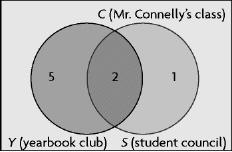 How many students are on the student council but not in the yearbook club?
|
|
|
21.
|
Consider the following Venn diagram of herbivores and carnivores: 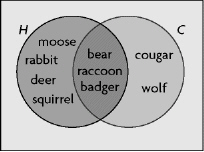 Determine n( H È
C).
|
|
|
22.
|
Which conditional statement is false?
A. | If today is Labour Day, then it is November 3. | B. | If it is October,
then students are in school. | C. | If today is Friday, then tomorrow is
Saturday. | D. | If there is deep snow outside, then the outside temperature is below
freezing. |
|
|
|
23.
|
Which statement is the inverse of the conditional statement below?
“If
tomorrow is Monday, then today is Sunday.”
A. | If tomorrow is Sunday, then today is not Monday. | B. | If today is Sunday,
then tomorrow is Monday. | C. | If tomorrow is not Monday, then today is not
Sunday. | D. | If today is not Sunday, then tomorrow is not Monday. |
|
|
|
24.
|
Evaluate. 
|
|
|
25.
|
Which of the following is equivalent to  ?
|
|
|
26.
|
Identify the term that best describes the following situation:
Determine the
number of pizzas with 4 different toppings from a list of 40 toppings.
A. | permutations | B. | combinations | C. | factorial | D. | none of the
above |
|
|
|
27.
|
The odds of Macy passing her driver’s test on the first try are 7 : 4.
Determine the odds against Macy passing her driver’s test.
A. | 4 : 7 | B. | 4 : 11 | C. | 7 :
11 | D. | 3 : 11 |
|
|
|
28.
|
Julie draws a card at random from a standard deck of 52 playing cards. Determine
the odds in favour of the card being a heart.
A. | 3 : 1 | B. | 1 : 3 | C. | 1 :
1 | D. | 3 : 13 |
|
|
|
29.
|
Julie draws a card at random from a standard deck of 52 playing cards. Determine
the probability of the card being a diamond.
A. | 0.250 | B. | 0.500 | C. |
0.625 | D. | 0.750 |
|
|
|
30.
|
A credit card company randomly generates temporary three-digit pass codes for
cardholders. The pass code will consist of three different even digits. Determine the total number of
pass codes using three different even digits.
|
|
|
31.
|
Yvonne tosses three coins. She is calculating the probability that at least one
coin will land as heads. Determine the total number of outcomes.
|
|
|
32.
|
Samuel rolls two regular six-sided dice. Determine the odds against him rolling
an even sum or an 8.
A. | 1 : 3 | B. | 25 : 11 | C. | 21 :
15 | D. | 1 : 1 |
|
|
|
33.
|
Min draws a card from a well-shuffled standard deck of 52 playing cards. Then
she puts the card back in the deck, shuffles again, and draws another card from the deck. Determine
the probability that both cards are face cards.
|
|
|
34.
|
Select the events that are dependent.
A. | Rolling a 2 and rolling a 5 with a pair of six-sided dice, numbered 1 to
6. | B. | Drawing an odd card from a standard deck of 52 playing cards, putting it back, and
then drawing another odd card. | C. | Drawing a spade from a standard deck of 52
playing cards and then drawing another spade, without replacing the first card. | D. | Rolling an even
number and rolling an odd number with a pair of six-sided dice, numbered 1 to
6. |
|
|
|
35.
|
Select the events that are independent.
A. | Choosing a number between 1 and 30 with the number being a multiple of 2 and also a
multiple of 4. | B. | Drawing a heart from a standard deck of 52 playing cards and then drawing another
heart, without replacing the first card. | C. | Rolling a 2 and having a sum greater than 4
with a pair of six-sided dice, numbered 1 to 6. | D. | Rolling a 1 and rolling a 6 with a pair of
six-sided dice, numbered 1 to 6. |
|
|
|
36.
|
Describe the characteristics of the trend in the data. 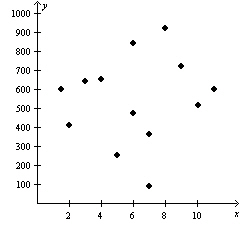 A. | increasing | B. | decreasing | C. | constant | D. | no trend |
|
|
|
37.
|
Determine the equation of the cubic regression function for the data. x | 2 | 4 | 7 | 10 | 12 | 13 | 17 | 19 | y | 135 | 120 | 105 | 102 | 99 | 88 | 78 | 47 | | | | | | | | | |
A. | y = 0.05x3 – 1.5x2 –
16x + 162.5 | B. | y = –0.05x3 +
1.5x2 – 16x + 162.5 | C. | y = 0.05x3 +
1.5x2 + 16x – 162.5 | D. | y = –0.05x3 +
1.5x2 + 16x – 162.5 |
|
|
|
38.
|
How many x-intercepts does the exponential function f(x) =
2(10)x have?
|
|
|
39.
|
Match the following graph with its function. 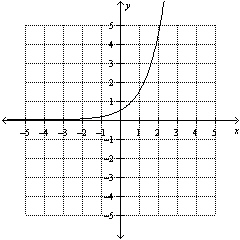 A. | y = 3(0.5)x | B. | y =
2(1.25)x | C. | y =
0.5(3)x | D. | y =
2(0.75)x |
|
|
|
40.
|
Determine the equation of the exponential regression function for the data.
x | 0 | 1 | 2 | 3 | 4 | 5 | y | 3.5 | 5.6 | 9.0 | 14.2 | 23.1 | 36.7 | | | | | | | |
A. | y = 3.5(1.6)x | B. | y =
2.2(1.6)x | C. | y =
3.5(1.8)x | D. | y =
3.5(0.8)x |
|
|
|
41.
|
Determine the equation of the exponential regression function for the data.
x | 3 | 4 | 5 | 6 | 8 | 10 | y | 1.85 | 2.07 | 2.32 | 2.62 | 3.25 | 4.10 | | | | | | | |
A. | y = 1.85(1.24)x | B. | y =
1.85(1.12)x | C. | y =
1.32(1.24)x | D. | y =
1.32(1.12)x |
|
|
|
42.
|
Which logarithmic equation correctly represents the exponential equation
107 = x?
A. | x = log 7 | B. | x = log 10 | C. | 7 = log
x | D. | 10 = log x |
|
|
|
43.
|
The equation of the logarithmic function that models a data set is y =
8.2 + 0.7 ln x.
Determine the domain of this function.
A. | {x | x Î R} | B. | {x | x
> 0, x Î R} | C. | {x | x > 0.7, x Î R} | D. | {x | x > 8.2, x Î R} |
|
|
|
44.
|
Choose the best estimate for 136° in radians.
|
|
|
45.
|
Imagine that it is now 2 p.m. What time will it be when the minute hand has
rotated through 300°?
|
|
|
46.
|
Identify the range of the graph of y = 1 + sin x.
A. | {y | –1 £ y £ 1, y Î R} | B. | {y | 0 £ y £ 2, y Î R} | C. | {y | –1 £ y £ 2, y Î R} | D. | {y | –2 £ y £ 2, y Î R} |
|
|
|
47.
|
Determine the period of the following graph. 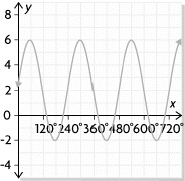
|
|
|
48.
|
Determine the period of the following function.
y = 3 sin 2(x +
90°) – 1
A. | 180° | B. | 360° | C. | 720° | D. | 1080° |
|
|
|
49.
|
Determine the midline of the following function. y = cos  x x + 12 A. | y = 12 | B. | y = 3 | C. | y =
4 | D. | y = 0 |
|
|
|
50.
|
The following data set is sinusoidal. Determine the missing value from the
table. x | –3 | –2 | –1 | 0 | 1 | 2 | 3 | 6 | y | 1.0 | 1.7 | 2.0 | 1.7 | 1.0 | 0.3 | 0.0 | | | | | | | | | | |
|