Multiple Choice
Identify the choice that best
completes the statement or answers the question.
|
|
|
1.
|
Freda has $14 000 to invest for 10 years. Which investment option will earn her
more interest? How much more interest?
A. 2.5% simple interest, paid daily
B.
1.25% compound interest, paid annually
A. | Option A: $1648.21 | B. | Option B: $1335.96 | C. | Option A:
$1524.91 | D. | Option B: $1798.50 |
|
|
|
2.
|
Which investment will earn the most interest?
A. $200 invested for 4
years at a compound interest rate of 2%
B. $300 invested for 3 years at a simple interest
rate of 2%
C. $250 invested for 2 years at a compound interest rate of 2%
D. $200
invested for 4 years at a simple interest rate of 2%
A. | Option A | B. | Option B | C. | Option
C | D. | Option D |
|
|
|
3.
|
How many compounding periods are there for $1000 invested for December and
January at 1.8% compounded daily?
|
|
|
4.
|
Determine the future value and the total interest earned for the
investment.
Principal (P) ($)
| Compound
Interest Rate per Annum (%) |
Compounding Frequency
|
Term
| 9000 | 2.25 | semi-annually | 3 years | | | | |
A. | $9728.91; $728.91 | B. | $9696.45; $696.45 | C. | $9626.65;
$625.65 | D. | $9624.84; $624.84 |
|
|
|
5.
|
Use the Rule of 72 to estimate the investment’s doubling time and then
determine the actual doubling time.
Principal (P)
($)
| Compound Interest Rate per Annum (%) |
Compounding
Frequency
|
Term
| 24 000 | 5 | semi-annually | 20
years | | | | |
A. | 14.4 years; 13.95 years | B. | 14.4 years; 14.04 years | C. | 14.4 years; 13.86
years | D. | 14.4 years; 14.21 years |
|
|
|
6.
|
Use the Rule of 72 to estimate the investment’s doubling time and then
determine the actual doubling time.
Principal (P)
($)
| Compound Interest Rate per Annum (%) |
Compounding
Frequency
|
Term
| 3200 | 6.3 | daily | 9 years | | | | |
A. | 11.43 years; 11.09 years | B. | 11.43 years; 10.96 years | C. | 11.43 years; 11.35
years | D. | 11.43 years; 11.00 years |
|
|
|
7.
|
Determine the interest earned on a 10-year investment with an interest rate of
5.4%, compounded annually, if the future value is $80 000.
A. | $32 719.30 | B. | $33 310.31 | C. | $33
605.82 | D. | $32 837.50 |
|
|
|
8.
|
Determine the term of a $39 000 investment with an interest rate of 2.06%,
compounded quarterly, if the future value is $52 000.
A. | 14 years | B. | 15 years | C. | 16
years | D. | 17 years |
|
|
|
9.
|
Regular weekly payments of $20 are deposited into an account paying 1.5%
interest, compounded weekly. If the final value of the account is $5000, how long was the money
invested?
A. | 4.64 years | B. | 5.30 years | C. | 4.96
years | D. | 4.10 years |
|
|
|
10.
|
This portfolio was started 10 years ago. What is the current value of the
portfolio?
• A $1200 GIC that earns 2.65%, compounded quarterly
• Monthly deposits
of $250 into an account earning 1.75%, compounded monthly
A. | $35 945.21 | B. | $32 578.18 | C. | $33
500.69 | D. | $34 321.78 |
|
|
|
11.
|
Claude has been approved for a $12 400 loan to pay for a new boat. The terms of
the loan state that it must be repaid in 4 years at a simple interest rate of 9.6%. How much interest
must Claude pay on this loan?
A. | $17 892.21 | B. | $4761.60 | C. | $5492.21 | D. | $17 161.60 |
|
|
|
12.
|
Carlos was approved for a mortgage to finance his new house that he purchased
for $325 000. He made a down payment that was 20% of the purchase price. The mortgage is
compounded semi-annually at an interest rate of 4.2%. Carlos will repay the mortgage in 25 with
regular monthly payments. How much interest will he have to pay?
A. | $93 796.24 | B. | $198 495.30 | C. | $158
796.24 | D. | $160 375.01 |
|
|
|
13.
|
Kristina took out a bank loan for $60 000 that must be repaid with regular
monthly payments of $1100. The bank charges her an interest rate of 3.0%, compounded monthly. How
many payments will Kristina have to make to pay off the bank loan?
|
|
|
14.
|
Garrick is purchasing equipment for his job as a builder. The equipment costs
$1000 and he wants to make monthly payments of $125. He has two different credit cards that he can
use to finance the purchase.
• Card A charges 9.9%, compounded daily, but it also charges a
fee of $65 for all purchases over $1000 that is immediately added to the balance.
• Card B
charges 13.3%, compounded daily.
What is the least amount of interest Garrick can pay?
A. | $125.00 | B. | $109.01 | C. | $44.01 | D. | $53.24 |
|
|
|
15.
|
Joanna needs to buy textbooks for school that cost $780. She cannot afford them
now but she has two different options to finance the cost.
Option A: Get a loan from her friend
that must be paid back in 3 months with a $50 fee.
Option B: Use her credit card which charges
18.8%, compounded daily. She plans to make the minimum monthly payment of $10 on the debt for 3
months, then pay off the remaining debt in full.
What annual interest rate does the fee in Option
A equate to if you assume the interest compounds monthly?
A. | 25.1% | B. | 25.6% | C. | 28.2% | D. | 6.4% |
|
|
|
16.
|
Jasmine needs a car. She has two different options. She can rent a car for $225
per month for three years. She can also buy a new car for $21 000. She will finance the purchase
through the dealership by making regular monthly payments over 9 years at an interest rate of 4.9%,
compounded monthly. If she purchases the car, she will sell it after three years at market value. The
car depreciates at a rate of 25%. In both options, she must make a down payment of $1200. What is the
total cost of the cheaper option?
A. | $9300.00 | B. | $14 657.02 | C. | $9375.17 | D. | $8100.00 |
|
|
|
17.
|
Which pair of sets represents disjoint sets?
A. | N, the set of natural numbers, and I, the set of
integers | B. | T, the set of all triangles, and C, the set of all
circles | C. | N, the set of natural numbers, and P, the set of positive
integers | D. | none of the above |
|
|
|
18.
|
There are 28 students in Mr. Connelly’s Grade 12 mathematics class. The
number of students in the yearbook club and the number of students on student council are shown in
the Venn diagram. Use the diagram to answer the following questions. 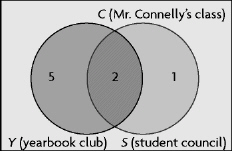 How many students are in at least one of the yearbook club or on student
council?
|
|
|
19.
|
Consider the following two sets:
• C = {–10, –8,
–6, –4, –2, 0, 2, 4, 6, 8, 10}
• B = {–9, –6, –3,
0, 3, 6, 9, 12}
Determine n(C Ç
B).
|
|
|
20.
|
Consider the following two sets:
• C = {–10, –8,
–6, –4, –2, 0, 2, 4, 6, 8, 10}
• B = {–9, –6, –3,
0, 3, 6, 9, 12}
Determine C Ç B.
A. | {3, 6, 9, 12} | B. | {–6, 0, 6} | C. | {0} | D. | {–6, 0, 6,
12} |
|
|
|
21.
|
Which truth tables apply to the conditional statement below and its
converse? “If x = y, then y =
x.” A.
C.
p | q | p Þ q | | p | q | p Þ
q | T | F | F | | T | T | F | q | p | q Þ p | | q | p | q Þ p | F | F | F | | T | F | T | | | | | | | |
B.
D. p | q | p Þ q | | p | q | p Þ
q | T | T | T | | T | F | T | q | p | q Þ p | | q | p | q Þ p | T | T | T | | T | F | F | | | | | | | |
|
|
|
22.
|
A restaurant offers 60 flavours of wings and your choice of three dips. How many
variations of wings and dip can you order?
|
|
|
23.
|
Solve for n, where n Î I. 
|
|
|
24.
|
Evaluate.
3P1
|
|
|
25.
|
How many ways can 7 friends stand in a row for a photograph if Sheng always
stands beside his girlfriend?
|
|
|
26.
|
How many different arrangements can be made using all the letters in
CANADA?
|
|
|
27.
|
There are 14 members of a student council. How many ways can 4 of the members be
chosen to serve on the dance committee?
A. | 1001 | B. | 2002 | C. | 6006 | D. | 24 024 |
|
|
|
28.
|
The numbers 10 to 16 are written on identical slips of paper and put in a hat.
How many ways can 2 numbers be drawn simultaneously?
|
|
|
29.
|
Which of the following is equivalent to  ?
|
|
|
30.
|
Which expression correctly describes the theoretically probability,
P(X), where n(X) is the number of times event X occurred and
n(S) is the number of outcomes in the sample space, S, where all outcomes are
equally likely?
|
|
|
31.
|
Julie draws a card at random from a standard deck of 52 playing cards. Determine
the probability of the card being a diamond.
A. | 0.250 | B. | 0.500 | C. |
0.625 | D. | 0.750 |
|
|
|
32.
|
Four boys and three girls will be riding in a van. Only two people will be
selected to sit at the front of the van. Determine the number of ways in which there can be more
girls than boys sitting at the front.
|
|
|
33.
|
Two dice are rolled. Let A represent rolling a sum greater than 6. Let
B represent rolling a sum that is a multiple of 4. Determine P(A Ç B).
|
|
|
34.
|
There are 60 males and 90 females in a graduating class. Of these students, 30
males and 50 females plan to attend a certain university next year. Determine the probability
that a randomly selected student plans to attend the university.
|
|
|
35.
|
A three-colour spinner is spun, and a die is rolled. Determine the probability
that you spin blue and roll a 4.
A. | 1.24% | B. | 5.56% | C. | 7.17% | D. | 9.82% |
|
|
|
36.
|
Two cards are drawn, without being replaced, from a standard deck of 52 playing
cards. Determine the probability of drawing a face card then drawing an even-numbered
card.
A. | 1.96% | B. | 9.05% | C. | 14.32% | D. | 23.08% |
|
|
|
37.
|
Determine the number of turning points on this polynomial function: 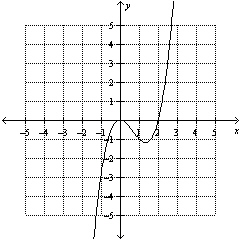
|
|
|
38.
|
The distance a marathon runner covers can be modelled by the
function
d(t) = 153.8t + 86
where d represents the distance in
metres and t represents the time in minutes.
Approximately how far has she run after the
first hour?
A. | 93 km | B. | 3 km | C. | 14
km | D. | 9 km |
|
|
|
39.
|
The path of a shot put thrown at a track and field meet is modelled by the
quadratic function
h(d) = –0.048(d2 – 20.7d
– 26.28)
where h is the height in metres and d is the horizontal distance in
metres.
Determine the height of the discus when it has travelled 10 m horizontally.
A. | 6.2 m | B. | 6.4 m | C. | 6.6
m | D. | 6.8 m |
|
|
|
40.
|
Match the following graph with its function. 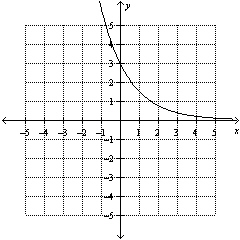 A. | y = 3(0.5)x | B. | y =
2(1.25)x | C. | y =
0.5(3)x | D. | y =
2(0.75)x |
|
|
|
41.
|
Match the following graph with its function. 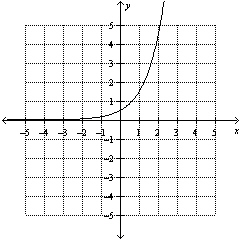 A. | y = 3(0.5)x | B. | y =
2(1.25)x | C. | y =
0.5(3)x | D. | y =
2(0.75)x |
|
|
|
42.
|
Match the following graph with its function. 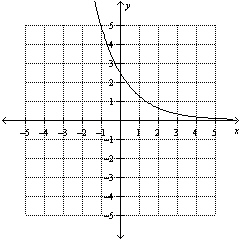
|
|
|
43.
|
The following data set involves exponential decay. Determine the missing value
from the table. x | –3 | –2 | –1 | 0 | 1 | 2 | y | 500.00 | 100.00 | | 4.00 | 0.80 | 0.16 | | | | | | | |
A. | 16.00 | B. | 20.00 | C. | 24.00 | D. | 40.00 |
|
|
|
44.
|
Match the following graph with its function. 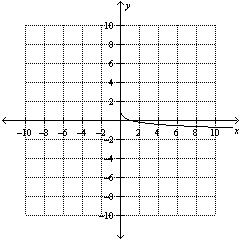
A. | y = – ln x ln x | B. | y = 3 log x | C. | y =
– (3)x (3)x | D. | y =
0.3(10)x |
|
|
|
45.
|
Choose the best estimate for the central angle in degrees. 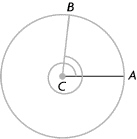
|
|
|
46.
|
Imagine that it is now 2 p.m. What time will it be when the minute hand has
rotated through  radians?
|
|
|
47.
|
A sinusoidal graph has a maximum at the point (5, 12) and a minimum at the point
(12, 5). Determine the midline of the graph.
A. | y = 0 | B. | y = 5 | C. | y =
12 | D. | y = 8.5 |
|
|
|
48.
|
Select the function with the greatest amplitude.
A. | y = 2 sin 3(x + 90°) + 5 | B. | y = 3 sin
2(x – 90°) – 3 | C. | y =  sin (x + 90°)
– 1 sin (x + 90°)
– 1 | D. | y = sin 0.5(x – 90°) |
|
|
|
49.
|
Determine the range of the following function. y = cos  x x +
12 A. | {y | 11 £ y £ 13, y Î R} | B. | {y | –4
£ y £ 4, y Î R} | C. | {y | 9 £
y £ 15, y Î
R} | D. | {y | y Î
R} |
|
|
|
50.
|
The following data set is sinusoidal. Determine the missing value from the
table. x | 0 | 1 | 2 | 3 | 4 | 5 | 6 | y | 1.0 | 2.5 | 4.0 | 2.5 | 1.0 | 2.5 | | | | | | | | | |
|