Multiple Choice
Identify the choice that best
completes the statement or answers the question.
|
|
|
1.
|
Choose the best estimate for 0.1 radians in degrees.
|
|
|
2.
|
Which of the following is not an x-intercept of the graph of y =
cos x?
|
|
|
3.
|
Determine the midline of the following graph. 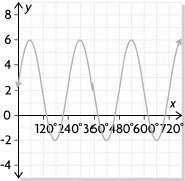 A. | y = 2 | B. | y = 3 | C. | y =
4 | D. | y = 5 |
|
|
|
4.
|
Determine the period of the following graph. 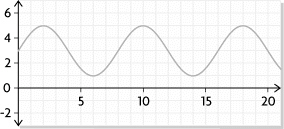
|
|
|
5.
|
Select the function with the greatest period.
A. | y = 2 sin 3(x + 90°) + 5 | B. | y = 3 sin
2(x – 90°) – 3 | C. | y =  sin (x + 90°)
– 1 sin (x + 90°)
– 1 | D. | y = sin 0.5(x – 90°) |
|
|
|
6.
|
Determine the amplitude of the following function. y = cos  x x + 12 A. |  | B. | 1 | C. | 2 | D. | 12 |
|
|
|
7.
|
Determine the period of the following function.
y = 3 sin 2(x +
90°) – 1
A. | 180° | B. | 360° | C. | 720° | D. | 1080° |
|
|
|
8.
|
The following data set is sinusoidal. Determine the missing value from the
table.
|
|
|
9.
|
Determine the equation of the sinusoidal regression function for the
data. x | –5 | –4 | –3 | –2 | –1 | 0 | 1 | 2 | y | 0.8 | 1.5 | 1.8 | 1.4 | 0.8 | 0.0 | –0.2 | 0.1 | | | | | | | | | |
A. | y = 1.0 sin 0.8(x – 2.3) + 0.8 | B. | y = 1.0 sin
0.8(x + 2.3) + 1.0 | C. | y = 0.8 sin 1.0(x – 3.2) +
1.0 | D. | y = 0.8 sin 1.0(x + 3.2) + 0.8 |
|
|
|
10.
|
The height of a mass attached to a spring can be modelled by the sinusoidal
function
h(t) = 84 – 6.7 cos 24.8t
where h(t)
represents the height in centimetres and t represents the time in seconds.
What is the
height of the mass after 10 s?
A. | 77.4 cm | B. | 84.0 cm | C. | 86.9
cm | D. | 90.6 cm |
|
Short Answer
|
|
|
1.
|
What is the equation of the midline of y = cos x?
|
|
|
2.
|
A sinusoidal graph has an amplitude of 9 and a midline of y = –2.
Determine the range of the graph.
|
|
|
3.
|
Determine the period of the following function.
y = 10 cos 4(x
– 180°) + 2
|
Problem
|
|
|
1.
|
The height of a chair on a Ferris wheel is described by the
function
h(t) = –14 cos 3.2t + 16
where h(t)
represents the height of the chair in metres and t represents the time in
minutes.
a) What are the maximum and minimum heights you can reach if you are riding the
Ferris wheel?
b) What is the period of the function? What does the period tell you about
the Ferris wheel in this context?
|
|
|
2.
|
For a physics project, Miro and Alex had to graph and analyze an example of
simple harmonic motion. Alex swung on a swing, and Miro used a motion detector to measure
Alex’s height above the ground every second, as she swung back and forth. The following table
gives the height of the swing over time. Time (s) | 1 | 2 | 3 | 4 | 5 | 6 | 7 | 8 | Height of swing (cm) |
189
|
87
|
135
|
173
|
74
|
168
|
142
|
83
| | | | | | | | | |
Use sinusoidal regression to estimate Alex’s minimum
and maximum heights, to the nearest centimetre. Show your work.
|