Multiple Choice
Identify the choice that best
completes the statement or answers the question.
|
|
|
1.
|
Which of the following is an exponential function?
A. | f(x) = x2 | B. | g(x) =
(–1)x | C. | h(x) =
17x | D. | j(x) = 23 –
x |
|
|
|
2.
|
Identify the range of the exponential function y =
10x.
A. | {y | y < 0, y Î
R} | B. | {y | y > 0, y Î
R} | C. | {y | y ¹ 0, y Î R} | D. | {y | y Î R} |
|
|
|
3.
|
Determine the equation of the exponential regression function for the data.
x | 0 | 1 | 2 | 3 | 4 | 5 | y | 3.5 | 5.6 | 9.0 | 14.2 | 23.1 | 36.7 | | | | | | | |
A. | y = 3.5(1.6)x | B. | y =
2.2(1.6)x | C. | y =
3.5(1.8)x | D. | y =
3.5(0.8)x |
|
|
|
4.
|
Determine the equation of the exponential regression function for the data.
x | 0 | 1 | 2 | 3 | 4 | 5 | y | 74.8 | 60.2 | 47.8 | 38.3 | 30.8 | 24.4 | | | | | | | |
A. | y = 75(0.8)x | B. | y =
75(1.6)x | C. | y =
60(0.8)x | D. | y =
60(1.6)x |
|
|
|
5.
|
The equation of the exponential function that models a data set is
y =
78.20(0.87)x
Determine the domain of this function.
A. | {x | x > 0, x Î
R} | B. | {x | x Î R} | C. | {x | x
> 78.20, x Î R} | D. | {x | x
> 0.87, x Î R} |
|
|
|
6.
|
Predict the x-intercept of f(x) = 10 log x.
|
|
|
7.
|
Match the following graph with its function. 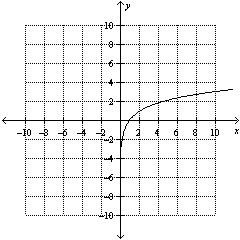
A. | y = – ln x ln x | B. | y = 3 log x | C. | y =
– (3)x (3)x | D. | y =
0.3(10)x |
|
|
|
8.
|
Match the following graph with its function. 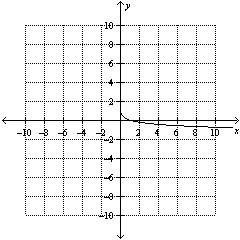
A. | y = – ln x ln x | B. | y = 3 log x | C. | y =
– (3)x (3)x | D. | y =
0.3(10)x |
|
|
|
9.
|
The equation of the logarithmic function that models a data set is y =
8.2 + 0.7 ln x.
Interpolate the value of y when x = 5.5.
A. | y = 8.8 | B. | y = 9.4 | C. | y =
9.9 | D. | y = 11.1 |
|
|
|
10.
|
The equation of the logarithmic function that models a data set is y =
43.9 – 8.7 ln x.
Interpolate the value of y when x = 5.5.
A. | y = 23 | B. | y = 25 | C. | y =
27 | D. | y = 29 |
|
Short Answer
|
|
|
1.
|
Complete the table of values for the function f( x) =
2 x.
|
|
|
2.
|
Complete the table of values for the function g( x) =  .
|
|
|
3.
|
Determine the equation of the exponential regression function for the data.
Round all values to the nearest hundredth. x | –2 | –1 | 0 | 1 | 2 | 3 | y | 8.2 | 5.6 | 3.8 | 2.6 | 1.8 | 1.2 | | | | | | | |
|
Problem
|
|
|
1.
|
Use what you know about the exponential function  to predict the number of
x-intercepts, the y-intercept, the end behaviour, the domain, and the range of the
following function: 
|
|
|
2.
|
A research lab recorded the radioactive decay of a 38 mg sample of thorium-243.
The data table shows the amount of thorium-243 remaining at the end of each week. Day | 0 | 7 | 14 | 21 | 28 | 35 | Amount of Thorium
(mg) |
38.0
|
31.0
|
25.3
|
20.6
|
16.7
|
13.6
| | | | | | | |
a) Use exponential
regression to model the radioactive decay. Round all values to the nearest hundredth. b)
Estimate the amount of thorium-243 remaining after 2 days, to the nearest tenth of a milligram.
Show your work. c) Use your function to model the decay of a 90 mg sample of thorium-243.
Estimate the amount of thorium-243 remaining after the first week, to the nearest tenth of a
milligram. Show your work.
|