Multiple Choice
Identify the
choice that best completes the statement or answers the question.
|
|
|
1.
|
Which one of the following equations is valid?
a. | cos 36° = –cos 144° | b. | cos 36° = –cos
36° | c. | cos 36° = cos 144° | d. | none of the
above |
|
|
|
2.
|
Calculate sin 16° to four decimal places. Predict another term that equals
sin 16°.
a. | –0.2756; sin 164° | b. | 0.2576; sin 164° | c. | 0.2756; –sin
16° | d. | none of the above |
|
|
|
3.
|
Calculate tan 25° to four decimal places. Predict another term that equals
tan 20°.
a. | 0.4663; –tan 155° | b. | 0.4663; tan 155° | c. | –0.4663; tan
155° | d. | –0.4663; –tan 155° |
|
|
|
4.
|
Which law could you use to determine the unknown angle in this triangle? 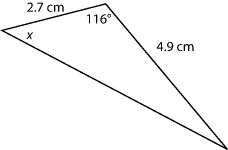 a. | the sine law and the cosine law | b. | the sine law only | c. | neither the sine law
nor the cosine law | d. | the cosine law
only |
|
|
|
5.
|
Determine the unknown angle to the nearest degree. 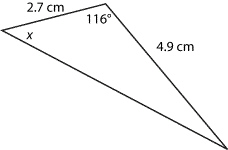 a. | 22° | b. | 52° | c. | none of
these | d. | 42° |
|
|
|
6.
|
Determine the unknown angle measure to the nearest degree. 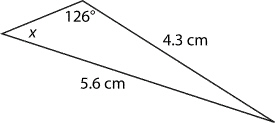 a. | 24° | b. | 54° | c. | 38° | d. | none of these |
|
|
|
7.
|
Determine the unknown side length to the nearest centimetre. 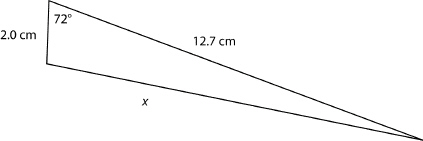 a. | 11.4 cm | b. | 10.8 cm | c. | 12.0
cm | d. | 12.2 cm |
|
|
|
8.
|
Which set of measurements will produce just one triangle?
a. | ÐA = 25°, a = 9.4 m, b =
10.0 m | b. | ÐA = 40°, a = 9.4 m, b =
10.0 m | c. | ÐA = 125°, a = 9.4 m, b =
10.0 m | d. | ÐA = 70°, a = 9.4 m, b =
10.0 m |
|
|
|
9.
|
In DPQR, ÐP = 18°, q = 4.5 m, and r = 6.0 m.
Which
statement is true for this set of measurements?
a. | This is not a SSA situation. | b. | This is a SSA situation; no triangle is
possible. | c. | This is a SSA situation; only one triangle is possible. | d. | This is a SSA
situation; two triangles are possible. |
|
|
|
10.
|
In DEFG, ÐG = 32°, f = 9.5 m, and g = 12.5 m.
Which
statement is true for this set of measurements?
a. | This is not a SSA situation. | b. | This is a SSA situation; no triangle is
possible. | c. | This is a SSA situation; only one triangle is possible. | d. | This is a SSA
situation; two triangles are possible. |
|
|
|
11.
|
In DFGH, GH = 4.5 cm and G =
15°.
What is the height of the triangle from base GF?
a. | 1.5 cm | b. | 1.3 cm | c. | 1.2
cm | d. | 0.9 cm |
|
|
|
12.
|
In DKLM, LM = 16.0 cm and ÐL = 36°.
What is the height of the triangle from base
LK?
a. | 9.4 cm | b. | 9.2 cm | c. | 8.7 cm
| d. | 8.5 cm. |
|
|
|
13.
|
Determine the indicated side length to the nearest tenth of a metre. 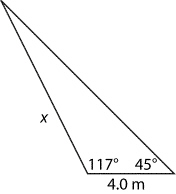
a. | 8.0 m | b. | 9.2 m | c. | 11.6
m | d. | cannot be determined |
|
|
|
14.
|
Determine the indicated angle measure to the nearest degree. 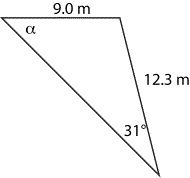 a. | 45° | b. | 104° | c. | 31° | d. | cannot be
determined |
|
|
|
15.
|
Determine the indicated side length to the nearest tenth of a metre. 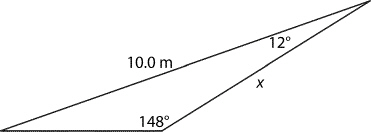
a. | 5.1 m | b. | 6.5 m | c. | 8.0
m | d. | cannot be determined |
|
Short Answer
|
|
|
16.
|
Write another term using the cosine ratio that is equivalent to cos
75°.
|
|
|
17.
|
In DABC, ÐA = 26°, a = 8.5 cm, and b = 5.0 cm. Determine
the number of triangles (zero, one, or two) that are possible for these measurements. Draw the
triangle(s) to support your answer.
|
|
|
18.
|
Determine the indicated side length to the nearest tenth of a
centimetre. 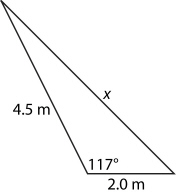
|
Problem
|
|
|
19.
|
In DQRS, q = 8.9 cm, r = 3.8 cm,
and s = 7.2 cm. Solve DQRS by determining the measure of
each angle to the nearest degree. Show your work.
|
|
|
20.
|
The posts of a soccer goal are 24 ft apart. A player is standing at a point 50
ft from one post and 42 ft from the other post. Within what angle must the player kick the ball to
score a goal? Express your answer to the nearest degree. Show your work and draw a diagram.
|
|
|
21.
|
A building is observed from two points, P and Q, that are 134.0 m
apart. The angle of elevation is 35° at P and 27° at Q. Sketch the situation.
Determine the height of the building to the nearest tenth of a metre.
|