Multiple Choice
Identify the
choice that best completes the statement or answers the question.
|
|
|
1.
|
Calculate tan 25° to four decimal places. Predict another term that equals
tan 20°.
a. | 0.4663; –tan 155° | b. | 0.4663; tan 155° | c. | –0.4663; tan
155° | d. | –0.4663; –tan 155° |
|
|
|
2.
|
Which law could you use to determine the unknown side length in this
triangle? 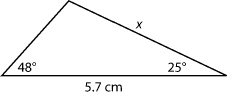 a. | neither the sine law nor the cosine law | b. | the sine law
only | c. | the cosine law only | d. | the sine law and the cosine
law |
|
|
|
3.
|
Determine the unknown angle to the nearest degree. 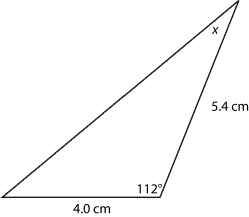 a. | 152° | b. | 18° | c. | 40° | d. | none of these |
|
|
|
4.
|
Which set of measurements can produce two possible triangles?
a. | ÐA = 28°, a = 10.5 m, b =
15.0 m | b. | ÐA = 28°, a = 7.0 m, b =
15.0 m | c. | ÐA = 28°, a = 16.0 m, b =
15.0 m | d. | ÐA = 28°, a = 5.5 m, b =
15.0 m |
|
|
|
5.
|
Which set of measurements will produce one right triangle with b as the
hypotenuse?
a. | ÐA = 60°, a = 10.4 m, b =
12.0 m | b. | ÐA = 60°, a = 11.6 m, b =
12.0 m | c. | ÐA = 60°, a = 8.7 m, b =
12.0 m | d. | ÐA = 60°, a = 14.5 m, b =
12.0 m |
|
|
|
6.
|
Which set of measurements can produce two possible triangles?
a. | ÐA = 48°, a = 4.2 m, b =
5.0 m | b. | ÐA = 48°, a = 8.2 m, b =
13.0 m | c. | ÐA = 48°, a = 5.2 m, b =
7.0 m | d. | ÐA = 35°, a = 10.8 m, b =
8.0 m |
|
|
|
7.
|
In DFGH, GH = 4.5 cm and G =
15°.
What is the height of the triangle from base GF?
a. | 1.5 cm | b. | 1.3 cm | c. | 1.2
cm | d. | 0.9 cm |
|
|
|
8.
|
In DCDE, DE = 9.0 cm and ÐD = 59°.
What is the height of the triangle from base
DC?
a. | 6.8 cm | b. | 7.1 cm | c. | 7.4 cm
| d. | 7.7 cm |
|
|
|
9.
|
Which would you use to determine the indicated angle measure? 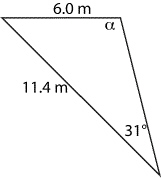 a. | primary trigonometric ratios | b. | the sine law only | c. | the cosine law
only | d. | the sine law or the cosine law |
|
|
|
10.
|
Which would you use to determine the indicated angle measure? 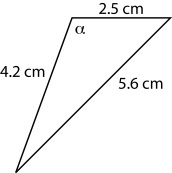 a. | primary trigonometric ratios | b. | the sine law only | c. | the cosine law
only | d. | the sine law or the cosine law |
|
|
|
11.
|
Determine the indicated side length to the nearest tenth of a metre. 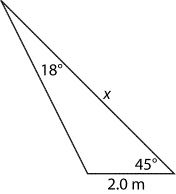 a. | 2.7 m | b. | 4.7 m | c. | 5.8
m | d. | cannot be determined |
|
|
|
12.
|
Determine the indicated angle measure to the nearest degree. 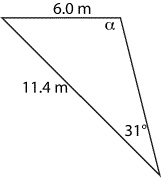 a. | 98° | b. | 100° | c. | 102° | d. | cannot be
determined |
|
|
|
13.
|
Determine the indicated side length to the nearest tenth of a metre. 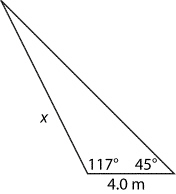
a. | 8.0 m | b. | 9.2 m | c. | 11.6
m | d. | cannot be determined |
|
|
|
14.
|
Determine the indicated angle measure to the nearest degree. 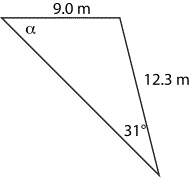 a. | 45° | b. | 104° | c. | 31° | d. | cannot be
determined |
|
|
|
15.
|
Determine the indicated side length to the nearest tenth of a metre. 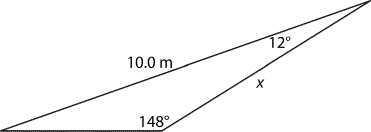
a. | 5.1 m | b. | 6.5 m | c. | 8.0
m | d. | cannot be determined |
|
Short Answer
|
|
|
16.
|
Write another sine ratio that is equivalent to sin 44°.
|
|
|
17.
|
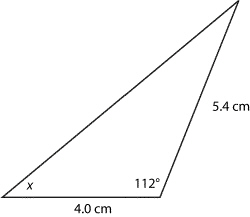
Which law could you use to determine the unknown angle in this triangle?
|
|
|
18.
|
Determine the unknown side length to the nearest tenth of a
centimetre. 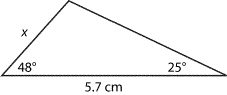
|
Problem
|
|
|
19.
|
The posts of a hockey goal are 2.0 m apart. A player is standing at a point 4.5
m from one post and 6.0 m from the other post. Within what angle must the player shoot the puck to
score a goal? Express your answer to the nearest degree. Show your work.
|
|
|
20.
|
Two forest-fire towers, A and B, are 12.2 km apart. From tower
A, the compass heading for tower B is S82°E. The ranger in each tower sees the
same forest fire. The heading of the fire from tower A is N73°E. The heading of the fire
from tower B is N57°W. How far, to the nearest tenth of a kilometre, is the fire from
each tower? Include a rough sketch in your solution.
|
|
|
21.
|
An airplane is flying directly toward two forest fires. From the airplane, the
angle of depression to one fire is 33° and 12° to the other fire. The airplane is flying at
an altitude of 3200 ft. What is the distance between the two fires to the nearest foot? Show
your work.
|