Multiple Choice
Identify the
choice that best completes the statement or answers the question.
|
|
|
1.
|
Which one of the following equations is valid?
a. | cos 36° = –cos 144° | b. | cos 36° = –cos
36° | c. | cos 36° = cos 144° | d. | none of the
above |
|
|
|
2.
|
Which law could you use to determine the unknown side length in this
triangle? 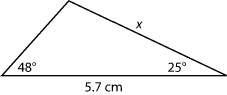 a. | neither the sine law nor the cosine law | b. | the sine law
only | c. | the cosine law only | d. | the sine law and the cosine
law |
|
|
|
3.
|
Determine the unknown angle to the nearest degree. 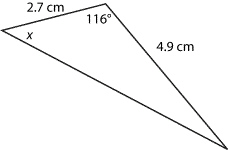 a. | 22° | b. | 52° | c. | none of
these | d. | 42° |
|
|
|
4.
|
Determine the unknown angle to the nearest degree. 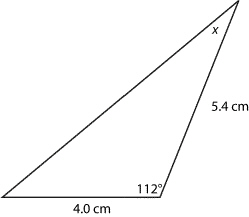 a. | 152° | b. | 18° | c. | 40° | d. | none of these |
|
|
|
5.
|
Determine the unknown side length to the nearest centimetre. 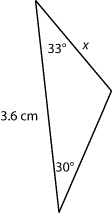 a. | 2.5 cm | b. | 1.8 cm | c. | 2.3
cm | d. | 2.0 cm |
|
|
|
6.
|
Determine the unknown side length to the nearest centimetre. 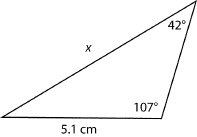 a. | 6.8 cm | b. | 7.1 cm | c. | 7.3
cm | d. | 7.0 cm |
|
|
|
7.
|
In DPQR, ÐP = 18°, q = 4.5 m, and r = 6.0 m.
Which
statement is true for this set of measurements?
a. | This is not a SSA situation. | b. | This is a SSA situation; no triangle is
possible. | c. | This is a SSA situation; only one triangle is possible. | d. | This is a SSA
situation; two triangles are possible. |
|
|
|
8.
|
In DEFG, ÐG = 32°, f = 9.5 m, and g = 12.5 m.
Which
statement is true for this set of measurements?
a. | This is not a SSA situation. | b. | This is a SSA situation; no triangle is
possible. | c. | This is a SSA situation; only one triangle is possible. | d. | This is a SSA
situation; two triangles are possible. |
|
|
|
9.
|
In DKLM, LM = 16.0 cm and ÐL = 36°.
What is the height of the triangle from base
LK?
a. | 9.4 cm | b. | 9.2 cm | c. | 8.7 cm
| d. | 8.5 cm. |
|
|
|
10.
|
In DNOP, OP = 175 mm and ÐO = 57°.
What is the height of the triangle from base
ON?
a. | 151 mm | b. | 147 mm | c. | 143
mm. | d. | 139 mm |
|
|
|
11.
|
Which would you use to determine the indicated angle measure? 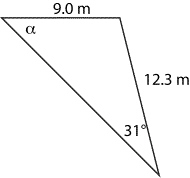 a. | primary trigonometric ratios | b. | the sine law only | c. | the cosine law
only | d. | the sine law or the cosine law |
|
|
|
12.
|
Determine the indicated side length to the nearest tenth of a metre. 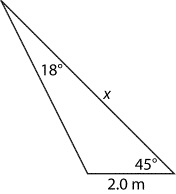 a. | 2.7 m | b. | 4.7 m | c. | 5.8
m | d. | cannot be determined |
|
|
|
13.
|
Determine the indicated side length to the nearest tenth of a
centimetre. 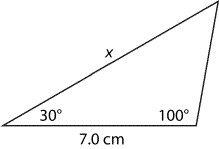
a. | 8.0 cm | b. | 8.5 cm | c. | 9.0
cm | d. | cannot be determined |
|
|
|
14.
|
Determine the indicated side length to the nearest tenth of a metre. 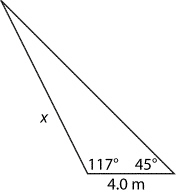
a. | 8.0 m | b. | 9.2 m | c. | 11.6
m | d. | cannot be determined |
|
|
|
15.
|
Determine the indicated angle measure to the nearest degree. 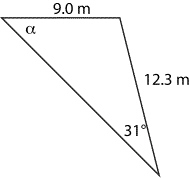 a. | 45° | b. | 104° | c. | 31° | d. | cannot be
determined |
|
Short Answer
|
|
|
16.
|
In DFGH, ÐF = 18°, h = 2.5 cm, and g = 6.3 cm. Does this
involve the SSA situation?
If so, how many triangles with the given measurements are
possible?
|
|
|
17.
|
In DUVW, ÐV = 73° and VW = 18.6 cm. Calculate the height of the
triangle from base VU to the nearest tenth of a centimetre.
|
|
|
18.
|
Determine the indicated side length to the nearest tenth of a
centimetre. 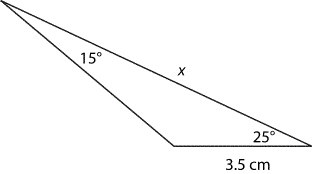
|
Problem
|
|
|
19.
|
A canoeist leaves the dock and paddles toward a buoy 220 m away. After reaching
the buoy, he changes directions and paddles another 180 m. From the dock, the angle between the buoy
and the canoeist’s current position measures 35°. How far is the canoeist from the dock?
Give two possible answers. Show your work.
|
|
|
20.
|
A farmer finishes repairing a fence post and then walks 180 yd through her corn
field. She turns and walks another 240 yd west, until she can see the fence post directly southeast
of her. She realizes that she left some of her tools at the fence post and heads directly back to it.
How far does she need to walk, to the nearest metre?
|
|
|
21.
|
A surveyor is measuring the length of a lake. He takes angle measurements from
two positions, A and B, that are 550 m apart, and on opposite sides of the lake. From
B, the measure of the angle between the sight lines to the ends of the lake is 130°, and
the measure of the angle between the sight lines to A and one end of the lake is 110°.
From A, the measure of the angle between the sight lines to the ends of the lake is 77°,
and the measure of the angle between the sight lines to B and the same end of the lake is
22°. Calculate the length of the lake, to the nearest metre. Show your work.
|