Multiple Choice
Identify the
choice that best completes the statement or answers the question.
|
|
|
1.
|
Which law could you use to determine the unknown angle in this triangle? 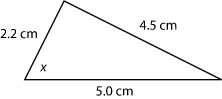 a. | the sine law only | b. | neither the sine law nor the cosine
law | c. | the cosine law only | d. | the sine law and the cosine
law |
|
|
|
2.
|
Which law could you use to determine the unknown side length in this triangle?
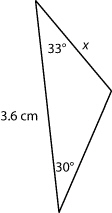 a. | the cosine law only | b. | the sine law only | c. | the sine law and the
cosine law | d. | neither the sine law nor the cosine law |
|
|
|
3.
|
Determine the unknown angle to the nearest degree. 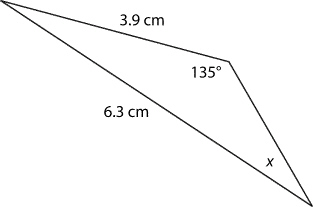
|
|
|
4.
|
Determine the unknown angle to the nearest degree. 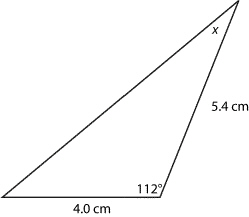 a. | 152° | b. | 18° | c. | 40° | d. | none of these |
|
|
|
5.
|
Determine the unknown side length to the nearest centimetre. 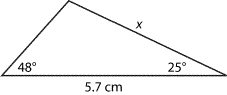 a. | 4.4 cm | b. | 4.3 cm | c. | 4.6
cm | d. | 4.7 cm |
|
|
|
6.
|
Determine the unknown side length to the nearest centimetre. 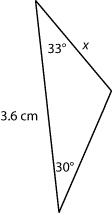 a. | 2.5 cm | b. | 1.8 cm | c. | 2.3
cm | d. | 2.0 cm |
|
|
|
7.
|
Determine the unknown side length to the nearest centimetre. 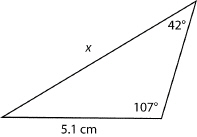 a. | 6.8 cm | b. | 7.1 cm | c. | 7.3
cm | d. | 7.0 cm |
|
|
|
8.
|
Determine the unknown side length to the nearest centimetre. 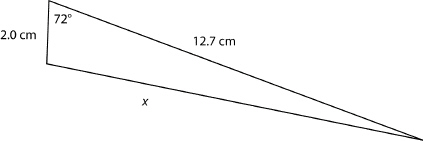 a. | 11.4 cm | b. | 10.8 cm | c. | 12.0
cm | d. | 12.2 cm |
|
|
|
9.
|
In DLMN, ÐM = 63°, m = 13.4 m, and n = 15.0 m.
Which
statement is true for this set of measurements?
a. | This is not a SSA situation. | b. | This is a SSA situation; no triangle is
possible. | c. | This is a SSA situation; only one triangle is possible. | d. | This is a SSA
situation; two triangles are possible. |
|
|
|
10.
|
In DJKL, ÐJ = 115°, k = 6.2 m, and j = 5.5 m.
Which
statement is true for this set of measurements?
a. | This is not a SSA situation. | b. | This is a SSA situation; no triangle is
possible. | c. | This is a SSA situation; only one triangle is possible. | d. | This is a SSA
situation; two triangles are possible. |
|
|
|
11.
|
In DFGH, GH = 4.5 cm and G =
15°.
What is the height of the triangle from base GF?
a. | 1.5 cm | b. | 1.3 cm | c. | 1.2
cm | d. | 0.9 cm |
|
|
|
12.
|
In DNOP, OP = 175 mm and ÐO = 57°.
What is the height of the triangle from base
ON?
a. | 151 mm | b. | 147 mm | c. | 143
mm. | d. | 139 mm |
|
|
|
13.
|
Which would you use to determine the indicated angle measure? 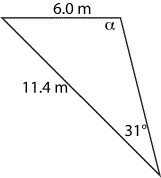 a. | primary trigonometric ratios | b. | the sine law only | c. | the cosine law
only | d. | the sine law or the cosine law |
|
|
|
14.
|
Determine the indicated side length to the nearest tenth of a metre. 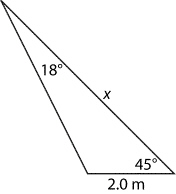 a. | 2.7 m | b. | 4.7 m | c. | 5.8
m | d. | cannot be determined |
|
|
|
15.
|
Determine the indicated side length to the nearest tenth of a metre. 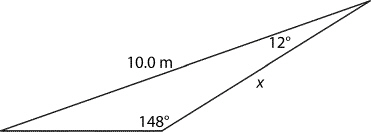
a. | 5.1 m | b. | 6.5 m | c. | 8.0
m | d. | cannot be determined |
|
Short Answer
|
|
|
16.
|
Which law could you use to determine the unknown angle in this triangle?
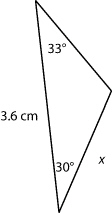
|
|
|
17.
|
Determine the unknown angle measure to the nearest degree. 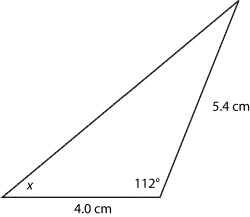
|
|
|
18.
|
In DJKL, ÐK = 54° and KL = 5.4 cm. Calculate the height of the
triangle from base KJ to the nearest tenth of a centimetre.
|
Problem
|
|
|
19.
|
In DQRS, q = 1.7 m, r = 4.3 m,
and s = 5.6 m. Solve DQRS by determining the measure of each
angle to the nearest degree. Show your work and draw DQRS.
|
|
|
20.
|
A landowner says that his property is triangular, with one side 500 m long and
another side 350 m long. The opposite angle to the 350 m side measures 20°. Determine two
possible lengths of the third side, to the nearest metre. Show your work.
|
|
|
21.
|
An obtuse triangle has two known side lengths: 10 cm and 11 cm. The angle
opposite the shorter side measures 15°. Calculate the measure of ÐA, the obtuse angle in the triangle, to the nearest degree. Show
your work.
|