Multiple Choice
Identify the
choice that best completes the statement or answers the question.
|
|
|
1.
|
Solve for the unknown angle measure. Round your answer to the nearest
degree. 
|
|
|
2.
|
Determine the length of c to the nearest tenth of a
centimetre.
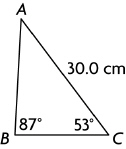 a. | 23.0 cm | b. | 25.0 cm | c. | 24.0
cm | d. | 26.1 cm |
|
|
|
3.
|
Determine the length of k to the nearest centimetre.
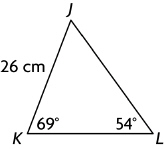 a. | 29 cm | b. | 28 cm | c. | 27
cm | d. | 30 cm |
|
|
|
4.
|
Determine the measure of q to the nearest
degree.
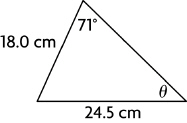
|
|
|
5.
|
In DXYZ, ÐX
= 51°, x = 7.0 cm, and ÐZ = 41°.
Determine the length of side y to the nearest tenth of a centimetre.
a. | 11.0 cm | b. | 10.0 cm | c. | 9.0
cm | d. | 8.0 cm |
|
|
|
6.
|
In DQRS, q = 10.0 cm, s = 9.0
cm, and ÐS = 61°.
Determine the measure of ÐQ to the nearest degree.
|
|
|
7.
|
What information do you need to know about an acute triangle to use the cosine
law?
a. | two sides and any angle | b. | two angles and any side | c. | all the
angles | d. | all the sides |
|
|
|
8.
|
Determine the measure of q to the nearest
degree.
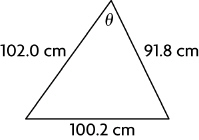
|
|
|
9.
|
In DDEF, d = 13.5 cm, e = 18.2
cm, and ÐF = 60°.
Determine the measure of f
to the nearest tenth of a centimetre.
a. | 17.0 cm | b. | 16.4 cm | c. | 16.6
cm | d. | 16.8 cm |
|
|
|
10.
|
How you would determine the indicated angle measure, if it is possible? 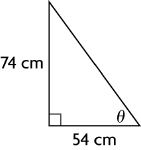 a. | the sine law | b. | not possible | c. | primary
trigonometric ratios | d. | the cosine law |
|
|
|
11.
|
How you would determine the indicated side length, if it is possible? 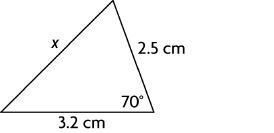 a. | the cosine law | b. | primary trigonometric
ratios | c. | not possible | d. | the sine law |
|
|
|
12.
|
A kayaker estimates the angle of elevation to the top of a cliff to be 20°.
He paddles closer to the cliff and the angle of elevation changes to 45°.
How you would
determine the distance to the cliff, if it is possible?
a. | the sine law | b. | primary trigonometric
ratios | c. | the cosine law | d. | not possible |
|
|
|
13.
|
How long, to the nearest inch, is the left rafter in the roof shown?
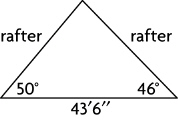 a. | 30¢6¢¢ | b. | 31¢6¢¢ | c. | 31¢0¢¢ | d. | 30¢0¢¢ |
|
|
|
14.
|
A radar operator on a ship discovers a large sunken vessel lying parallel to the
ocean surface, 150 m directly below the ship. The length of the vessel is a clue to which wreck has
been found. The radar operator measures the angles of depression to the front and back of the sunken
vessel to be 52° and 70°. How long, to the nearest tenth of a metre, is the sunken
vessel?
a. | 172.3 m | b. | 171.8 m | c. | 172.8
m | d. | 173.3 m |
|
|
|
15.
|
In a parallelogram, two adjacent sides measure 8.0 cm and 9.7 cm.
The
shorter diagonal is 10.5 cm. Determine, to the nearest degree,
the measures of the larger
angles in the parallelogram.
|
Short Answer
|
|
|
16.
|
In DLMN, the values of m, ÐL, and ÐN are known.
How
can you use the sine law to solve for n?
|
|
|
17.
|
In DQRS, r = 4.1 cm, s = 2.7 cm,
and ÐR = 88°.
Determine the measure of ÐS to the nearest degree.
|
|
|
18.
|
In DABC, a = 108 cm, b = 100 cm,
and c = 124 cm.
Determine the measure of ÐC to the
nearest degree.
|
Problem
|
|
|
19.
|
Determine the perimeter of the triangle to the nearest tenth of a
centimetre. 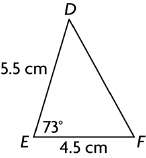
|
|
|
20.
|
Determine the perimeter of the regular decagon to the nearest tenth of a
metre. 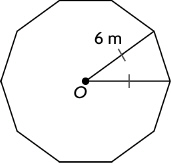
|
|
|
21.
|
A pilot leaves Bayridge Airport and flies to
Cherbrook at a constant speed of 400 km/h. She knows that the distance from Allenburg to
Bayridge is 1100 km N61°W and the distance from Allenburg to Cherbrook is 900 km N12°E.
Determine the duration of the flight, to the nearest minute.Show your work.
|