Multiple Choice
Identify the
choice that best completes the statement or answers the question.
|
|
|
1.
|
Solve for the unknown side length. Round your answer to one decimal
place. 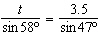
|
|
|
2.
|
Which expression describes the ratios of side-angle pairs in DQRS? 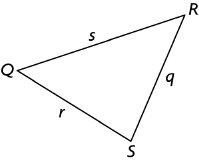 a. | q(sin Q) = r(sin R) = s(sin S)
| b. | q(sin R) = r(sin S) = s(sin Q)
| c. | 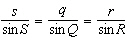 | d. | 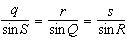 |
|
|
|
3.
|
Determine the length of k to the nearest centimetre.
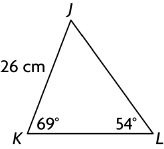 a. | 29 cm | b. | 28 cm | c. | 27
cm | d. | 30 cm |
|
|
|
4.
|
Determine the measure of q to the nearest
degree.
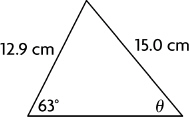
|
|
|
5.
|
Determine the measure of q to the nearest
degree.
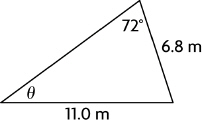
|
|
|
6.
|
What information do you need to know about an acute triangle to use the cosine
law?
a. | two sides and any angle | b. | two angles and any side | c. | all the
angles | d. | all the sides |
|
|
|
7.
|
Determine the length of EF to the nearest centimetre.
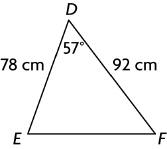 a. | 84 cm | b. | 82 cm | c. | 88
cm | d. | 86 cm |
|
|
|
8.
|
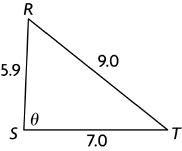
Determine the measure of q to the nearest
degree.
|
|
|
9.
|
In DDEF, d = 23.9 cm, e = 16.8
cm, and f = 27.0 cm.
Determine the measure of ÐD to
the nearest degree.
|
|
|
10.
|
How you would determine the indicated angle measure, if it is possible? 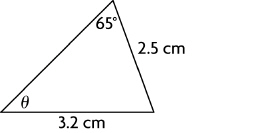 a. | not possible | b. | primary trigonometric
ratios | c. | the cosine law | d. | the sine law |
|
|
|
11.
|
How you would determine the indicated angle measure, if it is possible? 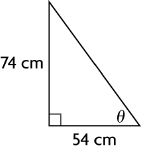 a. | the sine law | b. | not possible | c. | primary
trigonometric ratios | d. | the cosine law |
|
|
|
12.
|
A kayak leaves Rankin Inlet, Nunavut, and heads due south for 4.5 km.
At the
same time, a second kayak travels in a direction S75°E from
the inlet for 3.2 km. In which
direction, to the nearest degree,
would the second kayak have to travel to meet the first
kayak?
a. | S40°W | b. | S45°W | c. | S50°W | d. | S45°W |
|
|
|
13.
|
How long, to the nearest inch, is the right rafter in the roof shown?
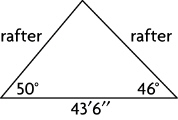 a. | 34¢6¢¢ | b. | 33¢6¢¢ | c. | 33¢0¢¢ | d. | 34¢0¢¢ |
|
|
|
14.
|
A radar operator on a ship discovers a large
sunken vessel lying parallel to the ocean surface, 120 m directly below the ship. The length of the
vessel is a clue to which wreck has been found. The radar operator measures the angles of depression
to the front and back of the sunken vessel to be 55° and 46°. How long, to the nearest
tenth of a metre, is the sunken vessel?
a. | 203.7 m | b. | 201.8 m | c. | 199.9
m | d. | 198.0 m |
|
|
|
15.
|
In a parallelogram, two adjacent sides measure 8.0 cm and 9.7 cm.
The
shorter diagonal is 10.5 cm. Determine, to the nearest degree,
the measures of the larger
angles in the parallelogram.
|
Short Answer
|
|
|
16.
|
In DPQR, p = 18.0 cm, q = 15.0
cm, and ÐR = 45°.
Determine the measure of r
to the nearest tenth of a centimetre.
|
|
|
17.
|
In DVWX, v = 52.5 cm, w = 48.0
cm, and x = 61.7 cm.
Determine the measure of ÐV to
the nearest degree.
|
|
|
18.
|
How would you determine the indicated angle measure, if it is possible?
Explain briefly. 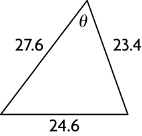
|
Problem
|
|
|
19.
|
A radio tower is supported by two wires on opposite sides. On the ground,
the ends of the wire are 280 m apart. One wire makes a 60° angle with the ground.
The
other makes a 66° angle with the ground.
Draw a diagram of the situation. Then,
determine the length of each wire to the nearest metre. Show your work.
|
|
|
20.
|
Determine the perimeter of the triangle to the nearest tenth of a
centimetre. 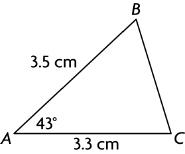
|
|
|
21.
|
A radio tower is supported by two wires on opposite sides. On the ground,
the ends of the wire are 46.5 m apart. One wire makes a 62° angle with the ground. The other
makes a 68° angle with the ground.
Draw a diagram of the situation. Then, determine the
height of the tower to the nearest tenth of a metre.
|