Multiple Choice
Identify the
choice that best completes the statement or answers the question.
|
|
|
1.
|
Which conjecture, if any, could you make about the
product of two odd integers?
a. | The product will be an even integer. | b. | The product will be an odd
integer. | c. | The product will be negative. | d. | It is not possible to make a
conjecture. |
|
|
|
2.
|
Sasha made the following conjecture: All polygons with six equal sides are regular
hexagons. Which figure, if either, is a counterexample to this conjecture?
Explain. 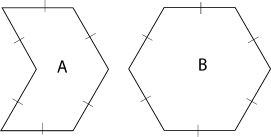 a. | Figure A is a counterexample, because all six sides are equal and it is a regular
hexagon. | b. | Figure B is a counterexample, because all six sides are equal and it is a regular
hexagon. | c. | Figure B is a counterexample, because all six sides are equal and it is not a regular
hexagon. | d. | Figure A is a counterexample, because all six sides are equal and it is not a regular
hexagon. |
|
|
|
3.
|
Tashi made the following conjecture. All polygons with equal sides are
regular. Which figure, if either, is a counterexample to this conjecture? 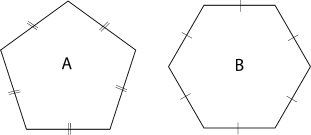 a. | Figure A and Figure B | b. | Figure B only | c. | Neither Figure A nor
Figure B | d. | Figure A only |
|
|
|
4.
|
Which of the following choices, if any, uses
inductive reasoning to show
that the sum of three even integers is even?
a. | 2x + 2y + 2z = 2(x + y +
z) | b. | 2 + 4 + 6 = 12 and 4 + 6 + 8 = 18 | c. | x + y + z = 2(x +
y + z) | d. | None of the above
choices |
|
|
|
5.
|
Which of the following choices, if any, uses
inductive reasoning to show
that the sum of two odd integers is even?
a. | (2x + 1) + (2y + 1) = 2(x + y + 1) | b. | 2x +
2y + 1 = 2(x + y) + 1 | c. | None of the above choices | d. | 3 + 5 = 8 and 7 + 5
= 12 |
|
|
|
6.
|
Which of the following choices, if any, uses
deductive reasoning to show
that the sum of two odd integers is even?
a. | 3 + 5 = 8 and 7 + 5 = 12 | b. | (2x + 1) +
(2y + 1) = 2(x + y + 1) | c. | 2x + 2y + 1 = 2(x +
y) + 1 | d. | None of the above choices |
|
|
|
7.
|
Which of the following choices, if any, uses
deductive reasoning to show
that an odd number and an even number sum to an odd
number?
a. | (2x + 1) + 2y = 2(x + y) + 1 | b. | 2x +
2y + 1 = 2(x + y + 1) | c. | 3 + 6 = 9 and 4 + 5 =
9 | d. | None of the above
choices |
|
|
|
8.
|
What type of error, if any, occurs in the
following deduction?
If you combine one haystack with
another haystack, you get one haystack. Therefore, 1 + 1 =
1. a. | a false assumption or generalization | b. | an error in reasoning | c. | an error in
calculation | d. | There is no error in the deduction. |
|
|
|
9.
|
Which type of reasoning does the following statement
demonstrate?
All birds have
feathers.
Robins are birds.
Therefore, robins have feathers.
a. | inductive reasoning | b. | neither inductive nor deductive
reasoning | c. | deductive reasoning |
|
|
|
10.
|
Determine the unknown term in this pattern.
1, 2, 4, ___, 16, 32,
64
|
|
|
11.
|
Determine the unknown term in this pattern.
101, 1001, 10001, _____,
1000001, 10000001, 100000001
a. | 100000 | b. | 100001 | c. | 110011 | d. | 111111 |
|
|
|
12.
|
Which number should go in the grey square in this Sudoku puzzle? 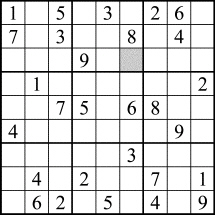
|
|
|
13.
|
Which pairs of angles are equal in this diagram? 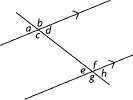 a. | a = b, c = d, and e = f | b. | a = e,
c = g, and b = f | c. | a = c, e = g, and
f = h | d. | a = e, b = d, and
c = g |
|
|
|
14.
|
In which diagram(s) is AB parallel to CD? | 1. | 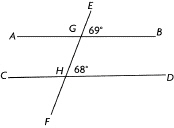 | 2. | 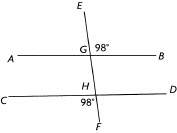 | | | | |
a. | Choice 1 only | b. | Choice 2 only | c. | Choice 1 and Choice
2 | d. | Neither Choice 1 nor Choice 2 |
|
|
|
15.
|
Which statement about the angles in this diagram is false? 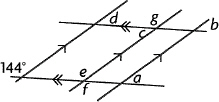 a. | Ðe + Ða
= 180° | b. | Ðd + Ðg
= 180° | c. | Ðb + Ðd
= 180° | d. | Ðf + Ðc
= 180° |
|
|
|
16.
|
Which statement about the angles in this diagram is false? 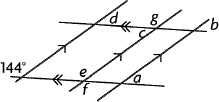 a. | Ðg = 36° | b. | Ða = 36° | c. | Ðc =
36° | d. | Ðd = 36° |
|
|
|
17.
|
Which angle property proves ÐEFS =
28°? 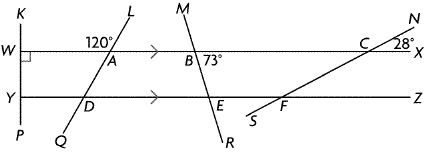
a. | alternate exterior angles | b. | supplementary angles | c. | alternate interior
angles | d. | corresponding angles |
|
|
|
18.
|
In which diagrams are two lines parallel? a. | Choice 2 and Choice 3 | b. | Choice 1 only | c. | Choice 1 and Choice
3 | d. | Choices 1, 2, and 3 |
|
|
|
19.
|
Which are the correct measures for ÐWXZ,
ÐUZY, and ÐVYX? 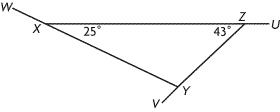 a. | ÐWXZ = 155°, ÐUZY = 137°, and ÐVYX =
68° | b. | ÐWXZ = 165°, ÐUZY = 137°, and ÐVYX =
66° | c. | ÐWXZ = 165°, ÐUZY = 127°, and ÐVYX =
88° | d. | ÐWXZ = 155°, ÐUZY = 127°, and ÐVYX =
86° |
|
|
|
20.
|
Determine the value of d.
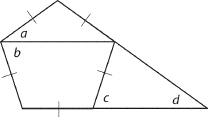
|
Short Answer
|
|
|
21.
|
While driving along the road one morning, Jenny
noticed that all the cows
in a field were standing up, with their heads pointing northward.
In the afternoon, it started to snow. Jenny made the conjecture that when cows stand and face
northward, it will likely snow. Is Jenny’s conjecture reasonable? Briefly justify your
decision.
|
|
|
22.
|
What type of error occurs in the following
deduction?
Briefly justify your answer.
All videos have large groups of dancers. The
western band is recording a new video, so it must have a large group of dancers.
|
|
|
23.
|
Draw the next figure in this sequence.
|
|
|
24.
|
Determine the measure of ÐPQR.
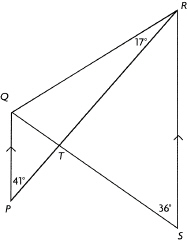
|
|
|
25.
|
Determine the measure of ÐTRS.
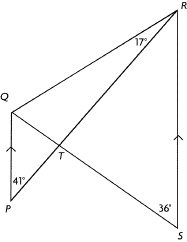
|
Problem
|
|
|
26.
|
Lucas found an interesting numeric pattern: 1 • 6 + 1
= 7 • 1
2 • 6 + 2 = 7
• 2
3 • 6 + 3 = 7 •
3
4 • 6 + 4 = 7
• 4
Do you think the pattern will
continue? Justify your decision with a counterexample if possible.
|
|
|
27.
|
Solve this Sudoku puzzle using the numbers 1 to 9. Fill the grid so that each
column, row, and block contains all the numbers. No number can be repeated within any column, row, or
block. 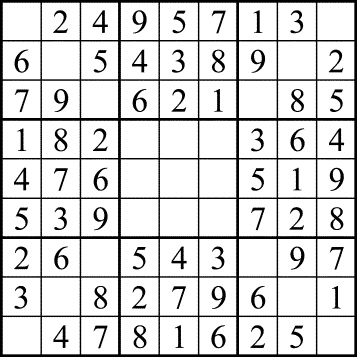
|
|
|
28.
|
Describe four different methods to prove EF || GH. 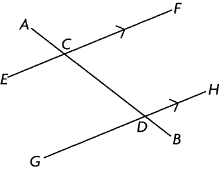
|
|
|
29.
|
Prove: FG || HI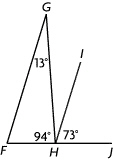
|
|
|
30.
|
A floor tiler designs custom floors using tiles in the shape of regular
polygons. The tiler uses three different tile shapes to cover a floor, all with the same side length.
At each corner, there is one square and one hexagon. What is the third tile shape? Draw part of the
tiling.
|