Multiple Choice
Identify the
choice that best completes the statement or answers the question.
|
|
|
1.
|
Jessica noticed a pattern when dividing these numbers by 4: 53,
93, 133.
Determine the pattern and make a conjecture.
a. | When the cube of an odd number that is 1 more than a multiple of 4 is divided by 4,
the decimal part of the result will be .75. | b. | When the cube of an odd number that is 1 less
than a multiple of 4 is divided by 4, the decimal part of the result will be .75. | c. | When the cube of an
odd number that is 1 more than a multiple of 4 is divided by 4, the decimal part of the result will
be .25. | d. | When the cube of an odd number that is 1 less than a multiple of 4 is divided by 4,
the decimal part of the result will be .25. |
|
|
|
2.
|
What type of error, if any, occurs in the
following deduction?
Diamond jewellery is
expensive. Beyondé has expensive
jewellery. Therefore, Beyondé has diamond
jewellery. a. | a false assumption or generalization | b. | an error in reasoning | c. | an error in
calculation | d. | There is no error in the deduction. |
|
|
|
3.
|
Alison created a number trick in which she always
ended with the original number. When Alison tried to prove her trick, however, it did not work. What
type of error occurs in the proof?
n | Use n to represent any number. | n + 4 | Add 4. | 2n +
4 | Multiply by 2. | 2n + 8 | Add 4. | n + 4 | Divide by 2. | n –
1 | Subtract 5. | | |
a. | a false assumption or generalization | b. | an error in reasoning | c. | an error in
calculation | d. | There is no error in the proof. |
|
|
|
4.
|
Determine the unknown term in this pattern.
3, 6, 12, 24, ____, 96,
192
|
|
|
5.
|
Determine the unknown term in this pattern.
17, 14, ____, 8, 5, 2,
–1
|
|
|
6.
|
Choose the next figure in this sequence. | | | | | | Figure 1 | Figure 2 | Figure 3 | Figure 4 | Figure 5 | Figure 6 | | | | | | |
|
|
|
7.
|
Which number should appear in the centre of Figure 4? | | | | Figure 1 | Figure 2 | Figure 3 | Figure 4 | | | | |
|
|
|
8.
|
Which number should go in the grey square in this Sudoku puzzle? 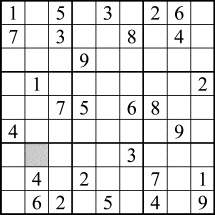
|
|
|
9.
|
In a Kakuro puzzle, you fill in the empty squares with the numbers from 1 to 9.
• Each row of squares must
add up to the circled number to the left of it.
• Each column
of squares must add up the circled number above it.
• A number
cannot appear more than once in the same sum.
Complete
this Kakuro puzzle by filling in the grey squares.
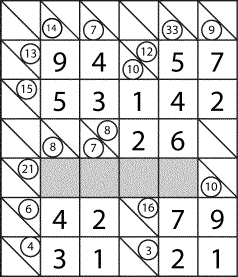 a. | 9, 7, 4, 1 | b. | 1, 4, 8, 8 | c. | 2, 3, 7,
9 | d. | 1, 4, 7, 9 |
|
|
|
10.
|
Fred and Ethel are playing darts. Ethel has a score of 16. To win, she must reduce her score to zero and have her last
counting dart be a double.
Which of the following scores on the dart board, in order, would give
her the win? | 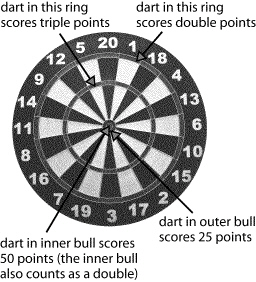 | | |
a. | triple 2, triple 2, double 3 | b. | 2, 2, 6 | c. | 4, 4, double
4 | d. | 4, triple 4 |
|
|
|
11.
|
In which diagram(s) is AB parallel to CD? | 1. | 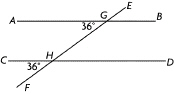 | 2. | 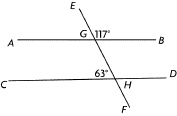 | | | | |
a. | Choice 1 only | b. | Choice 2 only | c. | Choice 1 and Choice
2 | d. | Neither Choice 1 nor Choice 2 |
|
|
|
12.
|
Which statement about the angles in this diagram is false? 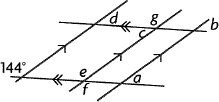 a. | Ðe = Ðf
| b. | Ða = Ðb | c. | Ðd =
Ðc | d. | Ðf =
Ða |
|
|
|
13.
|
Which statement about the angles in this diagram is false? 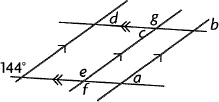 a. | Ðg = 36° | b. | Ða = 36° | c. | Ðc =
36° | d. | Ðd = 36° |
|
|
|
14.
|
Which angle property proves ÐDAB =
120°?
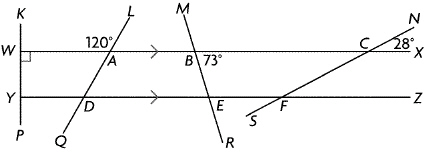
a. | vertically opposite angles | b. | alternate exterior angles | c. | alternate interior
angles | d. | corresponding angles |
|
|
|
15.
|
Which angle property proves ÐBEF =
107°? 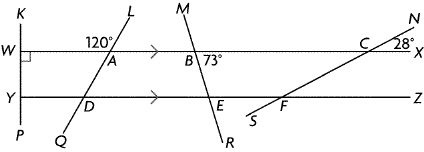
a. | supplementary angles | b. | corresponding angles | c. | alternate interior
angles | d. | alternate exterior angles |
|
|
|
16.
|
In which diagrams are two lines parallel? a. | Choice 2 and Choice 3 | b. | Choice 1 only | c. | Choice 1 and Choice
3 | d. | Choices 1, 2, and 3 |
|
|
|
17.
|
Which are the correct measures of the interior angles of DCDE? 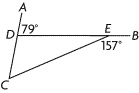 a. | ÐDCE = 46°, ÐCDE = 101°, and ÐCED =
33° | b. | ÐDCE = 32°, ÐCDE = 83°, and ÐCED =
65° | c. | ÐDCE = 76°, ÐCDE = 91°, and ÐCED =
13° | d. | ÐDCE = 56°, ÐCDE = 101°, and ÐCED =
23° |
|
|
|
18.
|
Which are the correct measures for ÐWXZ,
ÐUZY, and ÐVYX? 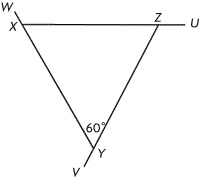 a. | ÐWXZ and ÐUZY cannot be determined; ÐVYX = 120° | b. | ÐWXZ,
ÐUZY, and ÐVYX cannot
be determined. | c. | ÐWXZ cannot be determined; ÐUZY = 120°, ÐVYX =
120° | d. | ÐWXZ = 120°, ÐUZY = 120°, and ÐVYX
=120° |
|
|
|
19.
|
With which of the following polygons could you create a tiling
pattern?
Choose the best answer.
a. | an equilateral triangle | b. | a square | c. | a
rectangle | d. | all of the above |
|
|
|
20.
|
The sum of the measures of the interior angles of a convex polygon is S.
Which expression results in the number of sides of the polygons?
|
Short Answer
|
|
|
21.
|
Jimmy claims that whenever you square an even integer, the result is
an even
number. Is his conjecture reasonable?
Briefly justify your decision.
|
|
|
22.
|
What can you deduce about the sum of two even numbers and an odd number?
Briefly explain your answer using deductive reasoning.
|
|
|
23.
|
What type of error occurs in the following deduction? Briefly justify your
answer.
3 = 3
7(3) = 7(2 + 1)
7(3) +
6 = 7(2 + 1) + 6
21 +
6 = 14 + 7
27 = 21
|
|
|
24.
|
Determine the unknown term in this pattern.
2, 10, 50, 250, ____, 6250,
31 250
|
|
|
25.
|
Determine the measure of ÐPTQ.
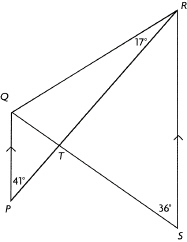
|
Problem
|
|
|
26.
|
Alison discovered a number trick in a book she
was reading:
Choose a number.
Add
3.
Multiply by 2.
Add
4.
Divide by 2.
Subtract
5.
Try the trick several times. Make a conjecture about
the relation between the number picked and the final result. Can you find a counterexample to your
conjecture? What does this imply?
|
|
|
27.
|
Crystal created a math trick in which she always ended with twice the number
with which she began. When Crystal tried to prove her trick, however, it did not
work.
Crystal’s Proof
n I used n
to represent any number.
4n Multiply by 4.
4n +
8 Add 8.
2n + 2 Divide by
2.
2n – 2 Subtract 4.
Identify the error in
Crystal’s proof and write the proof without error.
|
|
|
28.
|
Eldon, Pierre, Manny, and Burt swam a race. Early in the race, Eldon led Pierre
by
3 m, while Manny was behind Burt by 2 m. Burt was ahead of Pierre by 1 m. By the halfway
point, Eldon and Burt had exchanged places, although they were still the same distance apart. Manny
had pulled even with Eldon. Over the last part of the race, Manny dropped 1 m behind Eldon, and
Pierre passed Burt. Who finished third?
|
|
|
29.
|
In a magic square, the columns, rows, and diagonals all add up to the same
total. Use the natural numbers from 1 to 25 to complete this magic square. Use each number only
once. 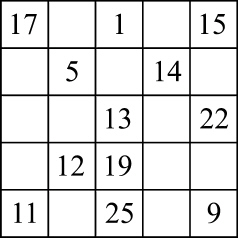
|
|
|
30.
|
Are BD and FE parallel? Explain how you know. 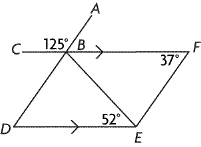
|