Multiple Choice
Identify the
choice that best completes the statement or answers the question.
|
|
|
1.
|
Bradley gathered the following evidence.
4(44) =
176 5(44) =
220 6(44) = 264
Which conjecture, if
any, is Bradley most likely to make from this evidence?
a. | When you multiply a one-digit number by 44, the first and last digits of the product
form a number that is four times the original number. | b. | When you multiply a two-digit number by 44, the
first and last digits of the product form a number that is twice the original
number. | c. | When you multiply a one-digit number by 44, the sum of the digits in the product is
equal to the original number. | d. | None of the above conjectures can be made from
this evidence. |
|
|
|
2.
|
Eileen studied the sum of the angles in pentagons and made a conjecture.
Which conjecture, if any, did she most likely make? 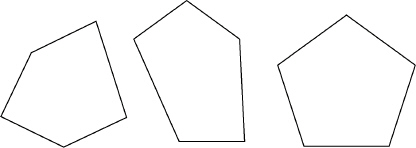 a. | The sum of the angles in a pentagon is always 180°. | b. | The sum of the
angles in a pentagon is always 360°. | c. | The sum of the angles in a pentagon is always
540°. | d. | It is not possible to make a conjecture. |
|
|
|
3.
|
Henry made the following conjecture: The square of a number is always greater than
the number.
Is the following equation a counterexample to this conjecture?
Explain.
0.42 = 0.16
a. | Yes, it is a counterexample, because 0.4 is less than 0.16. | b. | No, it is not a
counterexample, because 0.16 is less than 0.4. | c. | No, it is not a counterexample, because 0.4 is
less than 0.16. | d. | Yes, it is a counterexample, because 0.16 is less than
0.4. |
|
|
|
4.
|
All ostriches are birds. All birds have
backbones. Birds are the only animals that have feathers. Floradora is an ostrich. What can be
deduced about Floradora?
1. Floradora has a backbone. 2. Floradora has
feathers. a. | Neither Choice 1 nor Choice 2 | b. | Choice 1 and Choice 2 | c. | Choice 2
only | d. | Choice 1 only |
|
|
|
5.
|
Hali is a fitness instructor. People who take
Hali’s exercise class regularly soon become very fit. Regular exercise makes people feel happy.
Joshua takes Hali’s exercise class regularly. What can be deduced about
Joshua?
1. Joshua is very fit. 2. Joshua feels happy. a. | Choice 2 only | b. | Choice 1 only | c. | Neither Choice 1 nor
Choice 2 | d. | Choice 1 and Choice 2 |
|
|
|
6.
|
Alison created a number trick in which she always
ended with the original number. When Alison tried to prove her trick, however, it did not work. What
type of error occurs in the proof?
n | Use n to represent any number. | n + 4 | Add 4. | 2n +
4 | Multiply by 2. | 2n + 8 | Add 4. | n + 4 | Divide by 2. | n –
1 | Subtract 5. | | |
a. | a false assumption or generalization | b. | an error in reasoning | c. | an error in
calculation | d. | There is no error in the proof. |
|
|
|
7.
|
Determine the unknown term in this pattern.
1, 2, 4, ___, 16, 32,
64
|
|
|
8.
|
Determine the unknown term in this pattern.
2, 6, 18, 54, ____, 486,
1458
|
|
|
9.
|
Determine the unknown term in this pattern.
101, 1001, 10001, _____,
1000001, 10000001, 100000001
a. | 100000 | b. | 100001 | c. | 110011 | d. | 111111 |
|
|
|
10.
|
Choose the next figure in this sequence.
|
|
|
11.
|
Which number should appear in the centre of Figure 4? | | | | Figure 1 | Figure 2 | Figure 3 | Figure 4 | | | | |
|
|
|
12.
|
Which number should go in the grey square in this Sudoku puzzle? 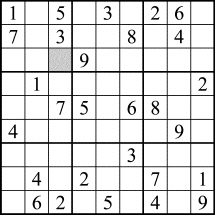
|
|
|
13.
|
Which angle property proves ÐBEF =
107°? 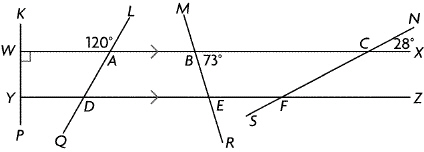
a. | supplementary angles | b. | corresponding angles | c. | alternate interior
angles | d. | alternate exterior angles |
|
|
|
14.
|
Which angle property proves ÐEFS =
28°? 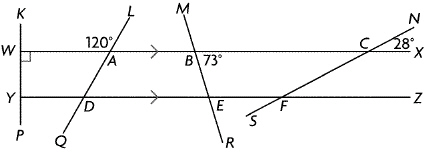
a. | alternate exterior angles | b. | supplementary angles | c. | alternate interior
angles | d. | corresponding angles |
|
|
|
15.
|
Which angle property proves ÐBED =
73°? 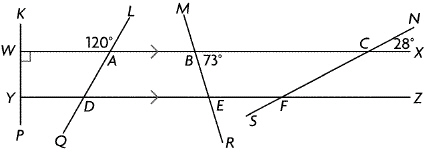
a. | alternate interior angles | b. | vertically opposite angles | c. | corresponding
angles | d. | alternate exterior angles |
|
|
|
16.
|
Which are the correct measures of the indicated angles? 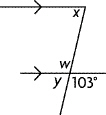 a. | Ðw = 77°, Ðx =77°, Ðy =
103° | b. | Ðw = 77°, Ðx =103°, Ðy =
103° | c. | Ðw = 103°, Ðx =77°, Ðy =
77° | d. | Ðw = 103°, Ðx =103°, Ðy =
77° |
|
|
|
17.
|
Which are the correct measures of the interior angles of DCDE? 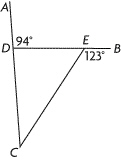 a. | ÐDCE = 37°, ÐCDE = 86°, and ÐCED =
57° | b. | ÐDCE = 57°, ÐCDE = 86°, and ÐCED =
37° | c. | ÐDCE = 48°, ÐCDE = 75°, and ÐCED =
57° | d. | ÐDCE = 37°, ÐCDE = 68°, and ÐCED =
75° |
|
|
|
18.
|
Which are the correct measures for ÐWXZ,
ÐUZY, and ÐVYX? 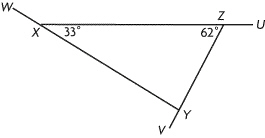 a. | ÐWXZ = 147°, ÐUZY = 118°, and ÐVYX =
95° | b. | ÐWXZ = 147°, ÐUZY = 108°, and ÐVYX =
85° | c. | ÐWXZ = 157°, ÐUZY = 118°, and ÐVYX =
95° | d. | ÐWXZ = 157°, ÐUZY = 108°, and ÐVYX =
85° |
|
|
|
19.
|
With which of the following polygons could you create a tiling
pattern?
a. | a regular hexagon | b. | a regular pentagon | c. | a regular
octagon | d. | none of the above |
|
|
|
20.
|
The sum of the measures of the interior angles of a convex polygon is S.
Which expression results in the number of sides of the polygons?
|
Short Answer
|
|
|
21.
|
Jason created the following table to show a pattern. | Multiples of 27 | 54 | 81 | 108 | 135 | 162 | | Sum of the Digits | 9 | 9 | 9 | 9 | 9 | | | | | | |
Based on this evidence,
Jason made the following conjecture: The sum of the digits of a
multiple of 27 is equal to 9. Try more examples. Is this conjecture reasonable? Briefly
justify your decision.
|
|
|
22.
|
Complete the conclusion for the following deductive argument: If an even integer is not divisible by 4, then half the number is an odd
number.
14 is not divisible by 4, therefore, ...
|
|
|
23.
|
What type of error occurs in the following deduction? Briefly justify your
answer. People wear hats to prevent sunstroke.
Eldon is
wearing a hat.
Therefore, Eldon is wearing the hat to prevent sunstroke.
|
|
|
24.
|
Alison created a number trick in which she always
ended with the original number. When Alison tried to prove her trick, however, it did not work. In
which step does the calculation error occur? What is the error?
n | Use n to represent any number. | n + 4 | Add
4. | 2n +
4 | Multiply by 2. | 2n + 8 | Add
4. | n +
4 | Divide by 2. | n – 1 | Subtract 5. | | |
|
|
|
25.
|
Determine the measure of ÐDBF.
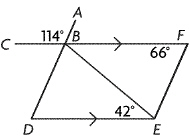
|
Problem
|
|
|
26.
|
Make a conjecture about the meaning of the symbols and colours in the flag
of the territory of Nunavut, which is shown here. (You may need to obtain a colour version of
this flag from a book or the Internet.)
|
|
|
27.
|
Star claims that whenever you add seven
consecutive integers, the sum is always 5 times the median of the numbers. Is Star’s conjecture
true or not? Prove your answer.
|
|
|
28.
|
A set of 8 cards, each showing one of the digits
from 1 to 8, is divided between two bags. The sum of the cards inside the red bag was twice the sum
of the cards in the white bag. The 3 and 7 are in the same bag. In which bag is the 5?
Explain.
|
|
|
29.
|
Solve this KenKen puzzle using only the numbers 1 to 4. Do not repeat a number
in any row or column. The darkly outlined sets of squares are cages. The numbers in each cage must
combine in any order to produce the target number, using the operation shown. A number may be
repeated in a cage as long as it is not in the same row or column. 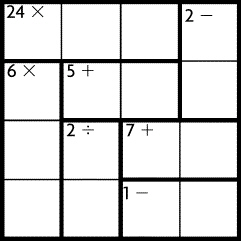
|
|
|
30.
|
Each interior angle of a regular polygon is eight times as large as its
corresponding exterior angle. How many sides does the polygon have? Explain your answer.
|