Multiple Choice
Identify the
choice that best completes the statement or answers the question.
|
|
|
1.
|
Hedly gathered the following evidence.
5(22) =
110 5(33) =
165 5(44) = 220
Which conjecture
might Hedly make from this evidence? Is the conjecture reasonable?
a. | When you multiply 11 by a multiple of 11, the first and last digits of the product
will sum to the middle digit; yes, this conjecture is valid. | b. | When you multiply 5
by a multiple of 11, the first and last digits of the product will sum to the middle digit; no, this
conjecture is not valid. | c. | When you multiply 5 by a multiple of 11, the
first and last digits of the product will sum to the middle digit; yes, this conjecture is
valid. | d. | When you multiply 11 by a multiple of 5, the first and last digits of the product
will sum to the middle digit; no, this conjecture is valid. |
|
|
|
2.
|
Jackie made the following conjecture. The square of a number is always greater than
the number.
Which choice, if either, is a counterexample to this
conjecture?
1. 0.52 =
0.25
2. (–5)2 = 25
a. | Choice 1 and Choice 2 | b. | Choice 2 only | c. | Neither Choice 1 nor
Choice 2 | d. | Choice 1 only |
|
|
|
3.
|
Sasha made the following conjecture: All polygons with six equal sides are regular
hexagons. Which figure, if either, is a counterexample to this conjecture?
Explain. 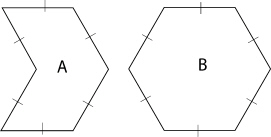 a. | Figure A is a counterexample, because all six sides are equal and it is a regular
hexagon. | b. | Figure B is a counterexample, because all six sides are equal and it is a regular
hexagon. | c. | Figure B is a counterexample, because all six sides are equal and it is not a regular
hexagon. | d. | Figure A is a counterexample, because all six sides are equal and it is not a regular
hexagon. |
|
|
|
4.
|
Attila made the following conjecture: The difference between two numbers always
lies between the two numbers.
Is the following equation a counterexample to this conjecture?
Explain.
6 – 2 = 4
a. | No, it is not a counterexample, because 4 lies between 2 and 6. | b. | Yes, it is a
counterexample, because 4 does not lie between 2 and 6. | c. | Yes, it is a
counterexample, because 4 lies between 2 and 6. | d. | No, it is not a counterexample, because 4 does
not lie between 2 and 6. |
|
|
|
5.
|
Bill made the following conjecture: When you add a multiple of 6 and a multiple
of 9, the sum will be a multiple of 6.
Is the following equation a counterexample to this
conjecture? Explain.
12 + 27 = 39
a. | Yes, it is a counterexample, because 39 is not a multiple of 6. | b. | Yes, it is a
counterexample, because 39 is a multiple of 3. | c. | No, it is not a counterexample, because 39 is a
multiple of 3. | d. | No, it is not a counterexample, because 39 is not a multiple of
9. |
|
|
|
6.
|
All cats are mammals. All mammals are warm-blooded. Tashi is a cat.
What can
be deduced about Tashi?
1. Tashi is warm-blooded.
2. Tashi is a
mammal.
a. | Choice 1 and Choice 2 | b. | Neither Choice nor Choice 2 | c. | Choice 1
only | d. | Choice 2 only |
|
|
|
7.
|
Which of the following choices, if any, uses
inductive reasoning to show
that the sum of three even integers is even?
a. | 2x + 2y + 2z = 2(x + y +
z) | b. | 2 + 4 + 6 = 12 and 4 + 6 + 8 = 18 | c. | x + y + z = 2(x +
y + z) | d. | None of the above
choices |
|
|
|
8.
|
What type of error, if any, occurs in the
following deduction?
All swimmers can swim one kilometre
without stopping. Joan is a swimmer.
Therefore, Joan can swim one kilometre without
stopping. a. | a false assumption or generalization | b. | an error in reasoning | c. | an error in
calculation | d. | There is no error in the deduction. |
|
|
|
9.
|
What type of error, if any, occurs in the
following proof?
Suppose
that: x + y = z
Then: (3x – 2x) + (3y –
2y) = (3z –
2z)
Reorganize: 3x + 3y –
3z = 2x + 2y – 2z
Using
distribution: 3(x + y –
z) = 2(x + y –
z)
3 = 2
a. | a false assumption or generalization | b. | an error in reasoning | c. | an error in
calculation | d. | There is no error in the proof. |
|
|
|
10.
|
What type of error, if any, occurs in the
following proof?
3 = 3
7(3) = 7(2 + 1)
7(3) +
6 = 7(2 + 1) + 6
21 +
6 = 14 + 7
27 = 21
a. | a false assumption or generalization | b. | an error in reasoning | c. | an error in
calculation | d. | There is no error in the proof. |
|
|
|
11.
|
Alison created a number trick in which she always
ended with the original number. When Alison tried to prove her trick, however, it did not work. What
type of error occurs in the proof?
n | Use n to represent any number. | n + 4 | Add 4. | 2n +
4 | Multiply by 2. | 2n + 8 | Add 4. | n + 4 | Divide by 2. | n –
1 | Subtract 5. | | |
a. | a false assumption or generalization | b. | an error in reasoning | c. | an error in
calculation | d. | There is no error in the proof. |
|
|
|
12.
|
Which type of reasoning does the following statement
demonstrate?
Every multiple of 9 has a factor of
3.
27 is a multiple of 9.
Therefore, 27 has a factor of 3.
a. | inductive reasoning | b. | deductive reasoning | c. | neither inductive
nor deductive reasoning |
|
|
|
13.
|
Determine the unknown term in this pattern.
17, 14, ____, 8, 5, 2,
–1
|
|
|
14.
|
Which number should appear in the centre of Figure 4? | | | | Figure 1 | Figure 2 | Figure 3 | Figure 4 | | | | |
|
|
|
15.
|
Andrew and Deirdre are playing darts. Andrew has a score of 31. To win, he must reduce his score to zero and have his last
counting dart be a double.
Which of the following scores on the dart board, in order, would give
him the win?
| 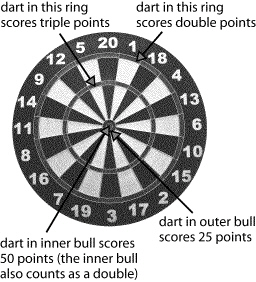 | | |
a. | 2, 4, 27 | b. | double 6, double 6, 7 | c. | 7, 12, double
6 | d. | triple 6, 12, 1 |
|
|
|
16.
|
In which diagram(s) is AB parallel to CD? | 1. | 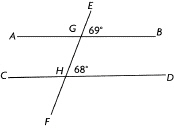 | 2. | 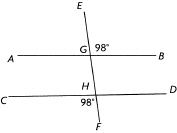 | | | | |
a. | Choice 1 only | b. | Choice 2 only | c. | Choice 1 and Choice
2 | d. | Neither Choice 1 nor Choice 2 |
|
|
|
17.
|
Which statement about the angles in this diagram is false?
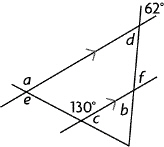 a. | Ða + Ðc
= 180° | b. | Ðe + Ðd
= 180° | c. | Ðd + Ðb
= 124° | d. | 180° – Ðf =
118° |
|
|
|
18.
|
Which statement about the angles in this diagram is false? 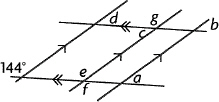 a. | Ðe + Ða
= 180° | b. | Ðd + Ðg
= 180° | c. | Ðb + Ðd
= 180° | d. | Ðf + Ðc
= 180° |
|
|
|
19.
|
Which are the correct measures for ÐLNO,
ÐLNM, and ÐMLN? 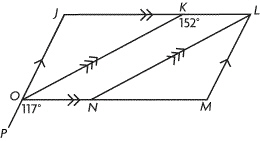 a. | ÐLNO = 145°, ÐLNM = 35°, and ÐMLN =
35° | b. | ÐLNO = 152°, ÐLNM = 28°, and ÐMLN =
35° | c. | ÐLNO = 117°, ÐLNM = 63°, and ÐMLN =
28° | d. | ÐLNO = 152°, ÐLNM = 28°, and ÐMLN =
28 |
|
|
|
20.
|
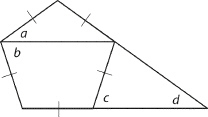
Determine the value of a.
|
Short Answer
|
|
|
21.
|
Jimmy claims that whenever you square an even integer, the result is
an even
number. Is his conjecture reasonable?
Briefly justify your decision.
|
|
|
22.
|
Complete the conclusion for the following deductive argument: If an even integer is not divisible by 4, then half the number is an odd
number.
14 is not divisible by 4, therefore, ...
|
|
|
23.
|
Does the following statement demonstrate inductive reasoning or deductive
reasoning?
For the pattern 4, 13, 22, 31, 40, the next term is 49.
|
|
|
24.
|
What number should go in the grey square in this Sudoku puzzle? 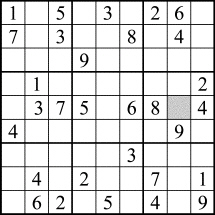
|
|
|
25.
|
Gareth is measuring the exterior angles of a convex hexagon.
So far, he has
measured 60°, 60°, 60°, 30°, and 30°.
What is the measure of the last
exterior angle?
Show your calculation.
|
Problem
|
|
|
26.
|
The square of an odd integer is subtracted from the square of an odd integer.
Develop a conjecture about whether the difference is odd or even.
Provide evidence to support
your conjecture.
|
|
|
27.
|
Blake discovered a number trick in a book he was
reading:
Choose a number.
Subtract
2.
Multiply by 3.
Add
9.
Multiply by 3.
Subtract
9.
Divide by 9.
Try the
trick several times. Make a conjecture about the relation between the number picked and the final
result. Can you find a counterexample to your conjecture? What does this imply?
|
|
|
28.
|
a) Draw a
triangle. Construct a line segment that joins two sides of your triangle and is parallel to the third
side.
b) Prove that the two triangles in your construction
are similar.
|
|
|
29.
|
Ariadne is measuring the exterior angles of a convex decagon. She noticed that
the measure of the exterior angles was either 45° or 15°. How many exterior angles of each
measure does the decagon have? Show your solution.
|
|
|
30.
|
Each interior angle of a regular polygon is eight times as large as its
corresponding exterior angle. How many sides does the polygon have? Explain your answer.
|