Multiple Choice
Identify the
choice that best completes the statement or answers the question.
|
|
|
1.
|
Which pairs of angles are equal in this diagram? 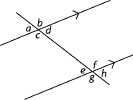 a. | a = b, c = d, and e = f | b. | a = e,
c = g, and b = f | c. | a = c, e = g, and
f = h | d. | a = e, b = d, and
c = g |
|
|
|
2.
|
In which diagram(s) is AB parallel to CD? | 1. | 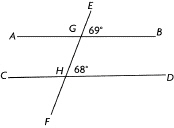 | 2. | 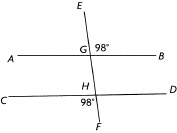 | | | | |
a. | Choice 1 only | b. | Choice 2 only | c. | Choice 1 and Choice
2 | d. | Neither Choice 1 nor Choice 2 |
|
|
|
3.
|
In which diagram(s) is AB parallel to CD? | 1. | 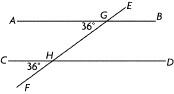 | 2. | 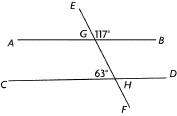 | | | | |
a. | Choice 1 only | b. | Choice 2 only | c. | Choice 1 and Choice
2 | d. | Neither Choice 1 nor Choice 2 |
|
|
|
4.
|
Which angle property proves ÐBEF =
107°? 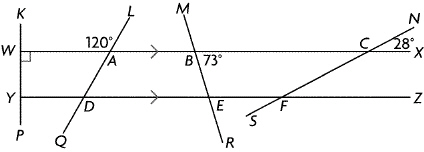
a. | supplementary angles | b. | corresponding angles | c. | alternate interior
angles | d. | alternate exterior angles |
|
|
|
5.
|
In which diagrams are two lines parallel? a. | Choice 2 and Choice 3 | b. | Choice 1 only | c. | Choice 1 and Choice
3 | d. | Choices 1, 2, and 3 |
|
|
|
6.
|
Which are the correct measures of the indicated angles? 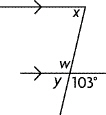 a. | Ðw = 77°, Ðx =77°, Ðy =
103° | b. | Ðw = 77°, Ðx =103°, Ðy =
103° | c. | Ðw = 103°, Ðx =77°, Ðy =
77° | d. | Ðw = 103°, Ðx =103°, Ðy =
77° |
|
|
|
7.
|
Which are the correct measures for ÐDCE
and ÐCAB? 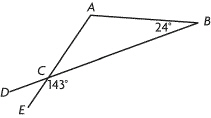 a. | ÐDCE = 47°, ÐCAB = 109° | b. | ÐDCE =
37°, ÐCAB = 119° | c. | ÐDCE = 13°, ÐCAB =
143° | d. | ÐDCE = 31°, ÐCAB = 134° |
|
|
|
8.
|
Which are the correct measures for ÐKLM,
ÐKLN, and ÐNML? 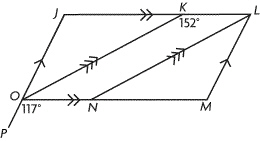 a. | ÐKLM = 117°, ÐKLN = 36°, and ÐNML =
124° | b. | ÐKLM = 71°, ÐKLN = 24°, and ÐNML =
63° | c. | ÐKLM = 73°, ÐKLN = 67°, and ÐNML =
117° | d. | ÐKLM = 63°, ÐKLN = 28°, and ÐNML =
117° |
|
|
|
9.
|
Which are the correct measures for ÐLNO,
ÐLNM, and ÐMLN? 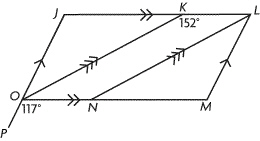 a. | ÐLNO = 145°, ÐLNM = 35°, and ÐMLN =
35° | b. | ÐLNO = 152°, ÐLNM = 28°, and ÐMLN =
35° | c. | ÐLNO = 117°, ÐLNM = 63°, and ÐMLN =
28° | d. | ÐLNO = 152°, ÐLNM = 28°, and ÐMLN =
28 |
|
|
|
10.
|
Which are the correct measures for ÐWXZ,
ÐUZY, and ÐVYX? 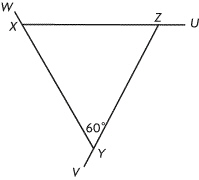 a. | ÐWXZ and ÐUZY cannot be determined; ÐVYX = 120° | b. | ÐWXZ,
ÐUZY, and ÐVYX cannot
be determined. | c. | ÐWXZ cannot be determined; ÐUZY = 120°, ÐVYX =
120° | d. | ÐWXZ = 120°, ÐUZY = 120°, and ÐVYX
=120° |
|
|
|
11.
|
Determine the sum of the measures of the interior angles of this
polygon.
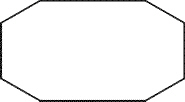
a. | 1080° | b. | 1440° | c. | 720° | d. | 540° |
|
|
|
12.
|
Determine the sum of the measures of the angles in a 9-sided convex
polygon.
a. | 1720° | b. | 1440° | c. | 1080° | d. | 1260° |
|
|
|
13.
|
Each interior angle of a regular convex polygon measures 144°.
How many
sides does the polygon have?
|
|
|
14.
|
The sum of the measures of the interior angles of a convex polygon is S.
Which expression results in the number of sides of the polygons?
|
|
|
15.
|
Determine the value of d.
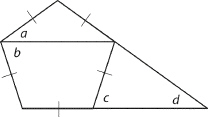
|
Short Answer
|
|
|
16.
|
Determine the measure of ÐRTQ.
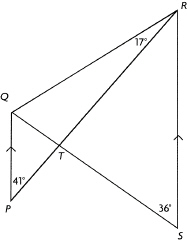
|
|
|
17.
|
Determine the value of x. 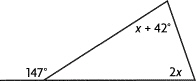
|
|
|
18.
|
Marion used a deck of card to create a convex polygon with 52 equal side
lengths. Determine the sum of the measures of the angles in her polygon.
Show your
calculation.
|
|
|
19.
|
Each interior angle of a regular convex polygon measures 156°.
How many
sides does the polygon have?
|
|
|
20.
|
Gareth is measuring the exterior angles of a convex hexagon.
So far, he has
measured 60°, 60°, 60°, 30°, and 30°.
What is the measure of the last
exterior angle?
Show your calculation.
|
Problem
|
|
|
21.
|
Are BD and FE parallel? Explain how you know. 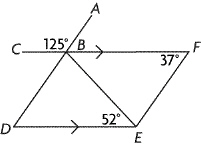
|
|
|
22.
|
Describe four different methods to prove EF || GH. 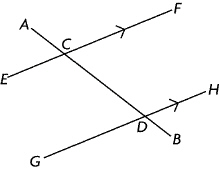
|
|
|
23.
|
a) Construct
a quadrilateral with one pair of parallel sides.
b) Make a
conjecture about the angles in your quadrilateral.
|
|
|
24.
|
Use the diagram to make a conjecture about the sum of the exterior angles of a
triangle. Prove your conjecture. 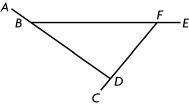
|
|
|
25.
|
A floor tiler designs custom floors using tiles in the shape of regular
polygons. Can the tiler use congruent regular dodecagons and just one other tile to cover a floor, if
they have the same side length and two dodecagons meet at each corner? Draw part of the
tiling.
|