Multiple Choice
Identify the
choice that best completes the statement or answers the question.
|
|
|
1.
|
Which statement about the angles in this diagram is false?
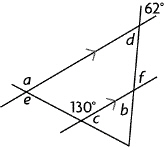 a. | Ða + Ðc
= 180° | b. | Ðe + Ðd
= 180° | c. | Ðd + Ðb
= 124° | d. | 180° – Ðf =
118° |
|
|
|
2.
|
Which statement about the angles in this diagram is false?
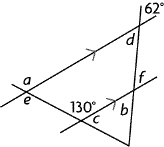 a. | Ða = Ðe | b. | Ðc =
Ðe | c. | Ðd =
Ðb | d. | Ðb =
Ðf |
|
|
|
3.
|
Which angle property proves ÐPYD =
90°? 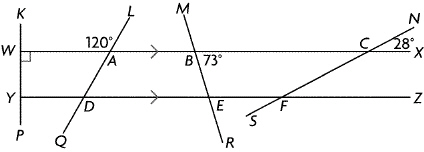 a. | corresponding angles | b. | alternate interior angles | c. | alternate exterior
angles | d. | supplementary angles |
|
|
|
4.
|
In which diagrams are two lines parallel? a. | Choice 2 and Choice 3 | b. | Choice 1 only | c. | Choice 1 and Choice
3 | d. | Choices 1, 2, and 3 |
|
|
|
5.
|
Which are the correct measures for ÐYXZ
and ÐXZY? 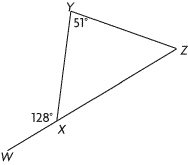 a. | ÐYXZ = 52°, ÐXZY = 77° | b. | ÐYXZ =
52°, ÐXZY = 87° | c. | ÐYXZ = 62°, ÐXZY =
77° | d. | ÐYXZ = 62°, ÐXZY = 87° |
|
|
|
6.
|
Which are the correct measures for ÐDCE
and ÐCAB? 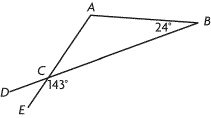 a. | ÐDCE = 47°, ÐCAB = 109° | b. | ÐDCE =
37°, ÐCAB = 119° | c. | ÐDCE = 13°, ÐCAB =
143° | d. | ÐDCE = 31°, ÐCAB = 134° |
|
|
|
7.
|
Which are the correct measures for ÐDCE
and ÐCAB? 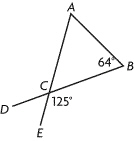 a. | ÐDCE = 75°, ÐCAB = 55° | b. | ÐDCE =
65°, ÐCAB = 50° | c. | ÐDCE = 75°, ÐCAB =
66° | d. | ÐDCE = 55°, ÐCAB = 61° |
|
|
|
8.
|
Which are the correct measures for ÐOJK,
ÐJKO, and ÐJOK? 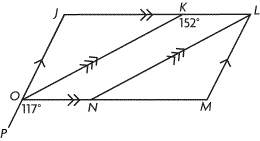 a. | ÐOJK = 102°, ÐJKO = 28°, and ÐJOK =
50° | b. | ÐOJK = 152°, ÐJKO = 18°, and ÐJOK =
10° | c. | ÐOJK = 117°, ÐJKO = 28°, and ÐJOK =
35° | d. | ÐOJK = 117°, ÐJKO = 36°, and ÐJOK =
37° |
|
|
|
9.
|
Which are the correct measures for ÐNOK
and ÐJON? 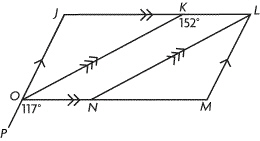 a. | ÐNOK = 38°, ÐJON = 35° | b. | ÐNOK =
28°, ÐJON = 63° | c. | ÐNOK = 35°, ÐJON =
36° | d. | ÐNOK = 35°, ÐJON = 82° |
|
|
|
10.
|
Which are the correct measures of the interior angles of DCDE?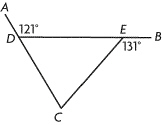 a. | ÐDCE = 92°, ÐCDE = 49°, and ÐCED =
39° | b. | ÐDCE = 52°, ÐCDE = 69°, and ÐCED =
59° | c. | ÐDCE = 62°, ÐCDE = 49°, and ÐCED =
69° | d. | ÐDCE = 72°, ÐCDE = 59°, and ÐCED =
49° |
|
|
|
11.
|
Which are the correct measures for ÐWXZ,
ÐUZY, and ÐVYX? 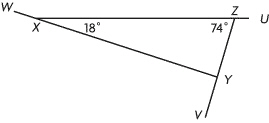 a. | ÐWXZ = 166°, ÐUZY = 109°, and ÐVYX =
89° | b. | ÐWXZ = 162°, ÐUZY = 106°, and ÐVYX =
92° | c. | ÐWXZ = 162°, ÐUZY = 106°, and ÐVYX =
88° | d. | ÐWXZ = 152°, ÐUZY = 116°, and ÐVYX =
88° |
|
|
|
12.
|
Determine the sum of the measures of the interior angles of this
polygon.
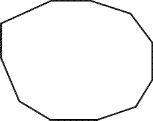
a. | 1080° | b. | 1260° | c. | 1620° | d. | 1440° |
|
|
|
13.
|
The sum of the measures of the interior angles of a convex polygon is S.
Which expression results in the number of sides of the polygons?
|
|
|
14.
|
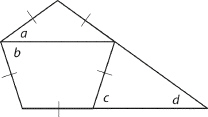
Determine the value of a.
|
|
|
15.
|
Determine the value of c.
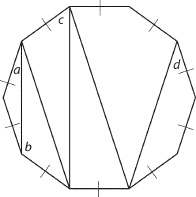
|
Short Answer
|
|
|
16.
|
Determine the measure of ÐBEF. 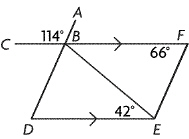
|
|
|
17.
|
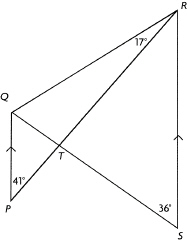
Determine the measure of ÐRTQ.
|
|
|
18.
|
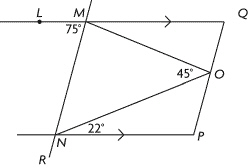
Given QP || MR, determine the measure of ÐQMO.
|
|
|
19.
|
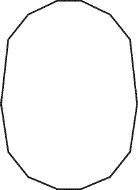
Determine the sum of the measures of the interior angles of this 14-sided
polygon. Show your calculation.
|
|
|
20.
|
Marion used a deck of card to create a convex polygon with 52 equal side
lengths. Determine the sum of the measures of the angles in her polygon.
Show your
calculation.
|
Problem
|
|
|
21.
|
Are BD and FE parallel? Explain how you know. 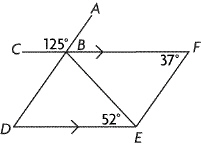
|
|
|
22.
|
a) Construct
an isosceles trapezoid.
b) Explain your method of
construction.
|
|
|
23.
|
Do you need to know QP || MR to determine the measure of ÐQMO? Explain. 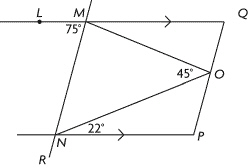
|
|
|
24.
|
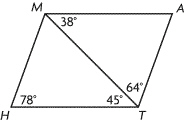
Is quadrilateral MATH a parallelogram? Explain.
|
|
|
25.
|
Each interior angle of a regular polygon is eight times as large as its
corresponding exterior angle. How many sides does the polygon have? Explain your answer.
|