Multiple Choice
Identify the
choice that best completes the statement or answers the question.
|
|
|
1.
|
Which statement about the angles in this diagram is false?
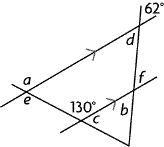
a. | Ðb = 50° | b. | Ðc = 50° | c. | Ðe =
130° | d. | Ðf = 62° |
|
|
|
2.
|
Which statement about the angles in this diagram is false?
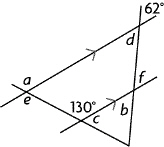 a. | Ða + Ðc
= 180° | b. | Ðe + Ðd
= 180° | c. | Ðd + Ðb
= 124° | d. | 180° – Ðf =
118° |
|
|
|
3.
|
Which angle property proves ÐBED =
73°? 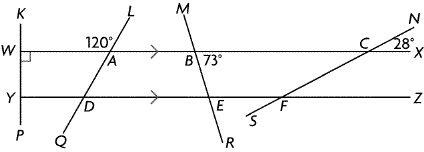
a. | alternate interior angles | b. | vertically opposite angles | c. | corresponding
angles | d. | alternate exterior angles |
|
|
|
4.
|
In which diagrams are two lines parallel? a. | Choices 1, 2, and 3 | b. | Choice 1 and Choice 3 | c. | Choice 2 and Choice
3 | d. | Choice 1 only |
|
|
|
5.
|
Which are the correct measures for ÐLNO,
ÐLNM, and ÐMLN? 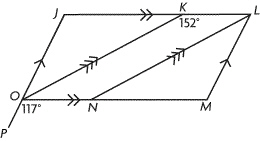 a. | ÐLNO = 145°, ÐLNM = 35°, and ÐMLN =
35° | b. | ÐLNO = 152°, ÐLNM = 28°, and ÐMLN =
35° | c. | ÐLNO = 117°, ÐLNM = 63°, and ÐMLN =
28° | d. | ÐLNO = 152°, ÐLNM = 28°, and ÐMLN =
28 |
|
|
|
6.
|
Which are the correct measures of the interior angles of DCDE?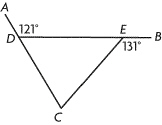 a. | ÐDCE = 92°, ÐCDE = 49°, and ÐCED =
39° | b. | ÐDCE = 52°, ÐCDE = 69°, and ÐCED =
59° | c. | ÐDCE = 62°, ÐCDE = 49°, and ÐCED =
69° | d. | ÐDCE = 72°, ÐCDE = 59°, and ÐCED =
49° |
|
|
|
7.
|
Which are the correct measures for ÐWXZ,
ÐUZY, and ÐVYX? 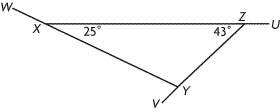 a. | ÐWXZ = 155°, ÐUZY = 137°, and ÐVYX =
68° | b. | ÐWXZ = 165°, ÐUZY = 137°, and ÐVYX =
66° | c. | ÐWXZ = 165°, ÐUZY = 127°, and ÐVYX =
88° | d. | ÐWXZ = 155°, ÐUZY = 127°, and ÐVYX =
86° |
|
|
|
8.
|
Which are the correct measures for ÐWXZ,
ÐUZY, and ÐVYX? 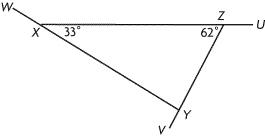 a. | ÐWXZ = 147°, ÐUZY = 118°, and ÐVYX =
95° | b. | ÐWXZ = 147°, ÐUZY = 108°, and ÐVYX =
85° | c. | ÐWXZ = 157°, ÐUZY = 118°, and ÐVYX =
95° | d. | ÐWXZ = 157°, ÐUZY = 108°, and ÐVYX =
85° |
|
|
|
9.
|
Determine the sum of the measures of the interior angles of this
polygon.
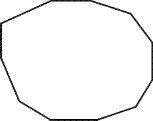
a. | 1080° | b. | 1260° | c. | 1620° | d. | 1440° |
|
|
|
10.
|
Determine the sum of the measures of the angles in a 12-sided convex
polygon.
a. | 2160° | b. | 1800° | c. | 1080° | d. | 3600° |
|
|
|
11.
|
Determine the sum of the measures of the angles in a 16-sided convex
polygon.
a. | 2700° | b. | 2520° | c. | 2340° | d. | 2880° |
|
|
|
12.
|
With which of the following polygons could you create a tiling
pattern?
Choose the best answer.
a. | an equilateral triangle | b. | a square | c. | a
rectangle | d. | all of the above |
|
|
|
13.
|
The sum of the measures of the interior angles of a convex polygon is S.
Which expression results in the number of sides of the polygons?
|
|
|
14.
|
Determine the value of b. 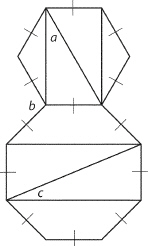
|
|
|
15.
|
Determine the value of a.
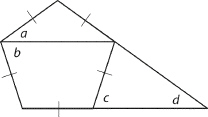
|
Short Answer
|
|
|
16.
|
Determine the values of a, b, and c. 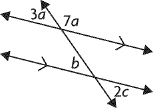
|
|
|
17.
|
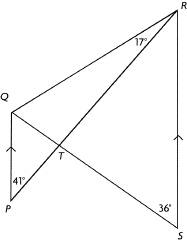
Determine the measure of ÐPQR.
|
|
|
18.
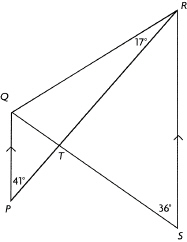
|
Determine the measure of ÐRQT.
|
|
|
19.
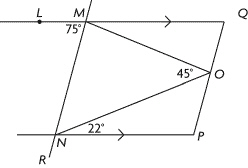
|
Given QP || MR, determine the measure of ÐQMO.
|
|
|
20.
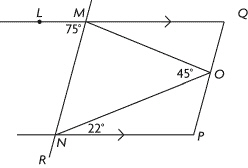
|
Given QP || MR, determine the measure of ÐOPN.
|
Problem
|
|
|
21.
|
Given LM || JK and ÐLMJ =
ÐKMJ, prove JK = KM. 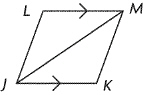
|
|
|
22.
|
a) Construct
a quadrilateral with one pair of parallel sides.
b) Make a
conjecture about the angles in your quadrilateral.
|
|
|
23.
|
Prove that a triangle cannot contain two right angles.
|
|
|
24.
|
Given Ðz = 115°. Determine the
measures of y. 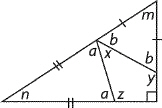
|
|
|
25.
|
Each interior angle of a regular polygon is 14 times as large as its
corresponding exterior angle. How many sides does the polygon have? Explain your answer.
|