Multiple Choice
Identify the
choice that best completes the statement or answers the question.
|
|
|
1.
|
Which pairs of angles are equal in this diagram? 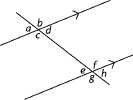 a. | b = e, c = h, and d = g | b. | b = a,
c = e, and d = f | c. | b = c, e = g, and
f = h | d. | b = f, c = g, and
d = h |
|
|
|
2.
|
In which diagram(s) is AB parallel to CD? | 1. | 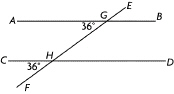 | 2. | 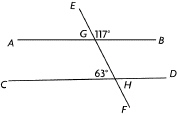 | | | | |
a. | Choice 1 only | b. | Choice 2 only | c. | Choice 1 and Choice
2 | d. | Neither Choice 1 nor Choice 2 |
|
|
|
3.
|
Which statement about the angles in this diagram is false?
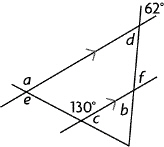
a. | Ðb = 50° | b. | Ðc = 50° | c. | Ðe =
130° | d. | Ðf = 62° |
|
|
|
4.
|
Which angle property proves ÐPYD =
90°? 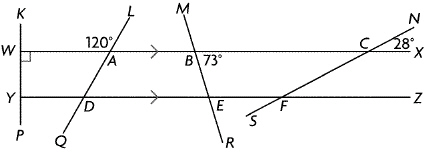 a. | corresponding angles | b. | alternate interior angles | c. | alternate exterior
angles | d. | supplementary angles |
|
|
|
5.
|
In which diagrams are two lines parallel? a. | Choice 2 and Choice 3 | b. | Choice 1 only | c. | Choice 1 and Choice
3 | d. | Choices 1, 2, and 3 |
|
|
|
6.
|
Which are the correct measures for ÐDCE
and ÐCAB? 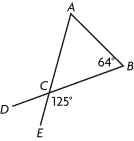 a. | ÐDCE = 75°, ÐCAB = 55° | b. | ÐDCE =
65°, ÐCAB = 50° | c. | ÐDCE = 75°, ÐCAB =
66° | d. | ÐDCE = 55°, ÐCAB = 61° |
|
|
|
7.
|
Which are the correct measures for ÐLNO,
ÐLNM, and ÐMLN? 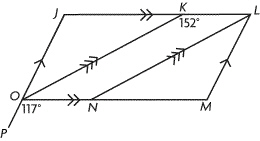 a. | ÐLNO = 145°, ÐLNM = 35°, and ÐMLN =
35° | b. | ÐLNO = 152°, ÐLNM = 28°, and ÐMLN =
35° | c. | ÐLNO = 117°, ÐLNM = 63°, and ÐMLN =
28° | d. | ÐLNO = 152°, ÐLNM = 28°, and ÐMLN =
28 |
|
|
|
8.
|
Which are the correct measures of the interior angles of DCDE? 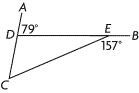 a. | ÐDCE = 46°, ÐCDE = 101°, and ÐCED =
33° | b. | ÐDCE = 32°, ÐCDE = 83°, and ÐCED =
65° | c. | ÐDCE = 76°, ÐCDE = 91°, and ÐCED =
13° | d. | ÐDCE = 56°, ÐCDE = 101°, and ÐCED =
23° |
|
|
|
9.
|
Which are the correct measures for ÐWXZ,
ÐUZY, and ÐVYX? 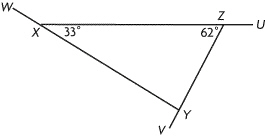 a. | ÐWXZ = 147°, ÐUZY = 118°, and ÐVYX =
95° | b. | ÐWXZ = 147°, ÐUZY = 108°, and ÐVYX =
85° | c. | ÐWXZ = 157°, ÐUZY = 118°, and ÐVYX =
95° | d. | ÐWXZ = 157°, ÐUZY = 108°, and ÐVYX =
85° |
|
|
|
10.
|
Which are the correct measures for ÐWXZ,
ÐUZY, and ÐVYX? 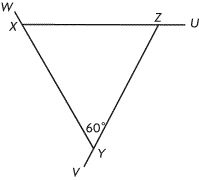 a. | ÐWXZ and ÐUZY cannot be determined; ÐVYX = 120° | b. | ÐWXZ,
ÐUZY, and ÐVYX cannot
be determined. | c. | ÐWXZ cannot be determined; ÐUZY = 120°, ÐVYX =
120° | d. | ÐWXZ = 120°, ÐUZY = 120°, and ÐVYX
=120° |
|
|
|
11.
|
Determine the sum of the measures of the interior angles of this
polygon.
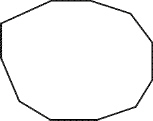
a. | 1080° | b. | 1260° | c. | 1620° | d. | 1440° |
|
|
|
12.
|
Determine the sum of the measures of the angles in a 12-sided convex
polygon.
a. | 2160° | b. | 1800° | c. | 1080° | d. | 3600° |
|
|
|
13.
|
Determine the sum of the measures of the angles in a 9-sided convex
polygon.
a. | 1720° | b. | 1440° | c. | 1080° | d. | 1260° |
|
|
|
14.
|
Determine the value of a. 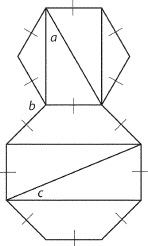
|
|
|
15.
|
Determine the value of b. 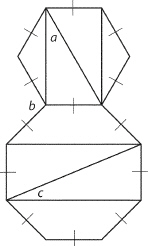
|
Short Answer
|
|
|
16.
|
Use a pencil to thicken one set of parallel lines in this
pattern. 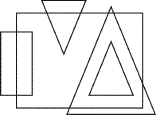
|
|
|
17.
|
Determine the measure of ÐPQT.
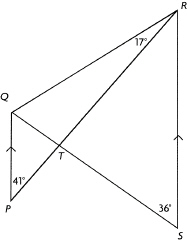
|
|
|
18.
|
Determine the measure of ÐRTQ.
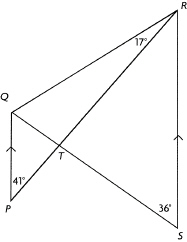
|
|
|
19.
|
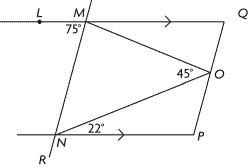
Given QP || MR, determine the measure of ÐMOQ.
|
|
|
20.
|
Determine the sum of the measures of the angles in a 18-sided convex
polygon.
Show your calculation.
|
Problem
|
|
|
21.
|
Given ÐUWX = ÐWYZ, prove: TV || WX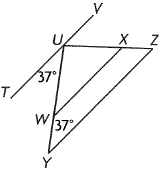
|
|
|
22.
|
Describe four different methods to prove EF || GH. 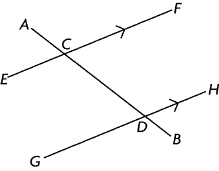
|
|
|
23.
|
a) Construct
an isosceles trapezoid.
b) Explain your method of
construction.
|
|
|
24.
|
a) Draw a
triangle. Construct a line segment that joins two sides of your triangle and is parallel to the third
side.
b) Prove that the two triangles in your construction
are similar.
|
|
|
25.
|
Given Ðz = 115°. Determine the
measures of y. 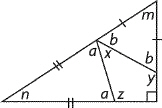
|