Multiple Choice
Identify the
choice that best completes the statement or answers the question.
|
|
|
1.
|
Ginerva made the following conjecture: The square of a number is always greater than
the number.
Is the following equation a counterexample to this conjecture?
Explain.
52 = 25
a. | No, it is not a counterexample, because 25 is greater than 5. | b. | No, it is not a
counterexample, because 25 is less than 5. | c. | Yes, it is a counterexample, because 25 is
greater than 5. | d. | Yes, it is a counterexample, because 5 is less than
25. |
|
|
|
2.
|
Hali is a fitness instructor. People who take
Hali’s exercise class regularly soon become very fit. Regular exercise makes people feel happy.
Joshua takes Hali’s exercise class regularly. What can be deduced about
Joshua?
1. Joshua is very fit. 2. Joshua feels happy. a. | Choice 2 only | b. | Choice 1 only | c. | Neither Choice 1 nor
Choice 2 | d. | Choice 1 and Choice 2 |
|
|
|
3.
|
What type of error, if any, occurs in the
following deduction?
If you combine one haystack with
another haystack, you get one haystack. Therefore, 1 + 1 =
1. a. | a false assumption or generalization | b. | an error in reasoning | c. | an error in
calculation | d. | There is no error in the deduction. |
|
|
|
4.
|
Which number should go in the grey square in this Sudoku puzzle? 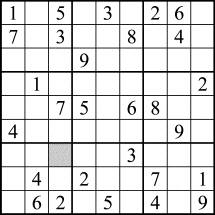
|
|
|
5.
|
Determine the sum of the measures of the angles in a 9-sided convex
polygon.
a. | 1720° | b. | 1440° | c. | 1080° | d. | 1260° |
|
|
|
6.
|
In DUVW, ÐU
= 50°, v = 19.4 cm, and ÐV = 45°.
Determine the length of side u to the nearest tenth of a centimetre.
a. | 20.0 cm | b. | 18.0 cm | c. | 21.0
cm | d. | 19.0 cm |
|
|
|
7.
|
In DXYZ, ÐX
= 51°, x = 7.0 cm, and ÐZ = 41°.
Determine the length of side y to the nearest tenth of a centimetre.
a. | 11.0 cm | b. | 10.0 cm | c. | 9.0
cm | d. | 8.0 cm |
|
|
|
8.
|
Determine the measure of q to the nearest
degree.
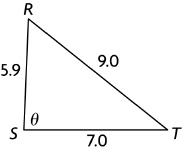
|
|
|
9.
|
Determine the unknown side length to the nearest centimetre. 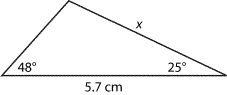 a. | 4.4 cm | b. | 4.3 cm | c. | 4.6
cm | d. | 4.7 cm |
|
|
|
10.
|
Determine the unknown side length to the nearest centimetre. 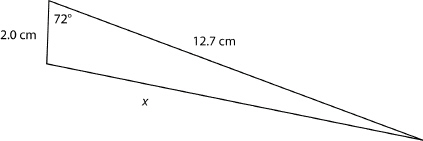 a. | 11.4 cm | b. | 10.8 cm | c. | 12.0
cm | d. | 12.2 cm |
|
|
|
11.
|
Determine the indicated side length to the nearest tenth of a metre. 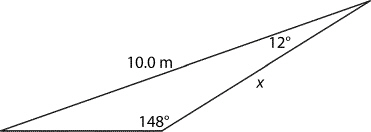
a. | 5.1 m | b. | 6.5 m | c. | 8.0
m | d. | cannot be determined |
|
|
|
12.
|
A pear orchard has 40 trees with these heights, given in
inches. 110
105 83 84
104 92 95
98 88
92 80 81
115 88 106
92 97
103 100 93
98 93 93
102 92
87 117 92
75 102 83
107 122
92 115 86
89 98 105
125 What value goes in the second row of this frequency table? Height (in.) | Frequency | 70–79 | 1 | 80–89 | | 90–99 | 14 | 100–109 | 9 | 110–119 | 4 | 120–129 | 2 | | |
|
|
|
13.
|
Which histogram represents the following test scores?
Geography Test 3 Scores
(our of 100)
92 85
78 67
54
92 83
78 65
53
90 83
77 62
50
88 80
75 62
48
86 80
68 60 42
|
|
|
14.
|
Environment Canada recorded the amount of rain (in millimetres) in Victoria, BC
for two months.
0 0
9.0 0 0
1.0 0
0
0 7.6 0
0 5.8
0.6
0 0
0.4 0 0
0
0 0 0
0 0 0
0
0 0 0
0 0
0 0
0 0 0
0.4
0 5.8
0 0 1.6
0.2
0 6.0
0 0 0.2
0
0 0.2
0 0 1.0
0
0 2.8
0 0 26.0
0
Determine the standard deviation, to one decimal place.
a. | 8.9 mm | b. | 3.7 mm | c. | 0.0
mm | d. | 1.2 mm |
|
|
|
15.
|
A teacher is analyzing the class results for a physics test. The marks are
normally distributed with a mean (µ) of 76 and a standard deviation (s) of 4.
Determine Olivia’s mark if she scored µ – s.
|
|
|
16.
|
Which set is normally distributed? | Interval | 0–9 | 10–19 | 20–29 | 30–39 | 40–49 | 50–59 | | Set A. | 100 | 500 | 850 | 820 | 450 | 150 | | Set B. | 800 | 750 | 700 | 650 | 600 | 550 | | Set C. | 950 | 420 | 180 | 220 | 460 | 990 | | Set D. | 400 | 620 | 760 | 820 | 900 | 850 | | | | | | | |
a. | Set A. | b. | Set C. | c. | Set
D. | d. | Set B. |
|
|
|
17.
|
Determine the percent of data to the left of the z-score: z =
1.44.
a. | 94.95% | b. | 95.91% | c. | 93.82% | d. | 92.51% |
|
|
|
18.
|
Determine the percent of data to the left of the z-score: z =
0.87.
a. | 80.78% | b. | 77.94% | c. | 79.71% | d. | 78.23% |
|
|
|
19.
|
Determine the percent of data between the following z-scores:
z
= –1.50 and z = 1.50.
a. | 47.20% | b. | 100% | c. | 94.41% | d. | 88.82% |
|
|
|
20.
|
A poll was conducted about an upcoming election. The result that 71% of people
intend to vote for one of the candidates is considered accurate within ±3.0 percent points, 9
times out of 10.
State the confidence interval.
a. | 69.5%–72.5% | b. | 71%–77% | c. | 74%–77% | d. | 71%–74% |
|
|
|
21.
|
Describe the boundary lines for the following system of linear
inequalities. { y – 3 x < 12, x + y  0, x  R, y  R} a. | Dashed line along y = 3x + 12; solid line along y =
–x | b. | Dashed line along y = 3x + 12; dashed line along y =
–x | c. | Solid line along y = 3x + 12; dashed line along y =
–x | d. | Solid line along y = 3x + 12; solid line along y =
–x |
|
|
|
22.
|
What system of linear inequalities is shown here? 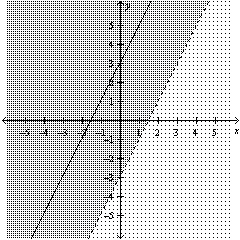 a. | y + 2x  3 3
y > 2x
+ 3 | b. | y – 2x  2 2
y >
2x – 2 | c. | y – x  3 3
y > x
– 3 | d. | y – 2x  3 3
y >
2x – 3 |
|
|
|
23.
|
A vending machine sells juice and pop.
• The machine holds, at most,
200 cans of drinks.
• Sales from the vending machine show that at least 3 cans of juice are
sold for each can of pop.
• Each can of juice sells for $1.50, and each can of pop sells for
$1.00.
Let x represent the number of cans of pop.
Let y represent the number of
cans of juice.
What are the restrictions on x and y?
a. | x Î W, y Î W | b. | x Î I,
y Î I | c. | x Î R,
y Î R | d. | No constraints. |
|
|
|
24.
|
Jan volunteers to fold origami frogs and swans for a display.
• She
has 8 squares of green paper for the frogs and 12 squares of white paper for the swans.
• It
takes her 4 min to fold an origami frog and 3 min to fold an origami swan.
• There
must be two swans for every frog.
Let f represent the number of frogs.
Let s
represent the number of swans.
Which of the following points is in the feasible
region?
a. | (1, 1) | b. | (1, 20) | c. | (5,
10) | d. | (10, 10) |
|
|
|
25.
|
Which set of data is correct for this graph? 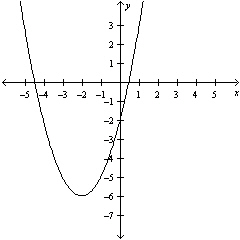 | Set | Axis of Symmetry | Vertex | Domain | Range | A. | x =
–2 | (–2, 6) | x Î R | y Î R | B. | x = –6 | (–6,
–2) | –8 £ x
£ 4 | –8 £ y | C. | x =
–2 | (–2, –6) | x Î R | –6 £ y | D. | x = 2 | (2, 6) | –6 £ x £ 2 | –6 £ y | | | | | |
a. | Set A. | b. | Set B. | c. | Set
D. | d. | Set C. |
|
|
|
26.
|
What are the x- and y-intercepts for the function
f(x) = x2 + 7x + 10?
a. | x = –5, x = 5, no y-intercept | b. | x = 10,
y = –2 | c. | x = –5, x = –2,
y = 10 | d. | no x-intercepts, y = –2 |
|
|
|
27.
|
Solve 12x2 + 11x = –2 by graphing the
expressions on both sides of the equation.
a. | x = 0.667, x = 0.25 | b. | x = 2, x = 4 | c. | x =
–0.667, x = –0.25 | d. | x = –2, x =
–4 |
|
|
|
28.
|
Rewrite x2 + 2x = –3x2
+ 2x + 36 in standard form. Then solve the equation in standard form by graphing.
a. | x = 3, x = –3 | b. | x = 6, x =
–6 | c. | x = 3, x = 3 | d. | x = 6, x =
6 |
|
|
|
29.
|
Which relation is the factored form of f(x) =
–2x2 – 5x – 2?
a. | f(x) = 2(x – 2)(x –
0.5) | b. | f(x) = –2(x – 1)(x –
5) | c. | f(x) = –2(x + 2)(x +
0.5) | d. | f(x) = 2(x – 2)(x +
0.5) |
|
|
|
30.
|
Solve m2 – 10m + 16 = 0 by factoring.
a. | m = 4, m = 4 | b. | m = –8, m =
–2 | c. | m = –4, m = –4 | d. | m = 8, m
= 2 |
|
|
|
31.
|
Solve 25x2 – 36 = 0 by factoring.
a. | x =  , x = – , x = – | b. | x =
–6, x = 5 | c. | x = 6, x =
–6 | d. | x =  , x = – , x = – |
|
|
|
32.
|
Solve –2p2 – 5p + 1 = 7p2
+ p using the quadratic formula.
|
|
|
33.
|
A bridge is supported by three arches. The function that describes the arches is
h(x) = –0.2x2 + 3.0x, where h(x) is
the height, in metres, of the arch above the ground at any distance, x, in metres, from one
end of the bridge. How tall is each arch?
a. | 9.7 m | b. | 13.5 m | c. | 10.8
m | d. | 11.3 m |
|
|
|
34.
|
A hockey arena sells premium tickets for $70. At this price, the arena will sell
150 premium tickets every game. The owners know from past years that they will sell 3 fewer premium
tickets per game for each price increase of $2. What should the owners charge for a premium ticket to
earn the maximum amount of money?
|
|
|
35.
|
An 8 kg bag of potatoes costs $9.15. What is the unit rate?
a. | $9.15/8 kg | b. | $0$0.87/kg | c. | $1.14/kg | d. | $0.99/kg |
|
|
|
36.
|
Which situations could be described using the rates 15 L/min,
$2.89/ft2, and $3.60/100 g?
a. | water flow from a leaky faucet, price of fabric, price of cheese | b. | fuel consumption,
price of sod, price of gold | c. | water flow through a hydro electric plant,
price of ceramic tile, price of trail mix | d. | water flow through a garden hose, price of
carpet, price of salami |
|
|
|
37.
|
The distance between two towns on a map is 5.4
cm. The map was made using a scale of 1 cm to 300 km. What is the actual distance between the two
towns?
a. | 1600 km | b. | 1550 km | c. | 1620
km | d. | 1520 km |
|
|
|
38.
|
Data for triangle ABC is shown on the first line of the table.
Triangle ABC is enlarged by a scale factor of 3.5. Which triangle is the enlargement
of triangle ABC? Triangle Name | Length of Base (cm) | Height of Triangle (cm) | Scale Factor | Area (cm2) | | ABC | 5.00 | 3.00 | 1.0 | 7.5 | 1 | DEF | 17.50 | 10.50 | 3.5 | 91.875 | 12.25 | GHI | 17.50 | 12.25 | 3.5 | 80.75 | 10.5 | JKL | 12.25 | 10.50 | 3.5 | 91.875 | 17.5 | MNO | 13.50 |
9.875 | 3.5 | 80.75 | 12.25 | | | | | | |
|
|
|
39.
|
Data for trapezoid ABCD is shown on the first line of the table.
Trapezoid ABCD is enlarged so the length of base a is 16 cm. Which rectangle is
the enlargement of trapezoid ABCD? Trape-
zoid
Name | Length of Base a (cm) | Length of Base b
(cm) | Height of
Trape-
zoid (cm) | Scale Factor | Area (cm2) | | ABCD | 8 | 6 | 16 | 1 | 112 | 1 | EFGH | 16 | 6 | 16 | 0.5 | 176 |
0.25 | JKLM | 16 | 12 | 32 | 2 | 448 | 4 | NOPQ | 16 | 16 | 28 | 2 | 448 | 4 | RSTU | 16 | 3 | 8 | 0.5 | 76 |
0.25 | | | | | | | |
|
|
|
40.
|
A large city map book will be changed so that it
can be used as a street guide. To keep the same number of pages, the page dimensions will be halved
and the maps will be less detailed. The area of each page in the original book is
3000 cm2. What is the area of each page in the smaller map book?
a. | 1500 cm2 | b. | 750 cm2 | c. | 425 cm2
| d. | 375 cm2 |
|
Short Answer
|
|
|
41.
|
While driving along the road one morning, Jenny
noticed that all the cows
in a field were standing up, with their heads pointing northward.
In the afternoon, it started to snow. Jenny made the conjecture that when cows stand and face
northward, it will likely snow. Is Jenny’s conjecture reasonable? Briefly justify your
decision.
|
|
|
42.
|
What type of error occurs in the following
deduction?
Briefly justify your answer.
All videos have large groups of dancers. The
western band is recording a new video, so it must have a large group of dancers.
|
|
|
43.
|
Marion used a deck of card to create a convex polygon with 52 equal side
lengths. Determine the sum of the measures of the angles in her polygon.
Show your
calculation.
|
|
|
44.
|
Abbie is measuring the exterior angles of a convex pentagon.
So far, she has
measured 90°, 90°, 120°, and 40°.
What is the measure of the last exterior
angle?
Show your calculation.
|
|
|
45.
|
Which side of the boundary line is the solution set for the linear inequality
x + 2 y – 1 > 0? 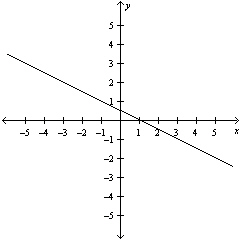
|
|
|
46.
|
Graph the solution set for the linear inequality 3y – 6x
< –1.
|
|
|
47.
|
What system of linear inequalities is shown here? 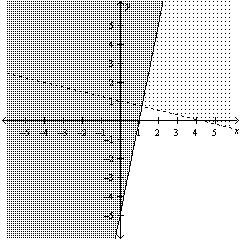
|
|
|
48.
|
Baskets of fruit are being prepared to sell.
• Each basket contains at
least 8 apples and more than 4 oranges.
• Apples cost 25¢ each, and oranges cost
40¢ each.
• The budget allows no more than $6, in total, for the fruit in each
basket.
Let x represent the number of apples.
Let y represent the number of
oranges.
Describe any restrictions on the variables.
|
|
|
49.
|
Determine the roots of the corresponding quadratic equation for the
graph. 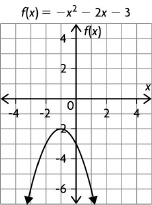
|
|
|
50.
|
The scale factor for two similar rectangles is 1:5.
The sum of their areas
is 78 cm2.
Determine the area of each rectangle.
|
Problem
|
|
|
51.
|
Jessica found an interesting numeric pattern: 1 • 5 +
1 = 6 • 1
2 • 5 +
2 = 6 • 2
3 • 5 +
3 = 6 • 3
4 • 5 +
4 = 6 • 4
Do you think the pattern will continue? Justify your decision
with a counterexample if possible.
|
|
|
52.
|
Alexandra, Morana, Rebecca, and Yvonne play on the high school basketball team.
After the first quarter of one game, Morana led Rebecca by 3 points. Yvonne led Alexandra by 5
points, and Rebecca led Alexandra by 2 points. In the second half, Alexandra got 4 points while
Rebecca was scoreless. At half time, Yvonne was ahead of Morana by 4 points and Morana was 4 points
ahead of Rebecca. Morana, Yvonne, and Rebecca did not play in the second half of the game. At the end
of the game, Alexandra had 2 more points than Yvonne. Who finished third in scoring?
|
|
|
53.
|
Solve this Sudoku puzzle using the numbers 1 to 9. Fill the grid so that each
column, row, and block contains all the numbers. No number can be repeated within any column, row, or
block. 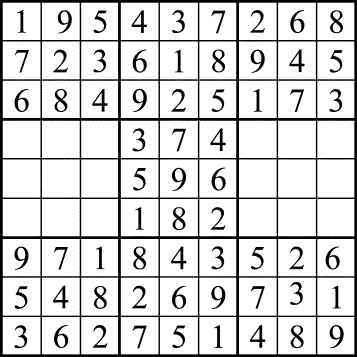
|
|
|
54.
|
A radio tower is supported by two wires on opposite sides. On the ground,
the ends of the wire are 84 m apart. One wire makes a 52° angle with the ground.
The
other makes a 74° angle with the ground.
Draw a diagram of the situation. Then, determine
the height of the tower to the nearest tenth of a metre.
|
|
|
55.
|
In DQRS, q = 8.9 cm, r = 3.8 cm,
and s = 7.2 cm. Solve DQRS by determining the measure of
each angle to the nearest degree. Show your work.
|
|
|
56.
|
The posts of a soccer goal are 24 ft apart. A player is standing at a point 50
ft from one post and 42 ft from the other post. Within what angle must the player kick the ball to
score a goal? Express your answer to the nearest degree. Show your work and draw a diagram.
|
|
|
57.
|
Three teams are travelling to a hockey tournament in cars and
minivans. • Each team has no more than 2 coaches and 18 athletes. • Each car can
take 3 team members, and each minivan can take 5 team members. • No more than 7 minivans and
15 cars are available. The school wants to know the combination of cars and minivans that will
require the maximum number of vehicles. Create and verify a model to represent this
situation. a) Use the optimization model to determine the combination of cars and minivans
that will use the maximum number of vehicles. b) How many team members can travel in the
maximum number of vehicles? Optimization Model
Let V represent the total number
of vehicles. Let c represent the number of cars. Let m represent the number of
minivans. Restrictions: c Î W, m Î W Constraints: c 
0 m  0 3 c + 5 m  60 c 
15 m  7 Objective function to maximize: V =
c + m
|
|
|
58.
|
The height, in metres, of a fireworks rocket is modelled by the function
h(t) = –4.9t2 + 25t + 10, where t is
the time in seconds after the rocket is fired.
a) Determine the domain and range of the
function to the nearest tenth.
b) Use technology to graph the function.
|
|
|
59.
|
Solve –x2 + 3x + 2 =
–3x2 – 2x + 4 by graphing.
|
|
|
60.
|
Gravity affects the speed at which objects travel when they fall. Suppose a rock
is dropped off a 7.5 m cliff on Mars. The height of the rock, h(t), in metres, over
time, t, in seconds could be modelled by the function h(t) =
–1.9t2 + 3.0t + 7.5. (The acceleration due to gravity on
Mars is 3.77 m/s.)
a) How long would it take the rock to hit the bottom of the
cliff?
b) The same rock dropped off a cliff of the same height on Earth could be modelled
by the function h(t) = –4.9t2 + 3.0t + 7.5.
Compare the time that the rock would be falling on Earth and on Mars.
|