Multiple Choice
Identify the
choice that best completes the statement or answers the question.
|
|
|
1.
|
Solve –2x2 – 24x + 75 = 0 by graphing the
corresponding function and determining the zeros.
a. | x = 5, x = –3 | b. | There are no zeros. | c. | x = 0, x
= –8.333 | d. | x = –3, x =
–5 |
|
|
|
2.
|
Solve x2 – 5x = –4 by graphing the
expressions on both sides of the equation.
a. | x = –4, x = 1 | b. | x = –4, x =
–1 | c. | x = 4, x = –1 | d. | x = 4, x =
1 |
|
|
|
3.
|
Solve –2x2 – 6x = –20 by
graphing the expressions on both sides of the equation.
a. | x = 5, x = –2 | b. | x = –4, x =
5 | c. | x = 4, x = –5 | d. | x = –5, x =
2 |
|
|
|
4.
|
What is the correct quadratic function for this parabola? 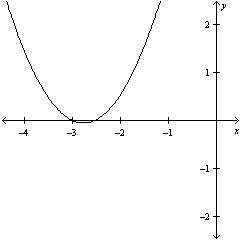 a. | f(x) = (x + 2.5)(x + 3) | b. | f(x) =
–(x + 2)(x + 3.5) | c. | f(x) = (x + 2)(x +
3) | d. | f(x) = (x + 2.5)(x + 3.5) |
|
|
|
5.
|
Which set of data is correct for the quadratic relation f( x) =
–2( x – 1)( x – 5)?
| | x-intercepts | y-intercept | Axis of Symmetry | Vertex | A. | (1, 0), (5, 0) | y =
–10 | x = 3 | (3, 8) | B. | (–1, 0), (–5, 0) | y = 10 | x =
–3 | (–3, 64) | C. | (–1, 0), (–5, 0) | y = –10 | x =
3 | (3, –8) | D. | (1, 0), (5, 0) | y =
10 | x = –3 | (3, 64) | | | | | |
a. | Set B. | b. | Set C. | c. | Set
D. | d. | Set A. |
|
|
|
6.
|
Which relation is the factored form of f(x) =
–2x2 – 5x – 2?
a. | f(x) = 2(x – 2)(x –
0.5) | b. | f(x) = –2(x – 1)(x –
5) | c. | f(x) = –2(x + 2)(x +
0.5) | d. | f(x) = 2(x – 2)(x +
0.5) |
|
|
|
7.
|
Which relation is the factored form of f(x) = x2
– 4x + 4?
a. | f(x) = (x – 2)(x + 2) | b. | f(x) =
4(x – 1)2 | c. | f(x) = (x +
4)(x – 1) | d. | f(x) = (x –
2)2 |
|
|
|
8.
|
Solve 3y2 – 12y =
–2y2 + 5y + 12 by factoring.
a. | y = –3, y = 4 | b. | y = – , y =
4 , y =
4 | c. | y = – , y = 4 , y = 4 | d. | y =
–5, y = 4 |
|
|
|
9.
|
Solve 10 + 5x2 + 18x =
–4x2 – 18x – 10 by factoring.
|
|
|
10.
|
Which set of data is correct for the quadratic relation f( x) =
–6( x – 18) 2 – 30? | | Direction parabola
opens | Vertex | Axis of Symmetry | | A. | upward | (30, –18) | x = 30 | | B. | downward | (6, 30) | x =
–18 | | C. | upward | (–6,
–18) | x = –30 | | D. | downward | (18, –30) | x = 18 | | | | |
a. | Set B. | b. | Set C. | c. | Set
D. | d. | Set A. |
|
|
|
11.
|
How many zeros does f(x) = (x – c)2
+ d have if d > 0?
a. | 2 | b. | 1 | c. | 0 | d. | It is impossible to
determine. |
|
|
|
12.
|
Solve 2y2 – 3y + 1 = 0 using the quadratic
formula.
a. | y = 1, y = – | b. | y = 1, y
= – | c. | y = –1, y =  | d. | y = 1, y =  |
|
|
|
13.
|
Solve 9w2 + 6w + 1 = 0 using the quadratic
formula.
a. | w =  | b. | w = – | c. | w = 0, w
= – | d. | w = 0, w =  |
|
|
|
14.
|
Solve x2 – 2x = 4 using the quadratic
formula.
|
|
|
15.
|
A fishing boat leaves a dock at 5:20 a.m. and travels due east at 20 km/h. A
second fishing boat leaves the same dock 30 min later and travels due north at 30 km/h. At what time
of day, to the nearest minute, will the two fishing boats be 50 km apart?
a. | 6:10 a.m. | b. | 8:18 a.m. | c. | 7:03
a.m. | d. | 6.35 a.m. |
|
Short Answer
|
|
|
16.
|
If a parabola with equation y = ax2 + bx +
c has a y-intercept above the x-axis, will c be positive or
negative?
|
|
|
17.
|
Fill in the table for the relation y = x2 + 2 x +
11 .| y-intercept | | | x-intercept(s) | | | Axis of symmetry | | | Vertex | | | Domain | | | Range | | | |
|
|
|
18.
|
Two consecutive integers are squared. The sum of these squares is 1513. What are
the integers?
|
Problem
|
|
|
19.
|
Anita is building four enclosed gardens as shown. She bought 150 m of fencing
and wants to maximize the total area for the gardens. She wrote the function A( x) =
– x2 + 75 x to represent the total area of the gardens,
A( x) , in square metres, if each garden is x metres wide.
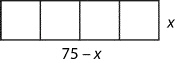
a) Determine the maximum total area of
the four gardens. b) State the domain and range of the variables in her equation. c)
What are the dimensions of one garden?
|
|
|
20.
|
A company manufactures aluminum cans. One customer places an order for cans that
must be 19 cm high, with a volume of 3358 cm3.
a) Use a method of your choice to
determine the radius that the company should use to manufacture these cans.
b) Explain why
you choose this method.
|
|
|
21.
|
At 11:15 p.m., a freighter leaves a harbour and travels due west at 65 km/h. One
hour later, another freighter leaves the same harbour and travels due south at 72 km/h. At what time
of day, to the nearest minute, will the two freighters be 200 km apart? Use a labelled diagram to
solve the problem.
|