Multiple Choice
Identify the
choice that best completes the statement or answers the question.
|
|
|
1.
|
Which relation is quadratic?
a. | y = x2 – x2 + 4x +
2 | b. | y = (2x2)(x + 1) | c. | y = (x
+ 5)2 | d. | y = 2x – 6x + 3 |
|
|
|
2.
|
Which set of data is correct for this graph? 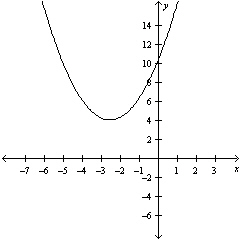 | | Axis of Symmetry | Vertex | Domain | Range | A. | x =
4.25 | (4.25, –2.5) | –8 £ x £ 4.25 | 2.5 £ y | B. | x =
2.5 | (2.5, 4) | x Î R | y Î R | C. | x = 4 | (4, 2.5) | –6 £ x £ 2 | 0 £ y | D. | x =
–2.5 | (–2.5, 4) | x Î R | 4 £ y | | | | | |
a. | Set D. | b. | Set A. | c. | Set
B. | d. | Set C. |
|
|
|
3.
|
Which set of ordered pairs satisfy the function f(x) =
–x2 + 4?
a. | (–2, 0), (1, 3), (6, 30) | b. | (–6, –30), (–4,
–12), (2, 0) | c. | (–5, –21), (–1, 3),
(4, –12) | d. | (–7, –42), (–5, –21), (0,
4) |
|
|
|
4.
|
Which set of ordered pairs satisfy the function f(x) =
x2 – 4x + 6?
a. | (–2, 18), (–1, 9), (6, 18) | b. | (2, 2), (4,
6), (7, 30) | c. | (–3, 27), (0, 6), (5, 11) | d. | (–1, 9), (1, 3), (2,
2) |
|
|
|
5.
|
Solve 2x2 + 4x + 2 = 0 by graphing the corresponding
function and determining the zeros.
a. | x = 1, x = 1 | b. | x = 1, x =
–1 | c. | x = 0, x = –1 | d. | x = –1, x = –1
|
|
|
|
6.
|
Solve x2 – 5x = –4 by graphing the
expressions on both sides of the equation.
a. | x = –4, x = 1 | b. | x = –4, x =
–1 | c. | x = 4, x = –1 | d. | x = 4, x =
1 |
|
|
|
7.
|
What is the correct quadratic function for this parabola? 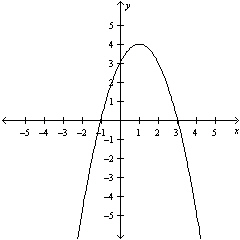 a. | f(x) = (x – 1)(x + 3) | b. |
f(x) = (x + 1)(x + 3) | c. | f(x) = –(x +
1)(x – 3) | d. | f(x) = (1 –
x)(3 – x) |
|
|
|
8.
|
Which set of data is correct for the quadratic relation f( x) =
( x + 1)( x – 2)? | | x-intercepts | y-intercept | Axis of Symmetry | Vertex | A. | (1, 0), (–2, 0) | y =
2 | x = –0.5 | (–0.5, –1.25) | B. | (–1, 0), (2, 0) | y =
–2 | x = 0.5 | (0.5, –2.25) | C. | (–1, 0), (–2, 0) | y = 2 | x =
–1.5 | (–1.5, 1.75) | D. | (1, 0), (2, 0) | y =
2 | x = 1.5 | (1.5, ––1.25) | | | | | |
a. | Set A. | b. | Set C. | c. | Set
D. | d. | Set B. |
|
|
|
9.
|
Which relation is the factored form of f(x) = x2
+ 2x – 8?
a. | f(x) = (x – 2)(x + 4) | b. | f(x) =
(x + 2)(x – 4) | c. | f(x) = (x –
1)(x + 8) | d. | f(x) = 2(x + 2)(x –
2) |
|
|
|
10.
|
Solve 10 + 5x2 + 18x =
–4x2 – 18x – 10 by factoring.
|
|
|
11.
|
Which function has a minimum value?
a. | f(x) = (x – 5)2 + 15 | b. | f(x) =
–(x + 1)2 – 5 | c. | f(x) = –(x –
15)2 + 5 | d. | f(x) = –(x –
5)2 + 10 |
|
|
|
12.
|
Which quadratic function represents this parabola? 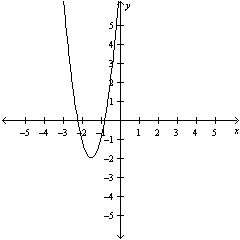
a. | f(x) = –4(x + 1.5)2 +
2 | b. | f(x) = 4(x – 1.5)2 –
2 | c. | f(x) = 4(x + 1.5)2 –
2 | d. | f(x) = 4(x + 1.5)2 +
2 |
|
|
|
13.
|
Solve 9w2 + 6w + 1 = 0 using the quadratic
formula.
a. | w =  | b. | w = – | c. | w = 0, w
= – | d. | w = 0, w =  |
|
|
|
14.
|
Solve y2 + 5y = –10 –
2y2 – 6y using the quadratic formula.
a. | x = – , x = 2 , x = 2 | b. | x =  ,
x = 2 ,
x = 2 | c. | x =  , x = –2 , x = –2 | d. | x =
– , x = –2 , x = –2 |
|
|
|
15.
|
A rug company sells circular rugs that have a uniform circular border. The area
of the border is about half the area of the circular rug it surrounds. If the radius of the entire
rug is 10.0 m, what is the width of the border?
a. | 7.6 m | b. | 3.0 m | c. | 2.4
m | d. | 1.8 m |
|
Short Answer
|
|
|
16.
|
Fill in the table for the relation y = x2 – 6 x
– 4. | Maximum or
minimum | | | Axis of symmetry | | | Vertex | | | |
|
|
|
17.
|
Solve –2x2 – 6x = –8 by graphing the
expressions on both sides of the equation.
|
|
|
18.
|
A quadratic function has an equation that can be written in the form
f(x) = a(x – r)(x – s). The graph
of the function has x-intercepts at (3, 0) and (6, 0) and passes through the point (7,
–4). Write the equation of the function.
|
|
|
19.
|
Solve and verify the following equation:
–17p –11 +
2p2 = –2p2 + 9p + 3
|
|
|
20.
|
Gina is making a square quilt with surrounding border. She wants the border to
be 0.1 m wide. She also wants the area of the interior of the quilt to be four times the area of the
border. What are the dimensions of the quilt, with border, to the nearest tenth of a metre?
|
Problem
|
|
|
21.
|
For the quadratic function f(x) = –2x2 +
6x + 12:
a) Use a partial factoring strategy to determine two points that are the
same distance from the axis of symmetry.
b) Determine the coordinates of the vertex.
c) Sketch the graph.
|
|
|
22.
|
Rosa is building three enclosed gardens as shown. She bought 200 m of fencing
and wants to maximize the total area for the gardens. She wrote the function A( x)
= – x2 + 100 x to represent the total area of the gardens,
A( x) , in square metres, if each garden is x metres wide. 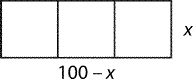
a) Determine the maximum total area of the three gardens. b) State the
domain and range of the variables in her equation. c) What are the dimensions of one
garden?
|
|
|
23.
|
A parabolic arch has zeros located at (2, 0) and (32, 0). The parabola has a
maximum height of 112.5 ft.
a) Define the equation of the parabola in vertex form. Explain
your reasoning.
b) State the domain and range of the function describing the arch.
|
|
|
24.
|
a) Suppose someone threw a stone off a 100 m cliff. The height of
the stone, h(t), in metres, after t seconds can be represented by the function
h(t) = –4.9t2 + 3.0t + 100. How long would
it take the stone to hit the ground?
b) The height of a stone, h(t), in
metres, falling from a 200 m cliff over time, t, in seconds, can be modelled by the function
h(t) = –4.9t2 + 3.0t + 250. How long it
would take the stone to hit the ground?
|
|
|
25.
|
A landscaper is designing a rectangular garden, which will be 5.5 m wide by 6.5
m long. She has enough crushed rock to cover an area of 6.0 m2 and she wants to make a
uniform border around the garden. How wide should the border be if she wants to use all the crushed
rock?
|