Multiple Choice
Identify the
choice that best completes the statement or answers the question.
|
|
|
1.
|
For which inequality is (–50, –50) a possible solution?
a. | y  –9 + 2x –9 + 2x | b. | y
– 2x  10 10 | c. | y < x
– 2 | d. | y > 9 |
|
|
|
2.
|
What is the boundary line for the linear inequality y – 2 x
 10? a. | y = –2x – 10 | b. | y = 2x
+ 10 | c. | y = 2x – 10 | d. | y = –2x
+ 10 |
|
|
|
3.
|
What is the boundary line for the linear inequality 3x – 6y
< 18?
a. | y =  x – 1 x – 1 | b. | y =  x – 6 x – 6 | c. | y =  x
– 3 x
– 3 | d. | y =  x – 2 x – 2 |
|
|
|
4.
|
Which test point is in the solution set for the linear inequality
{( x, y) | x + y < 3, x  W,
y  W}? a. | (1, 1) | b. | (–2, 5) | c. | (2,
2) | d. |  |
|
|
|
5.
|
What system of linear inequalities is shown here? 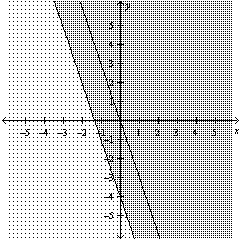 a. | 3x + y  0 0
y + 4  3x 3x | b. | 3x
+ y < 0
y + 4  3x 3x | c. | 3x + y < 0
y
– 4 > 3x | d. | 3x + y > 0
y +
4  3x 3x |
|
|
|
6.
|
Which system of linear inequalities has no solution?
a. | –5x – 5y > 0
5x + 5y
> 0 | b. | 5x + 5y > 5
x + y >
0 | c. | x + y  5 5
x – y  5
5 | d. | 5x + 2y > 0
2x + 5y >
0 |
|
|
|
7.
|
A football stadium has 60 000 seats.
• 70% of the seats are in the
lower deck.
• 30% of the seats are in the upper deck.
• At least 40 000 tickets are
sold per game.
• A lower deck ticket costs $100, and an upper deck ticket costs $60.
Let
x represent the number of lower deck tickets.
Let y represent the number of upper
deck tickets.
What are the restrictions on x and y?
a. | x Î W, y Î W | b. | x Î I,
y Î I | c. | x Î R,
y Î R | d. | No constraints. |
|
|
|
8.
|
Jan volunteers to fold origami frogs and swans for a display.
• She
has 8 squares of green paper for the frogs and 12 squares of white paper for the swans.
• It
takes her 4 min to fold an origami frog and 3 min to fold an origami swan.
• There
must be two swans for every frog.
Let f represent the number of frogs.
Let s
represent the number of swans.
How would you write the objective function for time,
T?
a. | T = 8s + 12f | b. | T = s +
f | c. | T = 3s + 4f | d. | T = 4s +
3f |
|
|
|
9.
|
A vending machine sells juice and pop.
• The machine holds, at most,
200 cans of drinks.
• Sales from the vending machine show that at least 3 cans of juice are
sold for each can of pop.
• Each can of juice sells for $1.50, and each can of pop sells for
$1.00.
Let x represent the number of cans of pop.
Let y represent the number of
cans of juice.
Which of the following is a constraint of this optimization problem?
|
|
|
10.
|
Where might you find the maximum solution to the objective
function? Restrictions: x  R y  R Constraints: –2  x x 
4 –2  y y 
4 Objective function: B = 2 y + 3 x
a. | (4, –2) | b. | (4, 4) | c. | (–2,
4) | d. | (–2, –2) |
|
|
|
11.
|
The following model represents an optimization problem. Determine the maximum
solution. Restrictions: x  W y  W Constraints: y  0 x  y y
+ 10 2 x + y  80 Objective
function: T = 2 y – x
a. | (40, 0) | b. | (30, 20) | c. | (0,
40) | d. | (40, 30) |
|
|
|
12.
|
The following model represents an optimization problem. Determine the maximum
solution. Restrictions: x  R y  R Constraints: x > 0 y
< 10 x – y  6 Objective
function: P = 10 x + 2 y
a. | (16, 10) | b. | (0, 10) | c. | (0,
–6) | d. | (20, 14) |
|
|
|
13.
|
The following model represents an optimization problem. Determine the maximum
solution. Restrictions: x  R y  R Constraints: x  4 x – y  12 x + 3 y  24 Objective function: G = x – 2 y
a. | (4, –2) | b. | (8, –2) | c. | (4,
–8) | d. | (12, 0) |
|
|
|
14.
|
Audrey notices the number of people and dogs in a dog park.
• There
are more people than dogs.
• There are at least 12 dogs.
• There are no more than
40 people and dogs, in total.
Let d represent the number of dogs and let p represent
the number of people.
Which inequality represents a restriction of d and p based on
the given information?
a. | d – p  40
40 | b. | d – p  12
12 | c. | d < p | d. | 2d  p
p |
|
|
|
15.
|
Audrey notices the number of people and dogs in a dog park.
• There
are more people than dogs.
• There are at least 12 dogs.
• There are no more than
40 people and dogs, in total.
Let d represent the number of dogs and let p represent
the number of people.
Which inequality represents a restriction of d and p based on
the given information?
a. | d + p  40 40 | b. | d + p
< 40 | c. | d + p  40 40 | d. | d + p
> 40 |
|
Short Answer
|
|
|
16.
|
Graph the solution set for the following system of inequalities. {( x,
y) | x + 2 y  2, y + 2 > x,
x  R, y 
R}
|
|
|
17.
|
Graph the solution set for the following system of inequalities. {( x,
y) | x + y > 0, x + y < 4, x  R,
y  R}
|
|
|
18.
|
The following model represents an optimization problem. Determine the maximum
solution. Restrictions: x  R y  R Constraints: x  0 y 
0 2 x + y  10 x + y  20 Objective function: Q = 2 y – 10 x
|
Problem
|
|
|
19.
|
The staff in a cafeteria are making two kinds of sandwiches: submarines and
cream cheese bagels.
• A maximum of 570 sandwiches are needed.
• Based on previous
demand, there should be at least five submarine sandwiches for every three cream cheese
bagels.
a) Define the variables and write a system of inequalities that models this
situation.
b) Suggest two combinations of numbers of sandwiches that the cafeteria staff
could make.
|
|
|
20.
|
The staff in a cafeteria are making two kinds of sandwiches: salami and
cheese.
• A maximum of 820 sandwiches are needed.
• Based on previous demand, there
should be at least two cheese sandwiches for every three salami sandwiches.
a) Define the
variables and write a system of inequalities that models this situation.
b) Suggest two
combinations of numbers of sandwiches that the cafeteria staff could make.
|
|
|
21.
|
On a flight between Calgary and Thunder Bay, there are business class and
economy seats.
• At capacity, the airplane can hold no more than 133 passengers.
•
No fewer than 124 economy seats are sold, and no more than 5 business class seats are
sold.
• The airline charges $624 for business class seats and $239 for economy
seats.
What combination of business class and economy seats will result in the maximum revenue?
What will this maximum revenue be?
|