Multiple Choice
Identify the
choice that best completes the statement or answers the question.
|
|
|
1.
|
For which inequality is (0, 9) a possible solution?
a. | y > 9 | b. | y < x
– 2 | c. | y  9
– 2x 9
– 2x | d. | y – 2x  10 10 |
|
|
|
2.
|
For which inequality is (5, 0) a possible solution?
a. | y > 9 | b. | y < x
– 2 | c. | y  9 – 2x 9 – 2x | d. | y
– 2x  10 10 |
|
|
|
3.
|
For which inequality is (–50, –50) a possible solution?
a. | y  –9 + 2x –9 + 2x | b. | y
– 2x  10 10 | c. | y < x
– 2 | d. | y > 9 |
|
|
|
4.
|
Which test point is in the solution set for the linear inequality
{( x, y) | x + y < 3, x  W,
y  W}? a. | (1, 1) | b. | (–2, 5) | c. | (2,
2) | d. |  |
|
|
|
5.
|
Which test point is in the solution set for the linear inequality
{( x, y) | 7 x + 5 y  0, x  I, y  I}? a. | (2, 2) | b. | (–1, –1) | c. | (1,
1) | d. | (2, –2) |
|
|
|
6.
|
How would you graph the solution set for the linear inequality y
+ 5 x  2? a. | Draw a dashed boundary line y = –5x + 2, then shade above
the line. | b. | Draw a solid boundary line y = –5x + 2, then shade above the
line. | c. | Draw a solid boundary line y = –5x + 2, then shade below the
line. | d. | Draw a dashed boundary line y = –5x + 2, then shade below
the line. |
|
|
|
7.
|
How would you graph the solution set for the linear inequality 2 y
– 2 x  10? a. | Draw a dashed boundary line y = x + 5, then shade below the
line. | b. | Draw a dashed boundary line y = x + 5, then shade above the
line. | c. | Draw a solid boundary line y = x + 5, then shade below the
line. | d. | Draw a solid boundary line y = x + 5, then shade above the
line. |
|
|
|
8.
|
What system of linear inequalities is shown here? 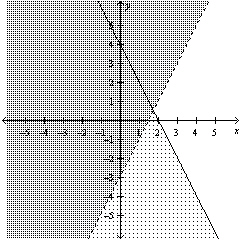 a. | 2x + y  4 4
y <
2x – 3 | b. | 2x + y  4 4
y > 2x
– 3 | c. | 2x + y  4 4
y >
2x – 3 | d. | 2x + y  4 4
y < 2x
– 3 |
|
|
|
9.
|
A vending machine sells juice and pop.
• The machine holds, at most,
200 cans of drinks.
• Sales from the vending machine show that at least 3 cans of juice are
sold for each can of pop.
• Each can of juice sells for $1.50, and each can of pop sells for
$1.00.
Let x represent the number of cans of pop.
Let y represent the number of
cans of juice.
How would you write the objective function for revenue, R?
a. | R = x + 1.50y | b. | R = 1.25x +
y | c. | R = 1.50(x + y) | d. | R = 1.50y –
x |
|
|
|
10.
|
A vending machine sells juice and pop.
• The machine holds, at most,
200 cans of drinks.
• Sales from the vending machine show that at least 3 cans of juice are
sold for each can of pop.
• Each can of juice sells for $1.50, and each can of pop sells for
$1.00.
Let x represent the number of cans of pop.
Let y represent the number of
cans of juice.
Which of the following is a constraint of this optimization problem?
a. | x + y  200 200 | b. | x + y
 200 200 | c. | 2x + y  200 200 | d. | x + 2y  200 200 |
|
|
|
11.
|
Jan volunteers to fold origami frogs and swans for a display.
• She
has 8 squares of green paper for the frogs and 12 squares of white paper for the swans.
• It
takes her 4 min to fold an origami frog and 3 min to fold an origami swan.
• There
must be two swans for every frog.
Let f represent the number of frogs.
Let s
represent the number of swans.
Which of the following is a constraint for this
situation?
|
|
|
12.
|
Jan volunteers to fold origami frogs and swans for a display.
• She
has 8 squares of green paper for the frogs and 12 squares of white paper for the swans.
• It
takes her 4 min to fold an origami frog and 3 min to fold an origami swan.
• There
must be two swans for every frog.
Let f represent the number of frogs.
Let s
represent the number of swans.
Which of the following is a constraint for this
situation?
a. | f = 2s | b. | f > 2s | c. | 2f =
s | d. | 2f < s |
|
|
|
13.
|
Where might you find the maximum solution to the objective
function? Restrictions: x  R y  R Constraints: –2  x x 
4 –2  y y 
4 Objective function: B = 2 y + 3 x
a. | (4, –2) | b. | (4, 4) | c. | (–2,
4) | d. | (–2, –2) |
|
|
|
14.
|
The following model represents an optimization problem. Determine the maximum
solution. Restrictions: x  R y  R Constraints: x > 0 y
< 10 x – y  6 Objective
function: P = 10 x + 2 y
a. | (16, 10) | b. | (0, 10) | c. | (0,
–6) | d. | (20, 14) |
|
|
|
15.
|
A butcher shop makes hamburger patties and sausages. Hamburger patties sell for
$2 and sausage sell for $1.50. The butcher noticed that they always sell at least twice as many
sausages as hamburger patties. Last week they sold 100 hamburger patties.
What is the maximum
amount of profit they can make this week?
a. | There is no maximum. | b. | $300 | c. | $200 | d. | $500 |
|
Short Answer
|
|
|
16.
|
Graph the system of linear inequalities: {( x, y) |
x + y  2, x > –3,
x  W, y 
W}
|
|
|
17.
|
Graph the solution set for the following system of inequalities. {( x,
y) | x + y > 0, x + y < 4, x  R,
y  R}
|
|
|
18.
|
Which point in the model below would result in the maximum value of the
objective function K = 5 x – y? What is the value of K at this
optimal solution? 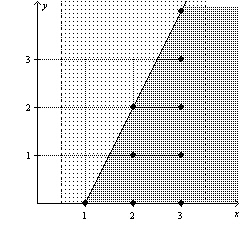
|
Problem
|
|
|
19.
|
A magazine sells full-page and half-page advertisements.
• There can be
no more than 100 pages worth of advertisements.
• No more than 120 half-page advertisements
can be sold.
• At least 25 pages must be full-page advertisement.
• A full-page
advertisement costs $300, and a half-page advertisement costs $200.
What combinations of
advertisements would maximize the magazine’s revenue?
Create a model of this problem.
|
|
|
20.
|
Indy volunteers to fold origami cranes and swans for a display.
• She
has 20 squares of white paper for the cranes and swans.
• It takes her 5 min to fold an
origami crane and 4 min to fold an origami swan.
• There must be at least two swans for
every crane.
• Indy needs a 10 minute break halfway through the job.
She wants to
minimize the time spent doing origami.
a) Create a model to represent this
situation.
b) Suppose that Indy’s given another 5 squares of origami paper. How would
your model change?
|
|
|
21.
|
Andrew has two summer jobs.
• He works no more than a total of 25 h a
week. Both jobs allow him to have flexible hours but in whole hours only.
• At one job,
Andrew works no less than 12 h and earns $9.00/h.
• At the other job, Andrew works no more
than 20 h and earns $8.25/h.
What combination of numbers of hours will allow him to maximize his
earnings? What can he expect to earn?
|