Multiple Choice
Identify the
choice that best completes the statement or answers the question.
|
|
|
1.
|
Which ratios are equivalent for all three side-angle pairs in acute
triangles?
|
|
|
2.
|
In DRST, ÐS
= 54°, s = 91.8 cm, and ÐT = 64°.
Determine the length of side t to the nearest tenth of a centimetre.
a. | 102.4 cm | b. | 102.2 cm | c. | 102.0
cm | d. | 102.6 cm |
|
|
|
3.
|
In DUVW, ÐU
= 50°, v = 19.4 cm, and ÐV = 45°.
Determine the length of side u to the nearest tenth of a centimetre.
a. | 20.0 cm | b. | 18.0 cm | c. | 21.0
cm | d. | 19.0 cm |
|
|
|
4.
|
In DXYZ, ÐX
= 51°, x = 7.0 cm, and ÐZ = 41°.
Determine the length of side y to the nearest tenth of a centimetre.
a. | 11.0 cm | b. | 10.0 cm | c. | 9.0
cm | d. | 8.0 cm |
|
|
|
5.
|
In DABC, a = 4.1 cm, b = 4.4 cm,
and ÐB = 64°.
Determine the measure of ÐC to the nearest degree.
|
|
|
6.
|
Determine the length of EF to the nearest centimetre.
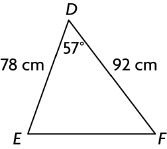 a. | 84 cm | b. | 82 cm | c. | 88
cm | d. | 86 cm |
|
|
|
7.
|
Determine the length of KL to the nearest centimetre.
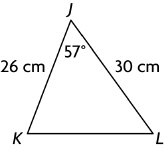 a. | 27 cm | b. | 26 cm | c. | 34
cm | d. | 33 cm |
|
|
|
8.
|
Determine the measure of q to the nearest
degree.
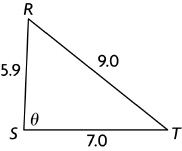
|
|
|
9.
|
In DDEF, d = 13.5 cm, e = 18.2
cm, and ÐF = 60°.
Determine the measure of f
to the nearest tenth of a centimetre.
a. | 17.0 cm | b. | 16.4 cm | c. | 16.6
cm | d. | 16.8 cm |
|
|
|
10.
|
In DDEF, d = 23.9 cm, e = 16.8
cm, and f = 27.0 cm.
Determine the measure of ÐD to
the nearest degree.
|
|
|
11.
|
In a parallelogram, two adjacent sides measure 20 cm and 27 cm.
The shorter
diagonal is 23 cm. Determine, to the nearest degree,
the measures of the larger angles in
the parallelogram.
|
|
|
12.
|
Which pair of angles have the tangent ratio 0.60?
a. | 53°, 127° | b. | 27°, 153° | c. | 0°,
180° | d. | none of the above |
|
|
|
13.
|
Which law could you use to determine the unknown angle in this triangle? 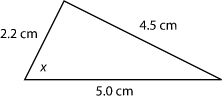 a. | the sine law only | b. | neither the sine law nor the cosine
law | c. | the cosine law only | d. | the sine law and the cosine
law |
|
|
|
14.
|
Which set of measurements can produce two possible triangles?
a. | ÐA = 28°, a = 10.5 m, b =
15.0 m | b. | ÐA = 28°, a = 7.0 m, b =
15.0 m | c. | ÐA = 28°, a = 16.0 m, b =
15.0 m | d. | ÐA = 28°, a = 5.5 m, b =
15.0 m |
|
|
|
15.
|
Which set of measurements will produce just one triangle?
a. | ÐA = 25°, a = 9.4 m, b =
10.0 m | b. | ÐA = 40°, a = 9.4 m, b =
10.0 m | c. | ÐA = 125°, a = 9.4 m, b =
10.0 m | d. | ÐA = 70°, a = 9.4 m, b =
10.0 m |
|
|
|
16.
|
In DXYZ, ÐY = 29°, x = 15.4 m, and y = 12.0 m.
Which
statement is true for this set of measurements?
a. | This is not a SSA situation. | b. | This is a SSA situation; no triangle is
possible. | c. | This is a SSA situation; only one triangle is possible. | d. | This is a SSA
situation; two triangles are possible. |
|
|
|
17.
|
In DFGH, GH = 4.5 cm and G =
15°.
What is the height of the triangle from base GF?
a. | 1.5 cm | b. | 1.3 cm | c. | 1.2
cm | d. | 0.9 cm |
|
|
|
18.
|
In DKLM, LM = 16.0 cm and ÐL = 36°.
What is the height of the triangle from base
LK?
a. | 9.4 cm | b. | 9.2 cm | c. | 8.7 cm
| d. | 8.5 cm. |
|
|
|
19.
|
Which would you use to determine the indicated angle measure? 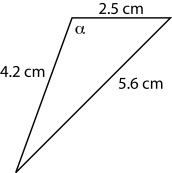 a. | primary trigonometric ratios | b. | the sine law only | c. | the cosine law
only | d. | the sine law or the cosine law |
|
|
|
20.
|
Determine the indicated angle measure to the nearest degree. 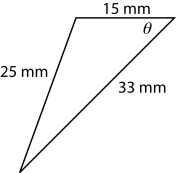
|
Short Answer
|
|
|
21.
|
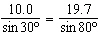
Sketch a triangle that corresponds to the equation. Then, determine the third
angle measure and the third side length.
|
|
|
22.
|
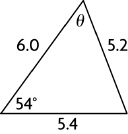
Determine the measure of q to the nearest
degree.
|
|
|
23.
|
In DXYZ, ÐX
= 36°, x = 14.4 cm, and ÐY = 70°.
Determine the length of side y to the nearest tenth of a centimetre.
|
|
|
24.
|
In a parallelogram, two adjacent sides measure 8.4 cm and 7.2 cm. The shorter
diagonal is 10.5 cm. Determine, to the nearest degree, the measures of the larger angles in the
parallelogram.
|
|
|
25.
|
Determine two angles between 0° and 180° that have the sine ratio
0.8480.
|
Problem
|
|
|
26.
|
Determine the perimeter of the regular pentagon to the nearest tenth of a
centimetre. 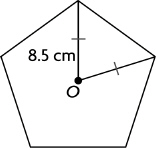
|
|
|
27.
|
A bush pilot delivers supplies to a remote camp
by flying 200 km in the direction N47°E. While at the camp, the pilot receives a radio message
to pick up a passenger at a village. The village is 105 km S21°E from the camp. The pilot
collects the passenger and flies back to his starting point. What is the total distance that the
pilot has flown, to the nearest kilometre?
|
|
|
28.
|
In DQRS, q = 1.7 m, r = 4.3 m,
and s = 5.6 m. Solve DQRS by determining the measure of each
angle to the nearest degree. Show your work and draw DQRS.
|
|
|
29.
|
A landowner claims that her property is triangular, with one side 400 m long and
another side 250 m long. The opposite angle to the 250 m side measures 30°. Determine two
possible lengths of the third side, to the nearest metre. Show your work.
|
|
|
30.
|
A surveyor is measuring the length of a lake. He takes angle measurements from
two positions, A and B, that are 436 m apart, and on opposite sides of the lake. From
B, the measure of the angle between the sight lines to the ends of the lake is 120°, and
the measure of the angle between the sight lines to A and one end of the lake is 105°.
From A, the measure of the angle between the sight lines to the ends of the lake is 50°,
and the measure of the angle between the sight lines to B and the same end of the lake is
16°. Calculate the length of the lake, to the nearest metre. Show your work.
|