Multiple Choice
Identify the
choice that best completes the statement or answers the question.
|
|
|
1.
|
Determine the length of f to the nearest tenth of a
centimetre.
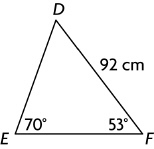 a. | 78.6 cm | b. | 79.0 cm | c. | 79.4
cm | d. | 78.2 cm |
|
|
|
2.
|
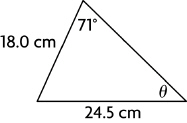
Determine the measure of q to the nearest
degree.
|
|
|
3.
|
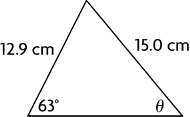
Determine the measure of q to the nearest
degree.
|
|
|
4.
|
Determine the length of EF to the nearest centimetre.
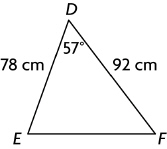 a. | 84 cm | b. | 82 cm | c. | 88
cm | d. | 86 cm |
|
|
|
5.
|
Determine the length of KL to the nearest centimetre.
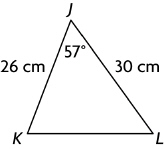 a. | 27 cm | b. | 26 cm | c. | 34
cm | d. | 33 cm |
|
|
|
6.
|
Determine the length of AC to the nearest tenth of a
centimetre.
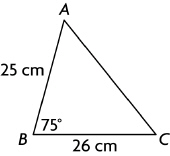 a. | 31.1 cm | b. | 31.0 cm | c. | 30.1
cm | d. | 30.2 cm |
|
|
|
7.
|
In DPQR, r = 52.5 cm, p = 40.0
cm, and ÐQ = 67°.
Determine the measure of q
to the nearest tenth of a centimetre.
a. | 53.2 cm | b. | 55.2 cm | c. | 54.1
cm | d. | 52.1 cm |
|
|
|
8.
|
In DXYZ, x = 18 cm, y = 14 cm,
and z = 17 cm.
Determine the measure of ÐY to the
nearest degree.
|
|
|
9.
|
How you would determine the indicated angle measure, if it is possible? 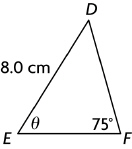 a. | the sine law | b. | not possible | c. | primary
trigonometric ratios | d. | the cosine law |
|
|
|
10.
|
Which one of the following equations is valid?
a. | cos 36° = –cos 144° | b. | cos 36° = –cos
36° | c. | cos 36° = cos 144° | d. | none of the
above |
|
|
|
11.
|
Which pair of angles have the tangent ratio 0.60?
a. | 53°, 127° | b. | 27°, 153° | c. | 0°,
180° | d. | none of the above |
|
|
|
12.
|
Which law could you use to determine the unknown angle in this triangle? 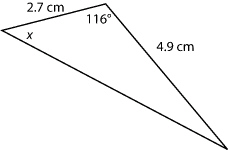 a. | the sine law and the cosine law | b. | the sine law only | c. | neither the sine law
nor the cosine law | d. | the cosine law
only |
|
|
|
13.
|
Which law could you use to determine the unknown angle in this triangle? 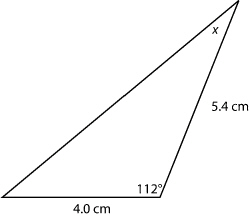 a. | neither the sine law nor the cosine law | b. | the cosine law
only | c. | the sine law and the cosine law | d. | the sine law
only |
|
|
|
14.
|
Determine the unknown angle to the nearest degree. 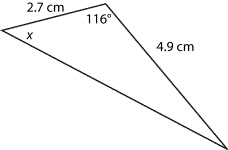 a. | 22° | b. | 52° | c. | none of
these | d. | 42° |
|
|
|
15.
|
Determine the unknown angle measure to the nearest degree. 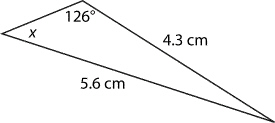 a. | 24° | b. | 54° | c. | 38° | d. | none of these |
|
|
|
16.
|
In DXYZ, ÐY = 29°, x = 15.4 m, and y = 12.0 m.
Which
statement is true for this set of measurements?
a. | This is not a SSA situation. | b. | This is a SSA situation; no triangle is
possible. | c. | This is a SSA situation; only one triangle is possible. | d. | This is a SSA
situation; two triangles are possible. |
|
|
|
17.
|
In DFGH, GH = 4.5 cm and G =
15°.
What is the height of the triangle from base GF?
a. | 1.5 cm | b. | 1.3 cm | c. | 1.2
cm | d. | 0.9 cm |
|
|
|
18.
|
In DOPQ, PQ = 47 mm and ÐP = 47°.
What is the height of the triangle from base
PO?
a. | 32 mm | b. | 34 mm | c. | 35
mm | d. | 39 mm |
|
|
|
19.
|
In DCDE, DE = 9.0 cm and ÐD = 59°.
What is the height of the triangle from base
DC?
a. | 6.8 cm | b. | 7.1 cm | c. | 7.4 cm
| d. | 7.7 cm |
|
|
|
20.
|
Which would you use to determine the indicated angle measure? 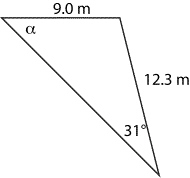 a. | primary trigonometric ratios | b. | the sine law only | c. | the cosine law
only | d. | the sine law or the cosine law |
|
Short Answer
|
|
|
21.
|
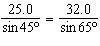
Sketch a triangle that corresponds to the equation. Then, determine the third
angle measure and the third side length.
|
|
|
22.
|
In DLMN, l = 10.0 cm, m = 13.2
cm, and ÐM = 79°.
Determine the measure of ÐL to the nearest degree.
|
|
|
23.
|
Determine the unknown side length to the nearest tenth of a
centimetre. 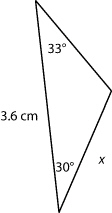
|
|
|
24.
|
In DMNO, ÐN = 19° and NO = 7.1 cm. Calculate the height of the
triangle from base NM to the nearest tenth of a centimetre.
|
|
|
25.
|
What law or property would you use to determine the indicated angle
measure? 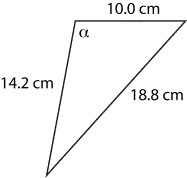
|
Problem
|
|
|
26.
|
Two Jasper National Park rangers in their fire towers spot a fire. Determine
the distances, to the nearest tenth of a kilometre, from each tower to the fire. Show your
work. 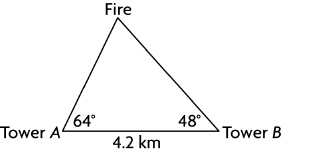
|
|
|
27.
|
A bush pilot delivers supplies to a remote camp
by flying 200 km in the direction N47°E. While at the camp, the pilot receives a radio message
to pick up a passenger at a village. The village is 105 km S21°E from the camp. The pilot
collects the passenger and flies back to his starting point. What is the total distance that the
pilot has flown, to the nearest kilometre?
|
|
|
28.
|
Determine the perimeter of this quadrilateral to the nearest tenth of a
centimetre. 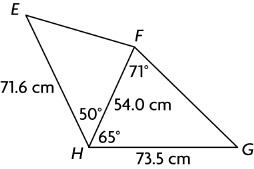
|
|
|
29.
|
In DMNO, ÐN = 43° and NO = 12.4 cm.
Calculate the height of
the triangle from base NM, to the nearest tenth of a centimetre.
Determine the possible
lengths of side OM, so that there are zero, one, or two triangles that satisfy these
conditions. Draw each triangle to support your answer.
|
|
|
30.
|
A landowner says that his property is triangular, with one side 500 m long and
another side 350 m long. The opposite angle to the 350 m side measures 20°. Determine two
possible lengths of the third side, to the nearest metre. Show your work.
|