Multiple Choice
Identify the
choice that best completes the statement or answers the question.
|
|
|
1.
|
Solve for the unknown side length. Round your answer to one decimal
place. 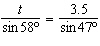
|
|
|
2.
|
In DDEF, ÐD
= 61°, d = 23.9 cm, and ÐE = 38°.
Determine the length of side e to the nearest tenth of a centimetre.
a. | 16.8 cm | b. | 16.0 cm | c. | 17.6
cm | d. | 18.4 cm |
|
|
|
3.
|
In DXYZ, ÐX
= 51°, x = 7.0 cm, and ÐZ = 41°.
Determine the length of side y to the nearest tenth of a centimetre.
a. | 11.0 cm | b. | 10.0 cm | c. | 9.0
cm | d. | 8.0 cm |
|
|
|
4.
|
Determine the length of EF to the nearest centimetre.
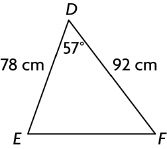 a. | 84 cm | b. | 82 cm | c. | 88
cm | d. | 86 cm |
|
|
|
5.
|
In DDEF, d = 23.9 cm, e = 16.8
cm, and f = 27.0 cm.
Determine the measure of ÐD to
the nearest degree.
|
|
|
6.
|
In DXYZ, x = 18 cm, y = 14 cm,
and z = 17 cm.
Determine the measure of ÐY to the
nearest degree.
|
|
|
7.
|
How you would determine the indicated angle measure, if it is possible? 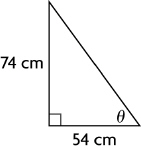 a. | the sine law | b. | not possible | c. | primary
trigonometric ratios | d. | the cosine law |
|
|
|
8.
|
How you would determine the indicated side length, if it is possible? 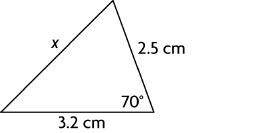 a. | the cosine law | b. | primary trigonometric
ratios | c. | not possible | d. | the sine law |
|
|
|
9.
|
Calculate tan 25° to four decimal places. Predict another term that equals
tan 20°.
a. | 0.4663; –tan 155° | b. | 0.4663; tan 155° | c. | –0.4663; tan
155° | d. | –0.4663; –tan 155° |
|
|
|
10.
|
Which law could you use to determine the unknown angle in this triangle? 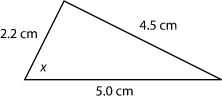 a. | the sine law only | b. | neither the sine law nor the cosine
law | c. | the cosine law only | d. | the sine law and the cosine
law |
|
|
|
11.
|
Determine the unknown angle to the nearest degree. 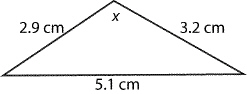
|
|
|
12.
|
Determine the unknown side length to the nearest centimetre. 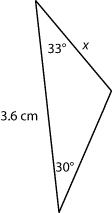 a. | 2.5 cm | b. | 1.8 cm | c. | 2.3
cm | d. | 2.0 cm |
|
|
|
13.
|
Determine the unknown side length to the nearest centimetre. 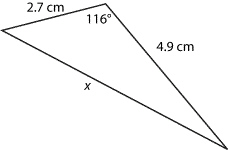 a. | 6.1 cm | b. | 6.5 cm | c. | 5.9
cm | d. | 6.8 cm |
|
|
|
14.
|
Determine the unknown side length to the nearest centimetre. 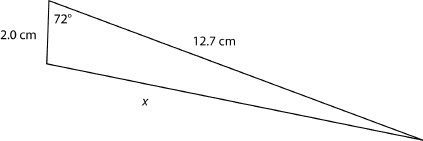 a. | 11.4 cm | b. | 10.8 cm | c. | 12.0
cm | d. | 12.2 cm |
|
|
|
15.
|
In DPQR, ÐP = 18°, q = 4.5 m, and r = 6.0 m.
Which
statement is true for this set of measurements?
a. | This is not a SSA situation. | b. | This is a SSA situation; no triangle is
possible. | c. | This is a SSA situation; only one triangle is possible. | d. | This is a SSA
situation; two triangles are possible. |
|
|
|
16.
|
In DJKL, ÐJ = 115°, k = 6.2 m, and j = 5.5 m.
Which
statement is true for this set of measurements?
a. | This is not a SSA situation. | b. | This is a SSA situation; no triangle is
possible. | c. | This is a SSA situation; only one triangle is possible. | d. | This is a SSA
situation; two triangles are possible. |
|
|
|
17.
|
Which would you use to determine the indicated angle measure? 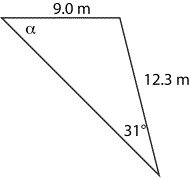 a. | primary trigonometric ratios | b. | the sine law only | c. | the cosine law
only | d. | the sine law or the cosine law |
|
|
|
18.
|
Determine the indicated angle measure to the nearest degree. 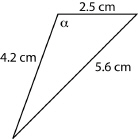
|
|
|
19.
|
Determine the indicated side length to the nearest tenth of a
centimetre. 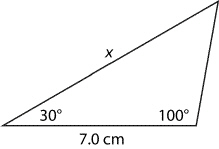
a. | 8.0 cm | b. | 8.5 cm | c. | 9.0
cm | d. | cannot be determined |
|
|
|
20.
|
Determine the indicated side length to the nearest tenth of a metre. 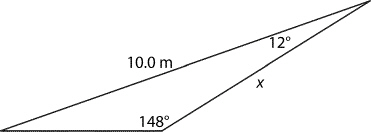
a. | 5.1 m | b. | 6.5 m | c. | 8.0
m | d. | cannot be determined |
|
Short Answer
|
|
|
21.
|
Solve for the unknown angle measure. Round your answer to the nearest
degree.

|
|
|
22.
|
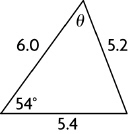
Determine the measure of q to the nearest
degree.
|
|
|
23.
|
Determine the unknown side length to the nearest tenth of a
centimetre. 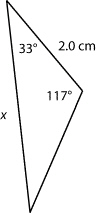
|
|
|
24.
|
What law or property would you use to determine the indicated side
length? 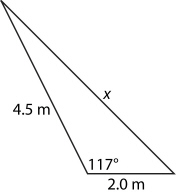
|
|
|
25.
|
What law or property would you use to determine the indicated angle
measure? 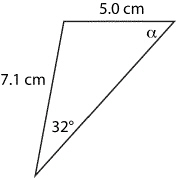
|
Problem
|
|
|
26.
|
A radio tower is supported by two wires on opposite sides. On the ground,
the ends of the wire are 235 m apart. One wire makes a 75° angle with the ground.
The
other makes a 55° angle with the ground.
Draw a diagram of the situation. Then, determine
the length of each wire to the nearest metre. Show your work.
|
|
|
27.
|
Determine, to the nearest centimetre, the perimeter of the triangle. 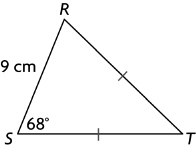
|
|
|
28.
|
A pilot leaves Eton Lake Airport and flies to
Foxford at a constant speed of 450 km/h. She knows that the distance from Dundalk to Eton Lake
is 1350 km N40°W and the distance from Dundalk to Foxford is 880 km S75°W.
Determine
the duration of the flight, to the nearest minute.
|
|
|
29.
|
A building is observed from two points, P and Q, that are 134.0 m
apart. The angle of elevation is 35° at P and 27° at Q. Sketch the situation.
Determine the height of the building to the nearest tenth of a metre.
|
|
|
30.
|
A canoeist leaves the dock and paddles toward a buoy 220 m away. After reaching
the buoy, he changes directions and paddles another 180 m. From the dock, the angle between the buoy
and the canoeist’s current position measures 35°. How far is the canoeist from the dock?
Give two possible answers. Show your work.
|