Multiple Choice
Identify the
choice that best completes the statement or answers the question.
|
|
|
1.
|
Determine the length of c to the nearest tenth of a
centimetre.
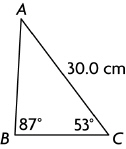 a. | 23.0 cm | b. | 25.0 cm | c. | 24.0
cm | d. | 26.1 cm |
|
|
|
2.
|
Determine the length of f to the nearest tenth of a
centimetre.
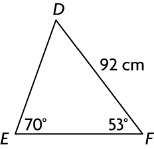 a. | 78.6 cm | b. | 79.0 cm | c. | 79.4
cm | d. | 78.2 cm |
|
|
|
3.
|
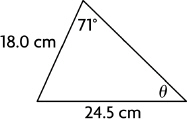
Determine the measure of q to the nearest
degree.
|
|
|
4.
|
In DRST, ÐS
= 54°, s = 91.8 cm, and ÐT = 64°.
Determine the length of side t to the nearest tenth of a centimetre.
a. | 102.4 cm | b. | 102.2 cm | c. | 102.0
cm | d. | 102.6 cm |
|
|
|
5.
|
In DDEF, d = 10.0 cm, e = 8.6
cm, and ÐE = 45°.
Determine the measure of ÐD to the nearest degree.
|
|
|
6.
|
In DQRS, q = 10.0 cm, s = 9.0
cm, and ÐS = 61°.
Determine the measure of ÐQ to the nearest degree.
|
|
|
7.
|
What information do you need to know about an acute triangle to use the cosine
law?
a. | two sides and any angle | b. | two angles and any side | c. | all the
angles | d. | all the sides |
|
|
|
8.
|
Determine the length of PQ to the nearest tenth of a
centimetre.
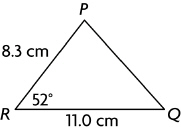 a. | 9.4 cm | b. | 9.1 cm | c. | 8.5
cm | d. | 8.8 cm |
|
|
|
9.
|
In DDEF, d = 23.9 cm, e = 16.8
cm, and f = 27.0 cm.
Determine the measure of ÐD to
the nearest degree.
|
|
|
10.
|
Which one of the following equations is valid?
a. | sin 45° = –sin 135° | b. | sin 45° = sin
135° | c. | sin 45° = –sin 45° | d. | none of the
above |
|
|
|
11.
|
Which one of the following equations is valid?
a. | cos 36° = –cos 144° | b. | cos 36° = –cos
36° | c. | cos 36° = cos 144° | d. | none of the
above |
|
|
|
12.
|
Calculate sin 16° to four decimal places. Predict another term that equals
sin 16°.
a. | –0.2756; sin 164° | b. | 0.2576; sin 164° | c. | 0.2756; –sin
16° | d. | none of the above |
|
|
|
13.
|
Which law could you use to determine the unknown side length in this
triangle? 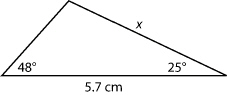 a. | neither the sine law nor the cosine law | b. | the sine law
only | c. | the cosine law only | d. | the sine law and the cosine
law |
|
|
|
14.
|
Which law could you use to determine the unknown angle in this triangle? 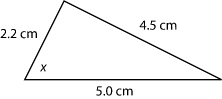 a. | the sine law only | b. | neither the sine law nor the cosine
law | c. | the cosine law only | d. | the sine law and the cosine
law |
|
|
|
15.
|
Determine the unknown side length to the nearest centimetre. 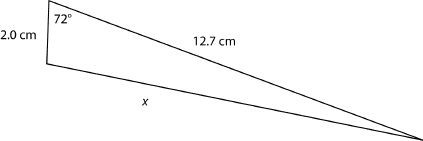 a. | 11.4 cm | b. | 10.8 cm | c. | 12.0
cm | d. | 12.2 cm |
|
|
|
16.
|
Which set of measurements will produce one right triangle with b as the
hypotenuse?
a. | ÐA = 60°, a = 10.4 m, b =
12.0 m | b. | ÐA = 60°, a = 11.6 m, b =
12.0 m | c. | ÐA = 60°, a = 8.7 m, b =
12.0 m | d. | ÐA = 60°, a = 14.5 m, b =
12.0 m |
|
|
|
17.
|
Which set of measurements will produce just one triangle?
a. | ÐA = 25°, a = 9.4 m, b =
10.0 m | b. | ÐA = 40°, a = 9.4 m, b =
10.0 m | c. | ÐA = 125°, a = 9.4 m, b =
10.0 m | d. | ÐA = 70°, a = 9.4 m, b =
10.0 m |
|
|
|
18.
|
Which set of measurements can produce two possible triangles?
a. | ÐA = 48°, a = 4.2 m, b =
5.0 m | b. | ÐA = 48°, a = 8.2 m, b =
13.0 m | c. | ÐA = 48°, a = 5.2 m, b =
7.0 m | d. | ÐA = 35°, a = 10.8 m, b =
8.0 m |
|
|
|
19.
|
In DJKL, ÐJ = 115°, k = 6.2 m, and j = 5.5 m.
Which
statement is true for this set of measurements?
a. | This is not a SSA situation. | b. | This is a SSA situation; no triangle is
possible. | c. | This is a SSA situation; only one triangle is possible. | d. | This is a SSA
situation; two triangles are possible. |
|
|
|
20.
|
Determine the indicated angle measure to the nearest degree. 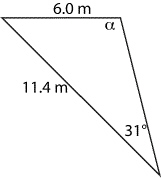 a. | 98° | b. | 100° | c. | 102° | d. | cannot be
determined |
|
Short Answer
|
|
|
21.
|
How long, to the nearest inch, is the right rafter in the roof shown? 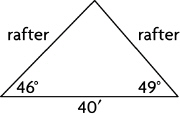
|
|
|
22.
|
Determine the unknown angle measure to the nearest degree. 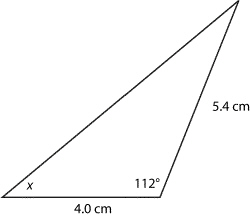
|
|
|
23.
|
Determine the unknown angle measure to the nearest degree. 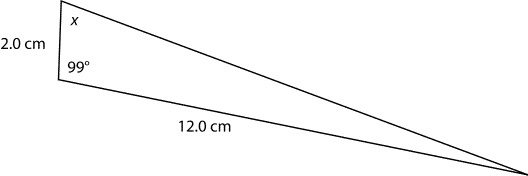
|
|
|
24.
|
In DPQR, ÐP = 36°, p = 9.0 cm, and q = 6.5 cm. Does this
involve the SSA situation? If so, how many triangles with the given measurements are possible?
Draw the triangle(s) to support your answer.
|
|
|
25.
|
What law or property would you use to determine the indicated angle
measure? 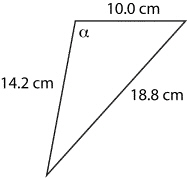
|
Problem
|
|
|
26.
|
Determine the perimeter of the triangle to the nearest tenth of a
centimetre. 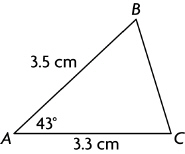
|
|
|
27.
|
A building is observed from two points, P and Q, that are 134.0 m
apart. The angle of elevation is 35° at P and 27° at Q. Sketch the situation.
Determine the height of the building to the nearest tenth of a metre.
|
|
|
28.
|
A farmer finishes repairing a fence post and then walks 180 yd through her corn
field. She turns and walks another 240 yd west, until she can see the fence post directly southeast
of her. She realizes that she left some of her tools at the fence post and heads directly back to it.
How far does she need to walk, to the nearest metre?
|
|
|
29.
|
Two forest-fire towers, A and B, are 18.9 km apart. From tower
A, the compass heading for tower B is S78°E. The ranger in each tower sees the
same forest fire. The heading of the fire from tower A is N43°E. The heading of the fire
from tower B is N48°W. How far, to the nearest tenth of a kilometre, is the fire from
each tower? Include a rough sketch in your solution.
|
|
|
30.
|
Two forest-fire towers, A and B, are 5.4 km apart. From tower
A, the compass heading for tower B is S62°E. The ranger in each tower sees the
same forest fire. The heading of the fire from tower A is N78°E. The heading of the fire
from tower B is N42°W. How far, to the nearest tenth of a kilometre, is the fire from
each tower? Include a rough sketch in your solution.
|