Multiple Choice
Identify the
choice that best completes the statement or answers the question.
|
|
|
1.
|
Emma works part-time at a bakery shop in Saskatoon. Today, the baker
made 20
apple pies, 20 cherry pies, and 20 bumbleberry pies.
Which conjecture is Emma most likely to make
from this evidence?
a. | People are more likely to buy bumbleberry pie than any other pie. | b. | People are more
likely to buy apple pie than any other pie. | c. | Each type of pie will sell equally as well as
the others. | d. | People are more likely to buy cherry pie than any other
pie. |
|
|
|
2.
|
Which conjecture, if any, could you make about the
sum of three odd integers?
a. | The sum will be an even integer. | b. | The sum will be an odd
integer. | c. | The sum will be negative. | d. | It is not possible to make a
conjecture. |
|
|
|
3.
|
Which conjecture, if any, could you make about the
product of two odd integers?
a. | The product will be an even integer. | b. | The product will be an odd
integer. | c. | The product will be negative. | d. | It is not possible to make a
conjecture. |
|
|
|
4.
|
Rosie made the following conjecture. All polygons with five equal sides are
regular pentagons. Which figure, if either, is a counterexample to this
conjecture? 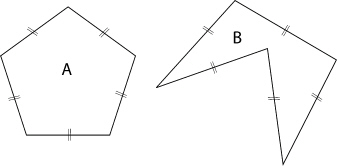 a. | Figure B only | b. | Figure A only | c. | Neither Figure A nor
Figure B | d. | Figure A and Figure B |
|
|
|
5.
|
Sasha made the following conjecture: All polygons with six equal sides are regular
hexagons. Which figure, if either, is a counterexample to this conjecture?
Explain. 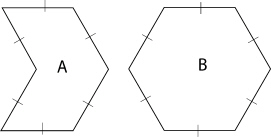 a. | Figure A is a counterexample, because all six sides are equal and it is a regular
hexagon. | b. | Figure B is a counterexample, because all six sides are equal and it is a regular
hexagon. | c. | Figure B is a counterexample, because all six sides are equal and it is not a regular
hexagon. | d. | Figure A is a counterexample, because all six sides are equal and it is not a regular
hexagon. |
|
|
|
6.
|
Isabelle is a manicurist. Everyone whose nails
are done by Isabelle gets a good manicure. Ginerva’s nails were done by Isabelle. What can be
deduced about Ginerva?
1. Ginerva has a good manicure. 2. Ginerva is a
manicurist. a. | Choice 2 only | b. | Choice 1 only | c. | Neither Choice 1 nor
Choice 2 | d. | Choice 1 and 2 |
|
|
|
7.
|
Hali is a fitness instructor. People who take
Hali’s exercise class regularly soon become very fit. Regular exercise makes people feel happy.
Joshua takes Hali’s exercise class regularly. What can be deduced about
Joshua?
1. Joshua is very fit. 2. Joshua feels happy. a. | Choice 2 only | b. | Choice 1 only | c. | Neither Choice 1 nor
Choice 2 | d. | Choice 1 and Choice 2 |
|
|
|
8.
|
What type of error, if any, occurs in the
following proof?
2 = 2 + 2
4(2) = 4(2 + 2)
4(2) +
3 = 4(2 + 2) + 3
8 +
3 = 16 + 3
11 = 19
a. | a false assumption or generalization | b. | an error in reasoning | c. | an error in
calculation | d. | There is no error in the proof. |
|
|
|
9.
|
What type of error, if any, occurs in the
following proof?
SIX = 6 | I know that
“six” and “6” are different ways of writing the same thing. | IX =
9 | In roman numerals, IX represents the number 9. | SIX has more letters than IX. | Therefore, SIX must be
greater than IX. | 6 >
9 | | | |
a. | a false assumption or generalization | b. | an error in reasoning | c. | an error in
calculation | d. | There is no error in the proof. |
|
|
|
10.
|
Which type of reasoning does the following statement
demonstrate?
All birds have
feathers.
Robins are birds.
Therefore, robins have feathers.
a. | inductive reasoning | b. | neither inductive nor deductive
reasoning | c. | deductive reasoning |
|
|
|
11.
|
Determine the unknown term in this pattern.
3, 6, 12, 24, ____, 96,
192
|
|
|
12.
|
Determine the unknown term in this pattern.
101, 1001, 10001, _____,
1000001, 10000001, 100000001
a. | 100000 | b. | 100001 | c. | 110011 | d. | 111111 |
|
|
|
13.
|
Choose the next figure in this sequence. | | | | | | Figure 1 | Figure 2 | Figure 3 | Figure 4 | Figure 5 | Figure 6 | | | | | | |
|
|
|
14.
|
Which number should appear in the centre of Figure 4? | | | | Figure 1 | Figure 2 | Figure 3 | Figure 4 | | | | |
|
|
|
15.
|
Fred and Ethel are playing darts. Ethel has a score of 16. To win, she must reduce her score to zero and have her last
counting dart be a double.
Which of the following scores on the dart board, in order, would give
her the win? | 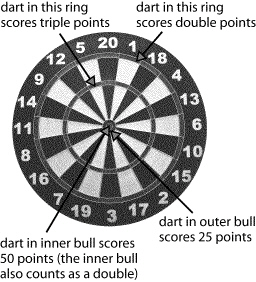 | | |
a. | triple 2, triple 2, double 3 | b. | 2, 2, 6 | c. | 4, 4, double
4 | d. | 4, triple 4 |
|
Short Answer
|
|
|
16.
|
Star claims that whenever you add an odd integer
to the square of
an odd integer, the result is an odd number. Is her conjecture
reasonable?
Briefly justify your decision.
|
|
|
17.
|
Kendra made the following conjecture: The sum of any three integers is greater than
each integer.
Do you agree or disagree? Briefly justify your decision with a
counterexample if possible.
|
|
|
18.
|
What type of error occurs in the following deduction? Briefly justify your
answer. Jay-Qs likes to watch videos by Émail Zola.
Therefore, the next video Jay-Qs watches will be by Émail Zola.
|
Problem
|
|
|
19.
|
Jessica found an interesting numeric pattern: 1 • 5 +
1 = 6 • 1
2 • 5 +
2 = 6 • 2
3 • 5 +
3 = 6 • 3
4 • 5 +
4 = 6 • 4
Do you think the pattern will continue? Justify your decision
with a counterexample if possible.
|
|
|
20.
|
The divisibility rule for 9 is:
If the sum of the digits of a number is divisible by 9,
then the original number is divisible by 9.
Prove this
rule is true for numbers with four digits.
|
|
|
21.
|
Art tried this number trick:
• Write down your street
number.
• Multiply by 2.
• Add the number of days in a week.
• Multiply by
50.
• Add the last two digits of your phone number.
• Subtract the number of days
in a year.
• Add 15.
Art’s result was a number in which the tens and ones
digits were the last digits of his phone number and the rest of the digits were his street number. He
tried to prove why this works, but his final expression did not make sense.
Let n
represent any street number.
2n Multiply by 2.
2n
+ 7 Add the number of days in a week.
100n +
7 Multiply by 50.
Let p represent the last two numbers of the
phone number.
100n + 7 + p Add phone number
digits.
100n + p – 358 Subtract the number of
days in a year.
100n + p – 343 Add
15.
Determine the errors in Art’s proof, and then correct them.
|