Multiple Choice
Identify the
choice that best completes the statement or answers the question.
|
|
|
1.
|
Which conjecture, if any, could you make about the
product of two odd integers?
a. | The product will be an even integer. | b. | The product will be an odd
integer. | c. | The product will be negative. | d. | It is not possible to make a
conjecture. |
|
|
|
2.
|
Jackie made the following conjecture. The square of a number is always greater than
the number.
Which choice, if either, is a counterexample to this
conjecture?
1. 0.52 =
0.25
2. (–5)2 = 25
a. | Choice 1 and Choice 2 | b. | Choice 2 only | c. | Neither Choice 1 nor
Choice 2 | d. | Choice 1 only |
|
|
|
3.
|
Rosie made the following conjecture. All polygons with five equal sides are
regular pentagons. Which figure, if either, is a counterexample to this
conjecture? 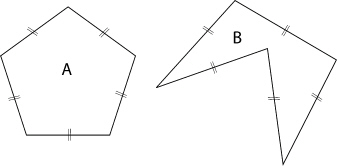 a. | Figure B only | b. | Figure A only | c. | Neither Figure A nor
Figure B | d. | Figure A and Figure B |
|
|
|
4.
|
Attila made the following conjecture: The difference between two numbers always
lies between the two numbers.
Is the following equation a counterexample to this conjecture?
Explain.
6 – 2 = 4
a. | No, it is not a counterexample, because 4 lies between 2 and 6. | b. | Yes, it is a
counterexample, because 4 does not lie between 2 and 6. | c. | Yes, it is a
counterexample, because 4 lies between 2 and 6. | d. | No, it is not a counterexample, because 4 does
not lie between 2 and 6. |
|
|
|
5.
|
Which of the following choices, if any, uses
inductive reasoning to show
that the sum of two odd integers is even?
a. | (2x + 1) + (2y + 1) = 2(x + y + 1) | b. | 2x +
2y + 1 = 2(x + y) + 1 | c. | None of the above choices | d. | 3 + 5 = 8 and 7 + 5
= 12 |
|
|
|
6.
|
What type of error, if any, occurs in the
following proof?
2 = 2
4(2) = 4(1 + 1)
4(2) +
3 = 4(1 + 1) + 3
8 +
3 = 6 + 3
11 = 9
a. | a false assumption or generalization | b. | an error in reasoning | c. | an error in
calculation | d. | There is no error in the proof. |
|
|
|
7.
|
What type of error, if any, occurs in the
following proof?
5 = 5
2.5(5) = 2.5(2 + 3)
2.5(5) +
1 = 2.5(2 + 3) + 1
12.5 +
1 = 10 + 4
13.5 = 14
a. | a false assumption or generalization | b. | an error in reasoning | c. | an error in
calculation | d. | There is no error in the proof. |
|
|
|
8.
|
Which type of reasoning does the following statement
demonstrate?
Over the past 11 years, a tree has produced
peaches each year.
Therefore, the tree will produce peaches this
year.
a. | inductive reasoning | b. | deductive reasoning | c. | neither inductive
nor deductive reasoning |
|
|
|
9.
|
Determine the unknown term in this pattern.
8, 17, 14, 23, ____, 29, 26,
35
|
|
|
10.
|
Choose the next figure in this sequence. | | | | | | Figure 1 | Figure 2 | Figure 3 | Figure 4 | Figure 5 | Figure 6 | | | | | | |
|
|
|
11.
|
Which number should go in the grey square in this Sudoku puzzle? 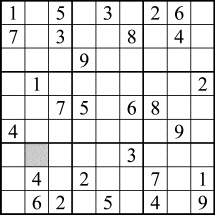
|
|
|
12.
|
In a leapfrog puzzle, coloured counters are moved along a space on a board.
A counter can move into an empty space. A counter can leapfrog over another counter into an
empty space. Board at start:  Board at end:  What would be the
minimum number of moves needed to exchange 6 red counters with 6 blue counters?
|
|
|
13.
|
Emma and Alexander are playing darts. Emma has a score of 37. To win, she must reduce her score to zero and have her last
counting dart be a double.
Which of the following scores on the dart board, in order, would give
her the win? | 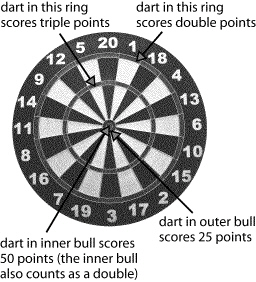 | | |
a. | 15, 16, 6 | b. | 8, 7, double 10 | c. | double 11, 6,
9 | d. | 9, 6, double 11 |
|
|
|
14.
|
Mary and Victor are playing darts. Mary has a score of 45. To win, she must reduce her score to zero and have her last
counting dart be a double.
Which of the following scores on the dart board, in order, would
not give her the win? | 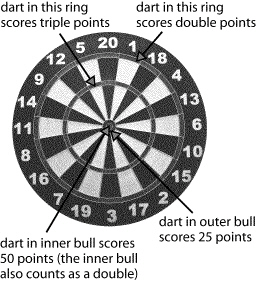 | | |
a. | 1, 4, double 20 | b. | 15, 20, double 5 | c. | 20, 5, double
10 | d. | double 15, 5, 10 |
|
|
|
15.
|
Fred and Ethel are playing darts. Ethel has a score of 16. To win, she must reduce her score to zero and have her last
counting dart be a double.
Which of the following scores on the dart board, in order, would give
her the win? | 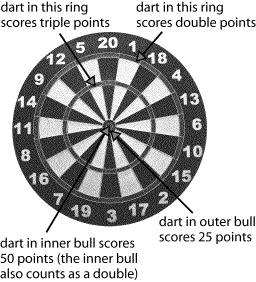 | | |
a. | triple 2, triple 2, double 3 | b. | 2, 2, 6 | c. | 4, 4, double
4 | d. | 4, triple 4 |
|
Short Answer
|
|
|
16.
|
Does the following statement demonstrate inductive reasoning or deductive
reasoning?
For the pattern 4, 13, 22, 31, 40, the next term is 49.
|
|
|
17.
|
What number should go in the grey square in this Sudoku puzzle? 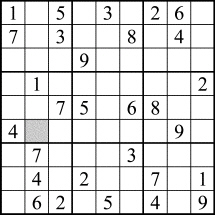
|
|
|
18.
|
What number should go in the grey square in this Sudoku puzzle? 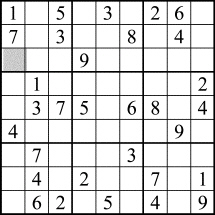
|
Problem
|
|
|
19.
|
Akilah, Barbara, Cathy, and Donna all go to the same high school. One likes
history the best, one likes math the best, one likes computer science the best, and one likes English
the best. Use the statements below to determine who likes computer science the best.
•
Akilah and Cathy eat lunch with the student who likes computer science.
• Donna likes
history the best.
|
|
|
20.
|
Each letter in the sentence about mathematics below represents a different
letter of the alphabet. Use reasoning to decipher the quote.
Hint 1: D = T and U = R.
Hint
2: Some words in the sentences above, including a word with 11 letters, appear in the
quote.
E DUERVIN CM YEDAVYEDZOG
ZG E QVELDZMLP
OCJHVODLUV
ULZJVI QN EJ LRPN MEOD.
|
|
|
21.
|
In a magic square, the columns, rows, and diagonals all add up to the same
total. Use the natural numbers from 1 to 25 to complete this magic square. Use each number only
once. 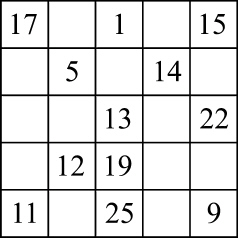
|