Multiple Choice
Identify the
choice that best completes the statement or answers the question.
|
|
|
1.
|
Which conjecture, if any, could you make about the product of an odd integer
and an even integer?
a. | The product will be an even integer. | b. | The product will be an odd
integer. | c. | The product will be negative. | d. | It is not possible to make a
conjecture. |
|
|
|
2.
|
Eileen studied the sum of the angles in pentagons and made a conjecture.
Which conjecture, if any, did she most likely make? 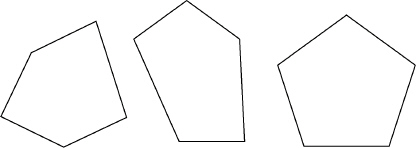 a. | The sum of the angles in a pentagon is always 180°. | b. | The sum of the
angles in a pentagon is always 360°. | c. | The sum of the angles in a pentagon is always
540°. | d. | It is not possible to make a conjecture. |
|
|
|
3.
|
Jackie made the following conjecture. The square of a number is always greater than
the number.
Which choice, if either, is a counterexample to this
conjecture?
1. 0.52 =
0.25
2. (–5)2 = 25
a. | Choice 1 and Choice 2 | b. | Choice 2 only | c. | Neither Choice 1 nor
Choice 2 | d. | Choice 1 only |
|
|
|
4.
|
Rosie made the following conjecture. All polygons with five equal sides are
regular pentagons. Which figure, if either, is a counterexample to this
conjecture? 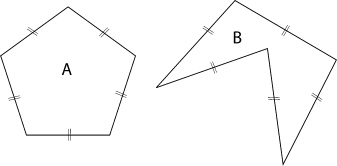 a. | Figure B only | b. | Figure A only | c. | Neither Figure A nor
Figure B | d. | Figure A and Figure B |
|
|
|
5.
|
Which of the following choices, if any, uses
deductive reasoning to show
that an odd number and an even number sum to an odd
number?
a. | (2x + 1) + 2y = 2(x + y) + 1 | b. | 2x +
2y + 1 = 2(x + y + 1) | c. | 3 + 6 = 9 and 4 + 5 =
9 | d. | None of the above
choices |
|
|
|
6.
|
What type of error, if any, occurs in the
following proof?
3 = 3 – 1
2(3) = 2(3 – 1)
2(3) +
1 = 2(3 –1) + 1
6 +
1 = 4 + 1
7 = 5
a. | a false assumption or generalization | b. | an error in reasoning | c. | an error in
calculation | d. | There is no error in the proof. |
|
|
|
7.
|
What type of error, if any, occurs in the
following proof?
Suppose
that: x + y = z
Then: (3x – 2x) + (3y –
2y) = (3z –
2z)
Reorganize: 3x + 3y –
3z = 2x + 2y – 2z
Using
distribution: 3(x + y –
z) = 2(x + y –
z)
3 = 2
a. | a false assumption or generalization | b. | an error in reasoning | c. | an error in
calculation | d. | There is no error in the proof. |
|
|
|
8.
|
What type of error, if any, occurs in the
following proof?
SIX = 6 | I know that
“six” and “6” are different ways of writing the same thing. | IX =
9 | In roman numerals, IX represents the number 9. | SIX has more letters than IX. | Therefore, SIX must be
greater than IX. | 6 >
9 | | | |
a. | a false assumption or generalization | b. | an error in reasoning | c. | an error in
calculation | d. | There is no error in the proof. |
|
|
|
9.
|
Which type of reasoning does the following statement
demonstrate?
Over the past 11 years, a tree has produced
peaches each year.
Therefore, the tree will produce peaches this
year.
a. | inductive reasoning | b. | deductive reasoning | c. | neither inductive
nor deductive reasoning |
|
|
|
10.
|
Which type of reasoning does the following statement
demonstrate?
Every multiple of 9 has a factor of
3.
27 is a multiple of 9.
Therefore, 27 has a factor of 3.
a. | inductive reasoning | b. | deductive reasoning | c. | neither inductive
nor deductive reasoning |
|
|
|
11.
|
Determine the unknown term in this pattern.
2, 6, 18, 54, ____, 486,
1458
|
|
|
12.
|
Determine the unknown term in this pattern.
1, 1, 2, 3, 5, ____, 13,
21
|
|
|
13.
|
Which number should go in the grey square in this Sudoku puzzle? 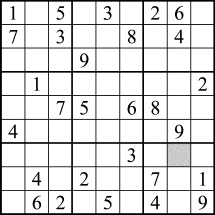
|
|
|
14.
|
In a Kakuro puzzle, you fill in the empty squares with the numbers from 1 to 9.
• Each row of squares must
add up to the circled number to the left of it.
• Each column
of squares must add up the circled number above it.
• A number
cannot appear more than once in the same sum.
Complete
this Kakuro puzzle by filling in the grey squares.
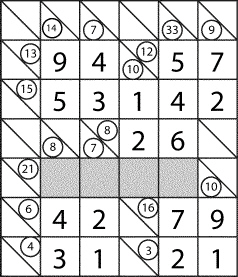 a. | 9, 7, 4, 1 | b. | 1, 4, 8, 8 | c. | 2, 3, 7,
9 | d. | 1, 4, 7, 9 |
|
|
|
15.
|
Emma and Alexander are playing darts. Emma has a score of 37. To win, she must reduce her score to zero and have her last
counting dart be a double.
Which of the following scores on the dart board, in order, would give
her the win? | 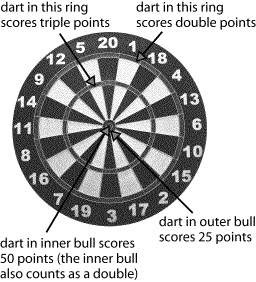 | | |
a. | 15, 16, 6 | b. | 8, 7, double 10 | c. | double 11, 6,
9 | d. | 9, 6, double 11 |
|
Short Answer
|
|
|
16.
|
Abria made the following conjecture: All people who can skate well are
professional hockey players.
Do you agree or disagree? Briefly justify your decision
with a counterexample if possible.
|
|
|
17.
|
Does the following statement demonstrate inductive reasoning or deductive
reasoning?
All reptiles have scales. Crocodiles are reptiles. Therefore, crocodiles have
scales.
|
|
|
18.
|
Draw the next figure in this sequence.
|
Problem
|
|
|
19.
|
Blake discovered a number trick in a book he was
reading:
Choose a number.
Subtract
2.
Multiply by 3.
Add
9.
Multiply by 3.
Subtract
9.
Divide by 9.
Prove deductively that any number you choose
will be the final result.
|
|
|
20.
|
Eldon, Pierre, Manny, and Burt swam a race. Early in the race, Eldon led Pierre
by
3 m, while Manny was behind Burt by 2 m. Burt was ahead of Pierre by 1 m. By the halfway
point, Eldon and Burt had exchanged places, although they were still the same distance apart. Manny
had pulled even with Eldon. Over the last part of the race, Manny dropped 1 m behind Eldon, and
Pierre passed Burt. Who finished third?
|
|
|
21.
|
A set of 10 cards, each showing one of the digits from 0 to 9, is divided
between five envelopes so that there are two cards in each envelope. The sum of the cards inside each
envelope is written on the envelope: 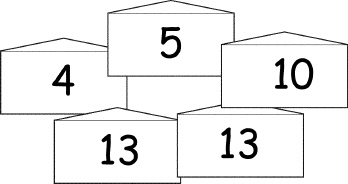 What pair of cards is definitely
in an envelope marked 13? Explain.
|