Multiple Choice
Identify the
choice that best completes the statement or answers the question.
|
|
|
1.
|
Which conjecture, if any, could you make about the sum of two odd integers
and one even integer?
a. | The sum will be an even integer. | b. | The sum will be an odd
integer. | c. | The sum will be negative. | d. | It is not possible to make a
conjecture. |
|
|
|
2.
|
Guilia created the following table to show a pattern. | Multiples of 9 | 18 | 27 | 36 | 45 | 54 | | Sum of the Digits | 9 | 9 | 9 | 9 | 9 | | | | | | |
Which conjecture could Guilia make, based solely on this evidence?
Choose the best answer. a. | The sum of the digits of a multiple of 9 is divisible by 9. | b. | The sum of the
digits of a multiple of 9 is an odd integer. | c. | The sum of the digits of a multiple of 9 is
equal to 9. | d. | Guilia could make any of the above conjectures, based on this
evidence.. |
|
|
|
3.
|
Jackie made the following conjecture. The square of a number is always greater than
the number.
Which choice, if either, is a counterexample to this
conjecture?
1. 0.52 =
0.25
2. (–5)2 = 25
a. | Choice 1 and Choice 2 | b. | Choice 2 only | c. | Neither Choice 1 nor
Choice 2 | d. | Choice 1 only |
|
|
|
4.
|
Tashi made the following conjecture. All polygons with equal sides are
regular. Which figure, if either, is a counterexample to this conjecture? 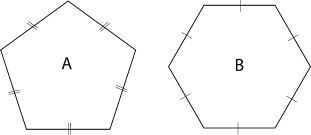 a. | Figure A and Figure B | b. | Figure B only | c. | Neither Figure A nor
Figure B | d. | Figure A only |
|
|
|
5.
|
Randolph made the following conjecture. The sum of a multiple of 4 and a multiple of
8 must be a multiple of 2.
Which choice, if either, is a counterexample to this
conjecture?
1. 4 + 8 =
12
2. 8 + 8 = 16
a. | Choice 2 only | b. | Choice 1 and Choice 2 | c. | Choice 1
only | d. | Neither Choice 1 nor Choice 2 |
|
|
|
6.
|
Loretta made the following conjecture: When you add a multiple of 6 and a multiple
of 9, the sum will be a multiple of 9.
Is the following equation a counterexample to this
conjecture? Explain.
12 + 27 = 39
a. | Yes, it is a counterexample, because 39 is not a multiple of 9. | b. | No, it is not a
counterexample, because 39 is a multiple of 3. | c. | Yes, it is a counterexample, because 39 is a
multiple of 9. | d. | No, it is not a counterexample, because 39 is not a multiple of
9. |
|
|
|
7.
|
Which of the following choices, if any, uses
inductive reasoning to show
that the sum of three even integers is even?
a. | 2x + 2y + 2z = 2(x + y +
z) | b. | 2 + 4 + 6 = 12 and 4 + 6 + 8 = 18 | c. | x + y + z = 2(x +
y + z) | d. | None of the above
choices |
|
|
|
8.
|
What type of error, if any, occurs in the
following deduction?
All people who work, do so in an
office, at a computer. Bill works, so he works in an office, at a
computer. a. | a false assumption or generalization | b. | an error in reasoning | c. | an error in
calculation | d. | There is no error in the deduction. |
|
|
|
9.
|
What type of error, if any, occurs in the
following deduction?
Saturday is not a school day for most students.
Therefore,
students should not wear red clothing on Saturdays.
a. | a false assumption or generalization | b. | an error in reasoning | c. | an error in
calculation | d. | There is no error in the deduction. |
|
|
|
10.
|
What type of error, if any, occurs in the
following deduction?
Diamond jewellery is
expensive. Beyondé has expensive
jewellery. Therefore, Beyondé has diamond
jewellery. a. | a false assumption or generalization | b. | an error in reasoning | c. | an error in
calculation | d. | There is no error in the deduction. |
|
|
|
11.
|
Determine the unknown term in this pattern.
4, 8, 12, ____, 20, 24,
28
|
|
|
12.
|
Determine the unknown term in this pattern.
1, 1, 2, 3, 5, ____, 13,
21
|
|
|
13.
|
Which number should appear in the centre of Figure 4? | | | | Figure 1 | Figure 2 | Figure 3 | Figure 4 | | | | |
|
|
|
14.
|
In a Kakuro puzzle, you fill in the empty squares with the numbers from 1 to 9.
• Each row of squares must
add up to the circled number to the left of it.
• Each column
of squares must add up the circled number above it.
• A number
cannot appear more than once in the same sum.
Complete
this Kakuro puzzle by filling in the grey squares.
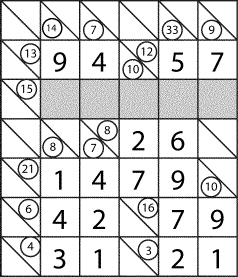 a. | 1, 2, 3, 4, 5 | b. | 5, 3, 1, 4, 2 | c. | 5, 4, 3, 2,
1 | d. | 1, 1, 3, 3, 7 |
|
|
|
15.
|
In a Kakuro puzzle, you fill in the empty squares with the numbers from 1 to 9.
• Each row of squares must
add up to the circled number to the left of it.
• Each column
of squares must add up the circled number above it.
• A number
cannot appear more than once in the same sum.
Complete
this Kakuro puzzle by filling in the grey squares.
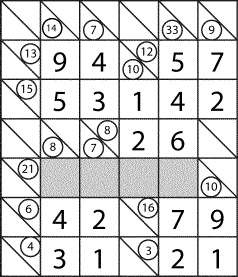 a. | 9, 7, 4, 1 | b. | 1, 4, 8, 8 | c. | 2, 3, 7,
9 | d. | 1, 4, 7, 9 |
|
Short Answer
|
|
|
16.
|
Abria made the following conjecture: All people who can skate well are
professional hockey players.
Do you agree or disagree? Briefly justify your decision
with a counterexample if possible.
|
|
|
17.
|
Examine the following example of deductive reasoning. Why is it
faulty?
Given: At 11:00 p.m. this evening, there will be a newscast on Channel 20. There is a
newscast on Channel 20 starting right now.
Deduction: It is now 11:00.
|
|
|
18.
|
Does the following statement demonstrate inductive reasoning or deductive
reasoning?
For the past three years, a bush has produced roses.
Therefore, the bush will
produce roses this year.
|
Problem
|
|
|
19.
|
The square of an odd integer is subtracted from the square of an even integer.
Develop a conjecture about whether the difference is odd or even.
Provide evidence to support
your conjecture.
|
|
|
20.
|
Solve this Sudoku puzzle using the numbers 1 to 9. Fill the grid so that each
column, row, and block contains all the numbers. No number can be repeated within any column, row, or
block. 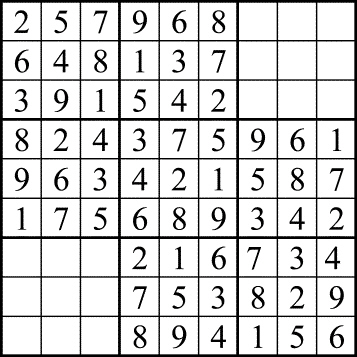
|
|
|
21.
|
Solve this KenKen puzzle using only the numbers 1 to 4. Do not repeat a number
in any row or column. The darkly outlined sets of squares are cages. The numbers in each cage must
combine in any order to produce the target number, using the operation shown. A number may be
repeated in a cage as long as it is not in the same row or column. 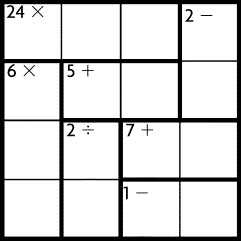
|