Multiple Choice
Identify the
choice that best completes the statement or answers the question.
|
|
|
1.
|
Bradley gathered the following evidence.
4(44) =
176 5(44) =
220 6(44) = 264
Which conjecture, if
any, is Bradley most likely to make from this evidence?
a. | When you multiply a one-digit number by 44, the first and last digits of the product
form a number that is four times the original number. | b. | When you multiply a two-digit number by 44, the
first and last digits of the product form a number that is twice the original
number. | c. | When you multiply a one-digit number by 44, the sum of the digits in the product is
equal to the original number. | d. | None of the above conjectures can be made from
this evidence. |
|
|
|
2.
|
Which conjecture, if any, could you make about the
sum of three odd integers?
a. | The sum will be an even integer. | b. | The sum will be an odd
integer. | c. | The sum will be negative. | d. | It is not possible to make a
conjecture. |
|
|
|
3.
|
Which conjecture, if any, could you make about the product of an odd integer
and an even integer?
a. | The product will be an even integer. | b. | The product will be an odd
integer. | c. | The product will be negative. | d. | It is not possible to make a
conjecture. |
|
|
|
4.
|
Kerry created the following tables to show patterns. | Multiples of 3 | 12 | 15 | 18 | 21 | | Sum of the Digits | 3 | 6 | 9 | 3 | | | | | |
In each case, the sum of the digits of a multiple of 3 is also a
multiple of 3. | Multiples of 3 • 3 = 9 | 18 | 27 | 36 | 45 | | Sum of the Digits | 9 | 9 | 9 | 9 | | | | | |
In each case, the sum of the digits of a multiple of 3 • 3,
or 9, is also a multiple of 9. Based on this evidence, which conjecture might Kerry make? Is
the conjecture valid? a. | The sum of the digits of a multiple of 2 • 3, or 6, is also a multiple of
6;
yes, this conjecture is valid. | b. | The sum of the digits of a multiple of 2
• 3, or 6, is also a multiple of 6;
no, this conjecture is not
valid. | c. | The sum of the digits of a multiple of 3 • 3 • 3, or 27, is also a
multiple of 27;
no, this conjecture is not valid. | d. | The sum of the digits of a multiple of 3
• 3 • 3, or 27, is also a multiple of 27;
yes, this conjecture is
valid. |
|
|
|
5.
|
Rosie made the following conjecture. All polygons with five equal sides are
regular pentagons. Which figure, if either, is a counterexample to this
conjecture? 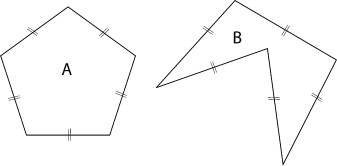 a. | Figure B only | b. | Figure A only | c. | Neither Figure A nor
Figure B | d. | Figure A and Figure B |
|
|
|
6.
|
Tashi made the following conjecture. All polygons with equal sides are
regular. Which figure, if either, is a counterexample to this conjecture? 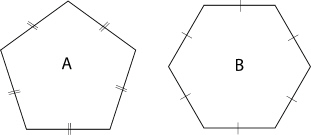 a. | Figure A and Figure B | b. | Figure B only | c. | Neither Figure A nor
Figure B | d. | Figure A only |
|
|
|
7.
|
Ginerva made the following conjecture: The square of a number is always greater than
the number.
Is the following equation a counterexample to this conjecture?
Explain.
52 = 25
a. | No, it is not a counterexample, because 25 is greater than 5. | b. | No, it is not a
counterexample, because 25 is less than 5. | c. | Yes, it is a counterexample, because 25 is
greater than 5. | d. | Yes, it is a counterexample, because 5 is less than
25. |
|
|
|
8.
|
Loretta made the following conjecture: When you add a multiple of 6 and a multiple
of 9, the sum will be a multiple of 9.
Is the following equation a counterexample to this
conjecture? Explain.
12 + 27 = 39
a. | Yes, it is a counterexample, because 39 is not a multiple of 9. | b. | No, it is not a
counterexample, because 39 is a multiple of 3. | c. | Yes, it is a counterexample, because 39 is a
multiple of 9. | d. | No, it is not a counterexample, because 39 is not a multiple of
9. |
|
|
|
9.
|
Which of the following choices, if any, uses
inductive reasoning to show
that the sum of three even integers is even?
a. | 2x + 2y + 2z = 2(x + y +
z) | b. | 2 + 4 + 6 = 12 and 4 + 6 + 8 = 18 | c. | x + y + z = 2(x +
y + z) | d. | None of the above
choices |
|
|
|
10.
|
Which of the following choices, if any, uses
deductive reasoning to show
that an odd number and an even number sum to an odd
number?
a. | (2x + 1) + 2y = 2(x + y) + 1 | b. | 2x +
2y + 1 = 2(x + y + 1) | c. | 3 + 6 = 9 and 4 + 5 =
9 | d. | None of the above
choices |
|
|
|
11.
|
Which of the following choices, if any, uses
inductive reasoning to show
that an odd number and an odd number sum to an even
number?
a. | 2x + 2y = 2(x + y) | b. | 2x +
2y + 1 = 2(x + y) + 1 | c. | 6 + 6 = 12 and 4 + 6 =
10 | d. | None of the above
choices |
|
|
|
12.
|
Which type of reasoning does the following statement
demonstrate?
Over the past 11 years, a tree has produced
peaches each year.
Therefore, the tree will produce peaches this
year.
a. | inductive reasoning | b. | deductive reasoning | c. | neither inductive
nor deductive reasoning |
|
|
|
13.
|
Determine the unknown term in this pattern.
101, 1001, 10001, _____,
1000001, 10000001, 100000001
a. | 100000 | b. | 100001 | c. | 110011 | d. | 111111 |
|
|
|
14.
|
In a leapfrog puzzle, coloured counters are moved along a space on a board.
A counter can move into an empty space. A counter can leapfrog over another counter into an
empty space. Board at start:  Board at end:  What would be the
minimum number of moves needed to exchange 6 red counters with 6 blue counters?
|
|
|
15.
|
Colin and Erynn are playing darts. Colin has a score of 75. To win, he must reduce his score to zero and have his last
counting dart be a double.
Which of the following scores on the dart board, in order, would give
him the win? | 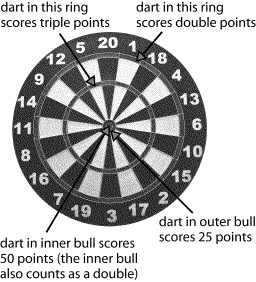 | | |
a. | 15, 20, double 20 | b. | 0, 15, triple 20 | c. | double 20, 20,
15 | d. | 10, 20, double 15 |
|
Short Answer
|
|
|
16.
|
Prove, using deductive reasoning, that the product of an even integer
and an
even integer is always even.
|
|
|
17.
|
What type of error occurs in the following deduction?
Briefly justify your
answer.
Given: Cheryl made blueberry muffins.
Blueberry muffin recipes call for flour and
milk.
Anton is baking carrot muffins.
Deduction: Anton’s recipe does not call for flour
and milk.
|
|
|
18.
|
What type of error occurs in the following proof? Briefly justify your
answer.
2 = 2
4(2) = 4(1 + 1)
4(2) +
3 = 4(1 + 1) + 3
8 +
3 = 6 + 3
11 = 9
|
Problem
|
|
|
19.
|
Lucas found an interesting numeric pattern: 1 • 6 + 1
= 7 • 1
2 • 6 + 2 = 7
• 2
3 • 6 + 3 = 7 •
3
4 • 6 + 4 = 7
• 4
Do you think the pattern will
continue? Justify your decision with a counterexample if possible.
|
|
|
20.
|
The divisibility rule for 9 is:
If the sum of the digits of a number is divisible by 9,
then the original number is divisible by 9.
Prove this
rule is true for numbers with four digits.
|
|
|
21.
|
Eldon, Pierre, Manny, and Burt swam a race. Early in the race, Eldon led Pierre
by
3 m, while Manny was behind Burt by 2 m. Burt was ahead of Pierre by 1 m. By the halfway
point, Eldon and Burt had exchanged places, although they were still the same distance apart. Manny
had pulled even with Eldon. Over the last part of the race, Manny dropped 1 m behind Eldon, and
Pierre passed Burt. Who finished third?
|