Multiple Choice
Identify the
choice that best completes the statement or answers the question.
|
|
|
1.
|
What is the quadratic function in vertex form for the parabola shown
below?
|
|
|
2.
|
What is the vertex of 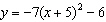 ? A | (–7, 6) | C | (6, 5) | B | (5, –6) | D | (–5,
–6) |
|
|
|
3.
|
Which graph represents the quadratic function 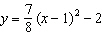 ?
|
|
|
4.
|
The vertex of a parabola is located at  . If the parabola has a
y-intercept of –35, which quadratic function represents the parabola?
|
|
|
5.
|
Identify the characteristics of this graph. A | vertex: (–10, –14)
axis of symmetry: 
y-intercept:
9.6
x-intercepts: –4 and –24
opens downward | C | vertex: (–14,
–10)
axis of symmetry: 
y-intercept: 9.6
x-intercepts: –4
and –24
opens upward | B | vertex: (–14, –10)
axis of
symmetry: 
y-intercept: 9.6
x-intercepts: 4 and 24
opens
downward | D | vertex: (–10,
–14)
axis of symmetry: 
y-intercept: 9.6
x-intercepts: –4
and –24
opens upward |
|
|
|
6.
|
If the points  and  are on the graph of the quadratic
function  , what are the values of b and c?
|
|
|
7.
|
What is the equation of the quadratic function 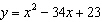 in vertex
form?
|
|
|
8.
|
What is the equation of the quadratic function  in vertex
form?
|
|
|
9.
|
State whether the function 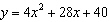 has a maximum or minimum value and
identify the coordinates of the vertex. A | minimum at  | C | minimum at  | B | maximum at  | D | maximum at  |
|
|
|
10.
|
What is the axis of symmetry for the quadratic function  ?
|
|
|
11.
|
How many x-intercepts does the graph of the quadratic function 
have? 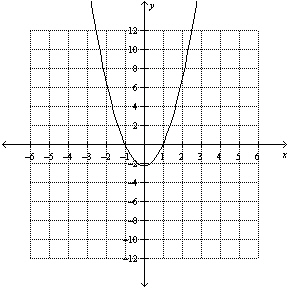
|
|
|
12.
|
What are the x-intercepts of the quadratic function graphed here? 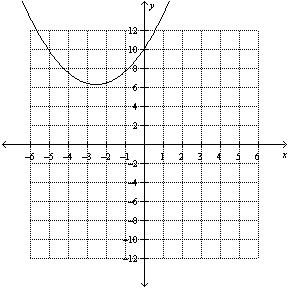 A | there are none | C | 6.3 | B | 10.0 | D | 2.5 |
|
|
|
13.
|
Factor  completely.
|
|
|
14.
|
Factor  completely.
|
|
|
15.
|
Determine the roots of the quadratic equation  .
|
|
|
16.
|
A rectangle has dimensions  and  , where x is in
centimetres. If the area of the rectangle is 54 cm 2, what is the value of x, to the
nearest tenth of a centimetre? 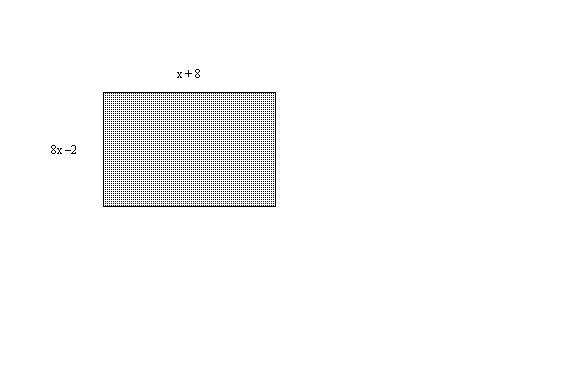
|
|
|
17.
|
The vertex form of  is
|
|
|
18.
|
The roots, to the nearest hundredth, of  are A | 11.34 and 0.63 | C | 22.68 and 1.25 | B | –22.68 and –1.25 | D | 45.37 and 2.51 |
|
|
|
19.
|
The x-intercepts, to the nearest hundredth, of  are A | 1.24 and –3.66 | C | 0.62 and –1.83 | B | 0.31 and –0.92 | D | 1.23 and
–1.23 |
|
|
|
20.
|
The number of real roots for the equation  is A | impossible to tell | C | 2 | B | 0 | D | 1 |
|
Short Answer
|
|
|
1.
|
Sketch the graph of the function  . Label the vertex.
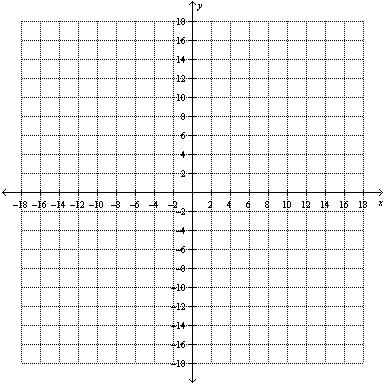
|
|
|
2.
|
Solve the quadratic function 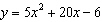 by completing the square. Round roots
to the nearest hundredth, if necessary.
|
Problem
|
|
|
1.
|
The graph of the relation  is reflected in the x-axis. What
is the equation of the new graph? Explain how you arrived at your answer.
|
|
|
2.
|
A car travelling at v kilometres per hour will need a stopping distance,
d, in metres, without skidding that can be modelled by the function  . What is the
speed, to the nearest kilometre per hour, at which a car can be travelling to be able to stop in 75
m?
|