Multiple Choice
Identify the
choice that best completes the statement or answers the question.
|
|
|
1.
|
What are the x-intercepts of 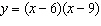 ? A | 6 and 9 | C | –6 and 9 | B | –6 and –9 | D | 6 and –9 |
|
|
|
2.
|
What is the axis of symmetry of  ? A | x = 2 | C | x = –6 | B | x = –3 | D | x = 6 |
|
|
|
3.
|
What is  written in standard form?
|
|
|
4.
|
What is the function  written in standard form?
|
|
|
5.
|
What is the equation of the quadratic function 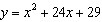 in vertex
form?
|
|
|
6.
|
What is the equation of the quadratic function 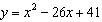 in vertex
form?
|
|
|
7.
|
Which quadratic function in standard form represents 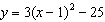 ?
|
|
|
8.
|
The vertex of the quadratic function  is
|
|
|
9.
|
Convert  to vertex form. Round coefficients to two decimal
places, if necessary.
|
|
|
10.
|
What is the axis of symmetry for the quadratic function  ?
|
|
|
11.
|
What is the x-intercept of the quadratic function graphed
here? 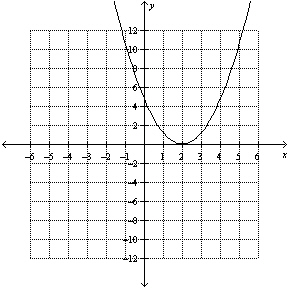
|
|
|
12.
|
Factor  completely.
|
|
|
13.
|
Determine the roots of the quadratic equation  . A | x = –10 and x = –1 | C | x = 10 and x =
1 | B | x = –50 and x = –5 | D | x =  and x = and x =  |
|
|
|
14.
|
A rectangle has dimensions  and  , where x is in
centimetres. If the area of the rectangle is 72 cm 2, what is the value of x, to the
nearest tenth of a centimetre? 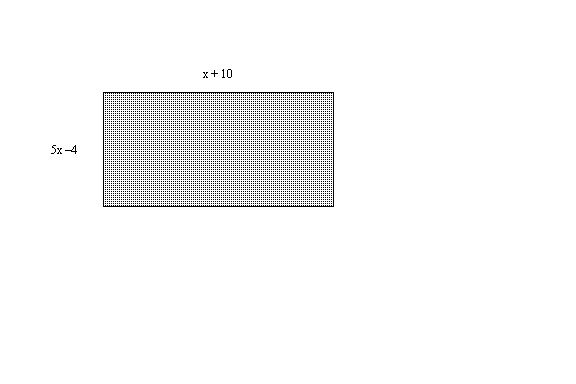
|
|
|
15.
|
The vertex form of  is
|
|
|
16.
|
Which is the vertex form of  ? Round coefficients to the nearest
hundredth if necessary.
|
|
|
17.
|
Solve  . A | 1 +  and 1 - and 1 -  | C |  | B | –1 +  and –1 - and –1 -  | D |  |
|
|
|
18.
|
The roots, to the nearest hundredth, of 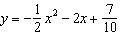 are A | –8.65 and 0.65 | C | –2.16 and 0.16 | B | 4.32 and –0.32 | D | –4.32 and
0.32 |
|
|
|
19.
|
For a science experiment, a projectile is launched. Its path is given by  ,
where h is the height of the projectile above the ground and d is the horizontal
distance of the projectile from the launch pad, both in metres. How far away from the launch pad is
the projectile when it begins to fall, to the nearest tenth of a metre? A | 255.8 m | C | 0.3 m | B | 7.7 m | D | 15.7 m |
|
|
|
20.
|
The table shows the coordinates of the curve of a parabolic arch at the entrance
to a park, where x is the horizontal distance from one side of the arch and h is the
height of the arch above ground, both in metres. x | h | 0.25 | 7.75 | 0.50 | 9.00 | 0.75 | 9.75 | 1.00 | 10.00 | 1.25 | 9.75 | 1.50 | 9.00 | 1.75 | 7.75 | | |
The quadratic equation that models the data
is
|
Short Answer
|
|
|
1.
|
State the x-intercept(s) of the function y =
49x2 + 42x + 9.
|
|
|
2.
|
Find the value of k that makes the expression x2 +
52x + k a perfect square trinomial.
|
Problem
|
|
|
1.
|
Write the equation of the quadratic function illustrated by the graph, in vertex
form. 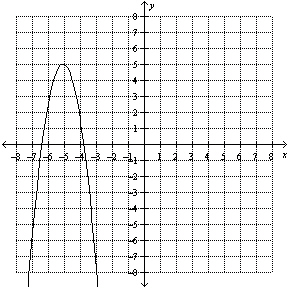
|
|
|
2.
|
The path of a parabolic arch is given by  , where h is the
height of the arch above the ground, and d is the horizontal width of the arch from the left
base, both in metres. How far is the right base from the left?
|