Multiple Choice
Identify the
choice that best completes the statement or answers the question.
|
|
|
1.
|
Which of the following numbers occurs in the sequence 28, 36, 44, 52, 60, . .
.?
|
|
|
2.
|
In the formula for the general term of an arithmetic sequence
tn = 19 + (n – 1) ´ (–3.25), the
common difference is
|
|
|
3.
|
What is the 9th term of the sequence –3, 7, 17, 27, 37, …?
|
|
|
4.
|
The sum of an arithmetic series where  ,  , and
n = 29 is
|
|
|
5.
|
On the first day of the month, Michael places 2¢ in a jar. The next day, he
places 7¢ in the jar. The third day, he places 12¢ in the jar, and so on for 48 days. What
amount will be in the jar at the end of this period of time?
A | $58.08 | C | $57.36 | B | $56.88 | D | $58.56 |
|
|
|
6.
|
The population of a community was 82 000 at the beginning of 2000. Assuming a
rate of growth of 1.6% per year since 2000, what will the population be at the beginning of
2031?
A | 132 016 | C | 136 274 | B | 2 582 672 | D | 134 128 |
|
|
|
7.
|
The first three terms of the sequence given by  are
|
|
|
8.
|
Determine the sum of the infinite geometric series with t1 = 3
and r =  .
|
|
|
9.
|
Which of the following best describes the series –10 + (  ) + (  ) +
(  ) +  ? A | The series is divergent and has a sum of  . . | B | The series is
convergent and has a sum of  . . | C | The series is divergent and has no
sum. | D | The series is convergent and has no sum. |
|
|
|
10.
|
The first three terms of the sequence defined by  are A | 0.5, 0.8, 1.1 | C | 0.2, –0.1, –0.4 | B | –0.3, 0.2,
0.7 | D | –0.3, –0.8,
–1.3 |
|
|
|
11.
|
What is the reference angle for 70° in standard
position?
|
|
|
12.
|
What are the three other angles in standard position that have a reference angle
of 87°?
A | 93°, 267°, 273° | C | 177°, 267°, 357° | B | 174°, 261°, 348° | D | 132°, 177°, 267° |
|
|
|
13.
|
The coordinates of a point P on the terminal arm of an angle are shown. What are
the exact trigonometric ratios for  ,  , and  ? 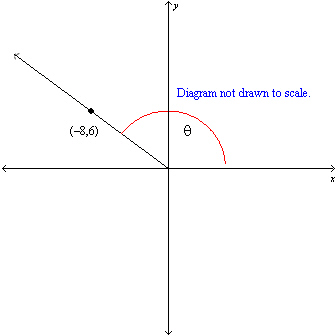
|
|
|
14.
|
Solve to the nearest tenth of a unit for the unknown side in the ratio 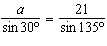 .
|
|
|
15.
|
Determine, to the nearest tenth of a centimetre, the two possible lengths of
a. 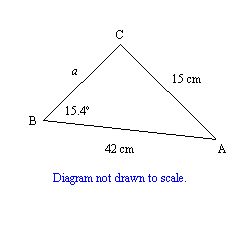 A | 141.5 cm and 85.3 cm | C | 50.5 cm and 30.5 cm | B | 141.5 cm and 30.5 cm | D | 85.3 cm and 50.5
cm |
|
|
|
16.
|
Which of the following triangles cannot be solved using the sine
law?
Diagrams not drawn to
scale.
|
|
|
17.
|
If  , c = 10.5 cm, and b = 15.9 cm, and DABC is acute, what is the measure of  , to the nearest tenth
of a degree? 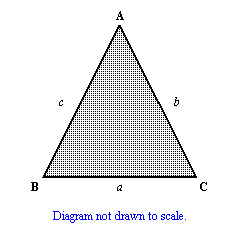 A | 144.4° | C | 35.6° | B | 161.9° | D | 18.1° |
|
|
|
18.
|
Which strategy would be best to solve for x in the triangle
shown? 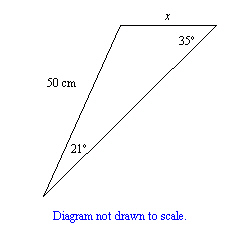 A | cosine law | C | primary trigonometric ratios | B | sine
law | D | none of the
above |
|
|
|
19.
|
Determine the measure of x, to the nearest tenth of a degree. 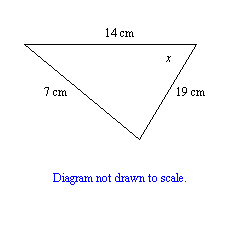 A | 36.4° | C | 72.7° | B | 126.3° | D | 17.3° |
|
|
|
20.
|
While flying, a helicopter pilot spots a water tower that is 5.4 km to the
north. At the same time, he sees a monument that is 6.9 km to the south. The tower and the
monument are separated by a distance of 8.2 km along the flat ground. What is the angle made by the
water tower, helicopter, and monument? 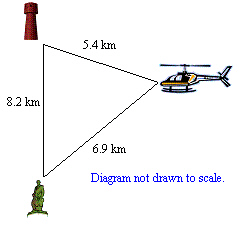
|
Problem
|
|
|
1.
|
In a lottery, the first ticket drawn wins a prize of $25. Each ticket after that
receives a prize that is twice the value of the preceding prize.
a) Write a function to
model the total amount of prize money given away.
b) How many prizes are given out if the
total amount of prize money is approximately $2 million?
|
|
|
2.
|
One side of a square is 12 cm. The midpoints of its sides are joined to form an
inscribed square, and this process is continued as shown. 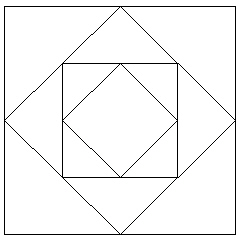 What is the sum of
the perimeters of the squares if this process is continued without end? Give an exact answer as well
as an approximation.
|
|
|
3.
|
Sarah and Simone are walking in a walk-a-thon down a straight street that leads
to the finish line. At the same time, they both notice a tethered hot-air balloon directly over the
finish line. Sarah sees that the angle from the ground to the balloon as 30°, and Simone (who is
0.25 km closer to the finish line than Sarah) sees the angle from the ground to the balloon as
45°.
a) Draw a diagram to represent this situation.
b) Let x
represent the distance that Simone is from the finish line, and write an expression for the distance
from Sarah to the finish line.
c) Write a trigonometric ratio for each girl’s
position that involves the height, h, of the balloon, the distance each girl is away from the
finish line, and the angle from the girl to the balloon.
d) Rearrange each equation from
part c) to isolate h.
e) Set the two expressions for h equal to each other
and solve for x, to the nearest hundredth of a kilometre.
f) Determine the height of
the balloon, to the nearest hundredth of a kilometre.
|
|
|
4.
|
A clock has two hands that are 12 cm and 15 cm long. What is the distance, to
the nearest tenth of a centimetre, between the tips of the hands at 2 p.m.?
|
|
|
5.
|
A racing bicycle has spokes on each wheel that are 35 cm long. Each spoke forms
a 30° angle with the adjacent spoke. What is the distance between the points where the spokes
attach to the wheel, rounded to the nearest centimetre?
|