Multiple Choice
Identify the
choice that best completes the statement or answers the question.
|
|
|
1.
|
What is the 18th term of the sequence –22, –21.2, –20.4,
–19.6, –18.8, …?
|
|
|
2.
|
The sum of the series (–5) + (–7) + (–9) +  + (–19)
is
|
|
|
3.
|
The common ratio for the geometric sequence 8, 1, 0.125, 0.015625, . . . is
A |  | C | 8 | B | –8 | D |  |
|
|
|
4.
|
The eighth term in the sequence 3 515 625, 703 125, 140 625, 28 125, …
is
A | 9 | C | 45 | B |  | D | 5 |
|
|
|
5.
|
The 6th term in the sequence  , 1,  ,  , . . .
is
|
|
|
6.
|
The first three terms of the sequence given by  are
|
|
|
7.
|
The sum of the geometric series 13 + 6.5 + 3.25 +  + 0.203125 is
|
|
|
8.
|
Determine the sum of the infinite geometric series with t1 = 2
and r =  .
|
|
|
9.
|
The sum of an infinite geometric series is  and its common ratio is
 . What is the first term of the series?
|
|
|
10.
|
Which of the following best describes the series –50 + (  ) + (  ) +
(  ) +  ? A | The series is convergent and has a sum of  . . | B | The series is
divergent and has a sum of  . . | C | The series is divergent and has no
sum. | D | The series is convergent and has no sum. |
|
|
|
11.
|
What is the reference angle for 15° in standard
position?
|
|
|
12.
|
What are the three other angles in standard position that have a reference angle
of 54°?
A | 99°, 144°, 234° | C | 144°, 234°, 324° | B | 108°, 162°, 216° | D | 126°, 234°, 306° |
|
|
|
13.
|
What is the exact sine of ÐA? 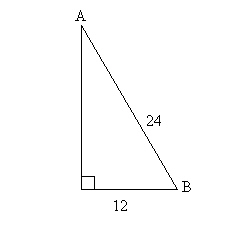 A | 1/ | C | 2/ | B | 1/3 | D | 1/2 |
|
|
|
14.
|
Which set of angles has the same terminal arm as 40°?
A | 80°, 120°, 160° | C | 200°, 380°, 560° | B | 130°, 220°, 310° | D | 400°, 760°, 1120° |
|
|
|
15.
|
The point (40, –9) is on the terminal arm of ÐA. Which is the set of exact primary trigonometric ratios for the
angle?
|
|
|
16.
|
Determine, to the nearest tenth of a centimetre, the two possible lengths of
a. 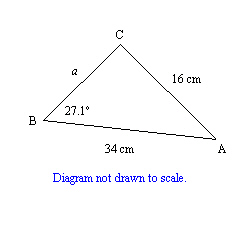 A | 72.8 cm and 26.3 cm | C | 72.8 cm and 55.8 cm | B | 34.3 cm and 26.3 cm | D | 55.8 cm and 34.3
cm |
|
|
|
17.
|
Which of the following triangles cannot be solved using the sine
law?
Diagrams not drawn to
scale.
|
|
|
18.
|
If  , c = 10.3 cm, and b = 10.5 cm, and DABC is acute, what is the measure of  , to the nearest tenth
of a degree? 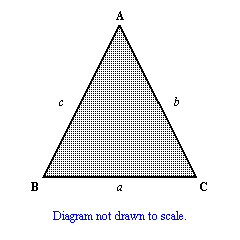
|
|
|
19.
|
Which strategy would be best to solve for x in the triangle
shown? 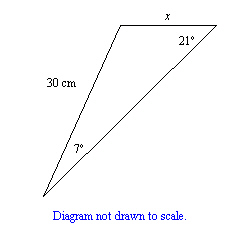 A | cosine law | C | sine law | B | primary trigonometric ratios | D | none of the
above |
|
|
|
20.
|
What is the length of x, to the nearest tenth of a metre? 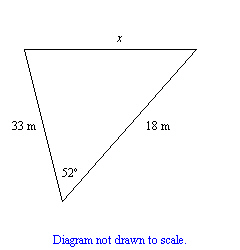 A | 27.7 m | C | 26.1 m | B | 21.8 m | D | 37.6 m |
|
Problem
|
|
|
1.
|
Consider an arithmetic sequence with  and  . a) Determine
the values of t1 and d. b) Determine an explicit formula for the
general term of the sequence. c) Determine the value of each term. i)
t12ii) t20iii)
t26d) Determine the term number of each term. i)  ii) ii) 9 iii) 
|
|
|
2.
|
For a geometric series,  . What are the first three terms of the
series if the first term is 3?
|
|
|
3.
|
Two wires are connected to a tower at the same point on the tower. Wire 1 makes
an angle of 45° with the ground and wire 2 makes an angle of 60° with the ground.
a) Represent this situation with a diagram.
b) Which wire is longer?
Explain.
c) If the point where the two wires connect to the tower is 35 m above the ground,
determine exact expressions for the lengths of the two wires.
d) Determine the length of
each wire, to the nearest tenth of a metre.
e) How do your answers to parts b) and d)
compare?
|
|
|
4.
|
Two sides of a triangle are x units and y units in length. The
angle between them is q. Prove that the area of the triangle is
 .
|
|
|
5.
|
A racing bicycle has spokes on each wheel that are 35 cm long. Each spoke forms
a 30° angle with the adjacent spoke. What is the distance between the points where the spokes
attach to the wheel, rounded to the nearest centimetre?
|