Multiple Choice
Identify the
choice that best completes the statement or answers the question.
|
|
|
1.
|
What is the reference angle for 200° in standard
position?
|
|
|
2.
|
What is the exact cosine of ÐA? 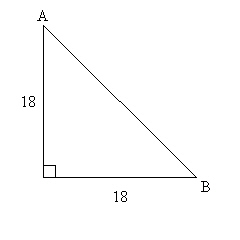 A |  | C | 18 | B | 1 | D |  |
|
|
|
3.
|
The point (40, –9) is on the terminal arm of ÐA. Which is the set of exact primary trigonometric ratios for the
angle?
|
|
|
4.
|
The coordinates of a point P on the terminal arm of an angle are shown. What are
the exact trigonometric ratios for  ,  , and  ? 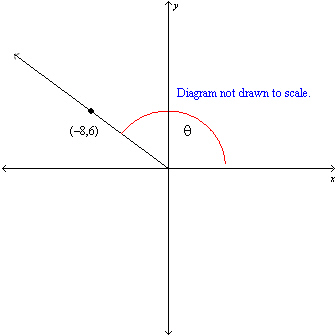
|
|
|
5.
|
What is the exact value for  ?
|
|
|
6.
|
Solve to the nearest tenth of a unit for the unknown side in the ratio 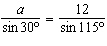 .
|
|
|
7.
|
Which of the following triangles cannot be solved using the sine
law?
Diagrams not drawn to
scale.
|
|
|
8.
|
Which strategy would be best to solve for x in the triangle
shown? 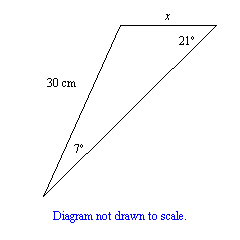 A | cosine law | C | sine law | B | primary trigonometric ratios | D | none of the
above |
|
|
|
9.
|
If  ° °, r = 20 cm, and
p = 23 cm, what is the length of q, to the nearest centimetre? 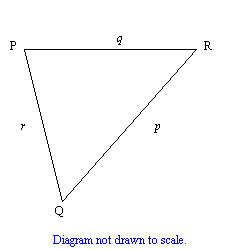
|
|
|
10.
|
While flying, a helicopter pilot spots a water tower that is 7.4 km to the
north. At the same time, he sees a monument that is 8.5 km to the south. The tower and the
monument are separated by a distance of 11.4 km along the flat ground. What is the angle made by the
water tower, helicopter, and monument? 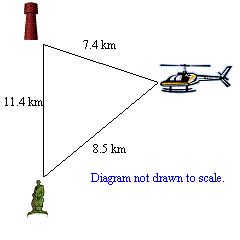
|
Short Answer
|
|
|
1.
|
The hypotenuse of a right isosceles triangle is 5 cm long.
a) Write
an exact expression for the base and the height of the right triangle, using primary trigonometric
ratios.
b) Use your expressions to determine the exact area of the triangle.
|
|
|
2.
|
A survey of a plot of land is shown. The plot is to have a hedge along its
border. How many linear metres of hedge are needed, to the nearest tenth of a metre? 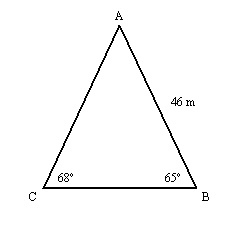
|
|
|
3.
|
a) For the given trigonometric ratio, determine two other angles that
give the same value.
i) sin 45°
ii) tan 300°
iii) cos
120°
b) Explain how you determined the angles in part a).
|
Problem
|
|
|
1.
|
Chang is participating in a charity bicycle road race. The route starts at
Centreville and travels east for 13 km to Eastdale. He then makes a 135° turn and heads
northwest for another 18 km, arriving at Northcote. The final leg of the race returns to
Centreville.
a) What is the total length of the race, to the nearest tenth of a
kilometre?
b) What are the angles in the triangle formed by the three towns, to the nearest
degree?
|
|
|
2.
|
Sheryl is surveying a cliff to determine the elevation from the base of a canyon
to the top of the cliff. She lays out a line AB that is 225 m in length. She also sites a point C at
the base of the cliff. Point D is a point directly above point C, at the top of the cliff. She
measures  to be 43°,  to be 58°, and the angle of elevation from point A to
point D to be 29°. a) Draw a diagram to model this situation. b) Which side
will you calculate first and which tool will you use? c) Perform the calculation in part
b). d) Which tool can now be used to find the height of the cliff? e) Use this
tool to solve for the height of the cliff, to the nearest tenth of a metre.
|