Multiple Choice
Identify the
choice that best completes the statement or answers the question.
|
|
|
1.
|
The common difference in the arithmetic sequence  ,  ,  ,
 ,  , . . . is A |  | C | 9 | B | 3 | D |  |
|
|
|
2.
|
The sum of an arithmetic series where t1 = –2,
t3 = 7, and n = 15 is
|
|
|
3.
|
The 6th term in the sequence  , 1,  ,  , . . .
is
|
|
|
4.
|
The first three terms of the sequence given by  are
|
|
|
5.
|
If you researched your ancestors back 16 generations, how many people would you
need to research?
A | 262 140 | C | 65 535 | B | 131 070 | D | 131 069 |
|
|
|
6.
|
What is the sum of the infinite geometric series 15 +  +  +
 +  ?
|
|
|
7.
|
Marco is 450 m due east of the centre of the park. His friend Ray is 450 m due
south of the centre of the park. Which is the correct expression for the exact distance between the
two boys?
|
|
|
8.
|
Determine the length of x, to the nearest tenth of a centimetre. 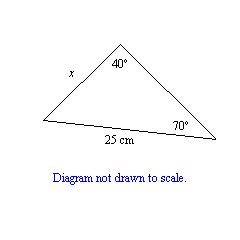
|
|
|
9.
|
Which of the following triangles cannot be solved using the sine
law?
Diagrams not drawn to
scale.
|
|
|
10.
|
What are the domain and range of  ?
|
|
|
11.
|
What is the equation of the quadratic function 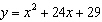 in vertex
form?
|
|
|
12.
|
State whether the function 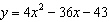 has a maximum or minimum value and
identify the coordinates of the vertex. A | maximum at  | C | minimum at  | B | maximum at  | D | minimum at  |
|
|
|
13.
|
How many x-intercepts does the graph of the quadratic function 
have? 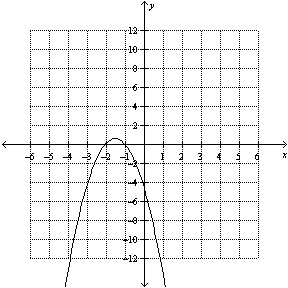
|
|
|
14.
|
What are the x-intercepts of the quadratic function graphed here? 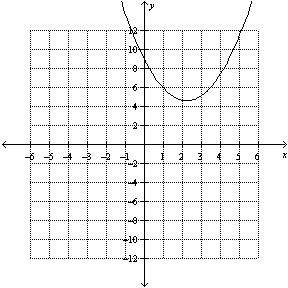 A | 4.6 | C | –2.2 | B | there are
none | D | 9.0 |
|
|
|
15.
|
What are the roots of the quadratic function  ? A | –0.125 | C | –4 and –3 | B | 4 and
3 | D | 6 |
|
|
|
16.
|
The x-intercepts, to the nearest hundredth, of  are A | –0.27 and 0.37 | C | –1.07 and 1.48 | B | –0.54 and 0.74 | D | –0.64 and
0.64 |
|
|
|
17.
|
Simplify  .
|
|
|
18.
|
Express  in simplest form.
|
|
|
19.
|
Express  in simplest form.
|
|
|
20.
|
What is 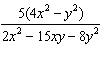 in simplest form? State any non-permissible values.
|
|
|
21.
|
Simplify the rational expression 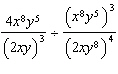 . Express your answer with positive
exponents only.
|
|
|
22.
|
When fully simplified,  is equal to
|
|
|
23.
|
Simplify  . State any non-permissible values.
|
|
|
24.
|
Courtney and Kurtis are planning to travel 60 km in a car by travelling at
x kilometres per hour for the first half of the distance, and then increasing their speed by 5
km/h to finish the distance. Which is the correct simplified expression for the total time of the
trip?
|
|
|
25.
|
What is the exact solution to the equation  
|
|
|
26.
|
This portfolio was started 20 years ago. What is
the current value of the portfolio?
• Semi-annual deposits of $3000 into an account
averaging 3.4%, compounded semi-annually
• A $25 000 bond earning 7.8%, compounded monthly
A | $288 247.10 | B | $247 841.90 | C | $251
336.57 | D | $269 174.83 |
|
|
|
27.
|
Nigel is purchasing a house for $225 000 that
appreciates at a rate of about 3% per year. He will finance this purchase with a 20-year mortgage at
an interest rate of 4.5%, compounded semi-annually, with monthly payments, where he is required to
make a 15% down payment. How much does he pay monthly?
A | $1418.41 | B | $1058.89 | C | $1205.65 | D | $922.46 |
|
|
|
28.
|
Johanna needs a place to live. She can either rent
an apartment or buy a new house. Renting costs $300 per week. She can finance the purchase of a house
that costs $280 000 with a mortage. She has negotiated with the bank a mortgage of 87% of the
purchase price at an interest rate of 3.9%, compounded semi-annually. The term of the mortgage is 15
years and it requires regular monthly payments. The house depreciates at a rate of 4%. If she
purchases the house, what will her regular monthly payments be?
A | $1200.00 | B | $2052.75 | C | $3796.61 | D | $1785.89 |
|
|
|
29.
|
Vito needs a truck. He has two different options.
He can lease a car for $45 per week for four years. He can also buy a new truck for $33 000. He will
finance the purchase through the dealership by making regular monthly payments over 8 years at an
interest rate of 3.4%, compounded monthly. If he purchases the truck, he will sell it after four
years at market value. The truck depreciates at a rate of 20%. In both options, he must make a down
payment of $2500. What is the total cost of the cheaper option?
A | $22 706.51 | B | $9360.00 | C | $11
860.00 | D | $17 439.37 |
|
|
|
30.
|
The graph of  is
|
|
|
31.
|
The graphical solution to y <  x x  is
|
|
|
32.
|
The solution set to the inequality  is
|
|
|
33.
|
Which graph represents the solution to the inequality 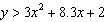 ?
|
|
|
A rock is thrown upward with an initial velocity of 14 m/s. The motion of the
rock can be modelled by the equation  . .
|
|
|
34.
|
To the nearest hundredth of a second, for what period of time is the
rock’s altitude greater than 6 m?
|
|
|
35.
|
For how long is the rock’s altitude greater than 6 m? Answer to the
nearest hundredth of a second.
A | 2.86 s | C | 2.33 s | B | 1.81 s | D | 0.53 s |
|
Short Answer
|
|
|
1.
|
The starting wage at a bookstore is $8.50 per hour with a yearly increase of
$0.75 per hour.
a) Write the general term of the sequence representing the hourly rate
earned in each year.
b) Use your expression from part a) to determine the hourly rate after
6 years.
c) How many years will someone need to work at the store to earn $15.25 per
hour?
|
|
|
2.
|
Given that  and that ÐA is located in
the second quadrant, determine exact values for the other two primary trigonometric ratios.
|
|
|
3.
|
Sketch the graph of the function  . Label the vertex.
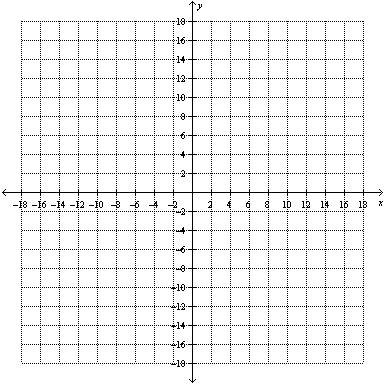
|
|
|
4.
|
Graph the quadratic function  . Use the graph to determine the zeros
of the function if they exist.
|
|
|
5.
|
Rationalize the denominator in each expression. Express each answer in simplest
form.
|
|
|
Simplify each expression and state any non-permissible values.
|
|
|
6.
|
|
|
|
Simplify each expression and state any non-permissible values.
|
|
|
7.
|
|
|
|
8.
|
Principal of $2000 is invested at 5.9% simple
interest, paid annually, for 3 years. What is the rate of return?
|
|
|
9.
|
Graph the inequality  . 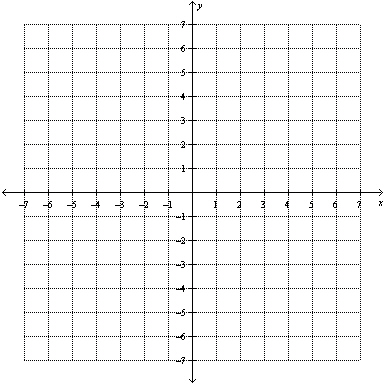
|
|
|
10.
|
Given the quadratic inequality  : a) Graph the
inequality. b) Solve the inequality. 
|