Multiple Choice
Identify the choice that best
completes the statement or answers the question.
|
|
|
1.
|
Principal of $1700 is invested at 8.2% simple interest, paid annually, for 7
years. What is the rate of return?
|
|
|
2.
|
How many compounding periods are there for $850 invested for 10 years at 4.75%
compounded quarterly?
|
|
|
3.
|
Determine the future value of semi-annual payments of $350 into an account that
pays 2.4% interest, compounded semi-annually, for 32 years.
A. | $13 556.48 | B. | $33 413.92 | C. | $51
952.26 | D. | $38 830.51 |
|
|
|
4.
|
Determine the regular annual payment required to have $5000 at the end of 12
years if the investment earns 3% interest, compounded annually.
A. | $320.08 | B. | $333.82 | C. | $348.61 | D. | $352.31 |
|
|
|
5.
|
Regular weekly payments of $20 are deposited into an account paying 1.5%
interest, compounded weekly. If the final value of the account is $5000, how long was the money
invested?
A. | 4.64 years | B. | 5.30 years | C. | 4.96
years | D. | 4.10 years |
|
|
|
6.
|
Regular quarterly payments of $6000 are deposited into an account paying 3.19%
interest, compounded quarterly. If the final value of the account is $75 000, how long was the money
invested?
A. | 3.12 years | B. | 2.99 years | C. | 2.85
years | D. | 3.27 years |
|
|
|
7.
|
For 3 years, regular weekly payments of $50 are deposited into an account that
compounds interest weekly. If the final value of the account is $8600, what was the interest
rate?
A. | 6.51% | B. | 6.43% | C. | 6.23% | D. | 6.45% |
|
|
|
8.
|
Catherine wants to travel to England. The trip costs $3000 and she can afford
monthly payments of $150. She can finance her trip using one of her two credit cards.
• Card
1 charges 12.7%, compounded daily.
• Card 2 charges 18.1%, compounded daily, but she gets 3%
cash back on all purchases.
What is the least amount of interest Catherine can pay?
A. | $473.75 | B. | $300.00 | C. | $391.02 | D. | $563.75 |
|
|
|
9.
|
Cormac wants to pay off all his debts in 4 years. He has two credit cards on
which he makes monthly payments:
• Card A has a balance of $3002.91 and an interest rate of
17.6%, compounded daily.
• Card B has a balance of $4712.01 and an interest rate of 15.9%,
compounded daily.
Cormac wants to consolidate his debts into a line of credit with an interest
rate of 8.9%, compounded monthly. If Cormac does not consolidate his debt, what will his combined
monthly payments be?
A. | $87.78 | B. | $191.62 | C. | $221.33 | D. | $133.55 |
|
|
|
A banquet room can seat up to 600 guests. Each
rectangular table seats 11 guests and each circular table seats 6 guests.
|
|
|
10.
|
If the banquet organizers want to have close to the
same number of rectangular and circular tables, what combination of tables could they use and still
seat the maximum number of people?
A. | 24 rectangular and 24 circular
tables | C. | 37 rectangular and 37 circular
tables | B. | 35 rectangular and 35 circular tables
| D. | 9 rectangular and 9 circular tables |
|
|
|
11.
|
Which number line represents the solution set to
the inequality  ? ?
|
|
|
800 people will attend a concert if tickets cost
$20 each. Attendance will decrease by 30 people for each $1 increase in the price. The concert
promoters need to make a minimum of $12 800.
|
|
|
12.
|
What quadratic inequality represents this
situation?
|
|
|
13.
|
What is the range of ticket prices the concert
promoters can charge and still make at least the minimum amount of money desired?
|
|
|
14.
|
The solution to the inequality 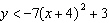 is
is
|
|
|
15.
|
Which point does not satisfy the inequality
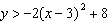 ? ?
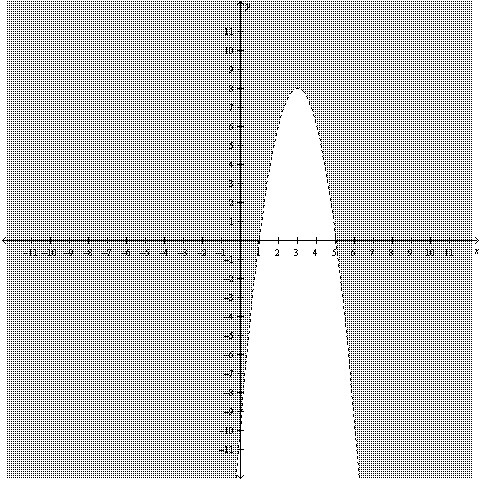
|
Short Answer
|
|
|
1.
|
How long will it take for monthly payments of $145 to grow to more than $60 000
if the interest rate is 4.15%, compounded monthly?
|
|
|
2.
|
Vladimir is buying a house that costs $375 000. He has negotiated a mortgage
with the bank that requires a down payment of 12% of the cost of the house. He will pay off the
mortgage with regular monthly payments over 25 years at an interest rate of 2.8%, compounded
semi-annually. How much interest will he pay?
|
|
|
3.
|
Emily is purchasing a house for $185 000 that appreciates at a rate of about
1.5% per year. She will finance this purchase with a 15-year mortgage at an interest rate of 3.9%,
compounded semi-annually, with monthly payments, where she is required to make a 10% down payment. If
she sells the house after 5 years at market value, what will be her profit on the sale?
|
|
|
4.
|
a) Sketch the graph of the quadratic
inequality 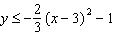 . .
b) Check your answer using a test point not in
the solution region you graphed..
|
|
|
5.
|
What is the graphical solution to the quadratic
inequality  ? ?
|