Multiple Choice
Identify the
choice that best completes the statement or answers the question.
|
|
|
1.
|
What does the expression  simplify to?
|
|
|
2.
|
Determine the value of the expression  when  and  .
|
|
|
3.
|
Simplify  .
|
|
|
4.
|
The volume, V, in cubic units, of a cylinder is given by  , where
r is the radius and h is the height, both in the same units. Find the exact radius of a
cylinder with a height of 64 cm and a volume of 576 p cm 3.
Express your answer in simplest form.
|
|
|
5.
|
Express  in simplest form.
|
|
|
6.
|
Express 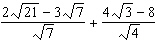 in simplest form.
|
|
|
7.
|
An equilateral triangle has an area of 6.93 cm 2. What is the side
length of the triangle, to the nearest tenth of a centimetre? 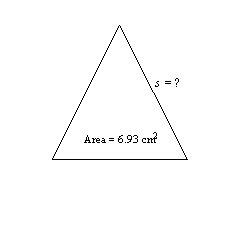 A | 2.3 cm | C | 1.9 cm | B | 3.5 cm | D | 4.0 cm |
|
|
|
8.
|
An equilateral triangle has an area of 43.3 cm 2. What is the height
of the triangle, to the nearest tenth of a centimetre? 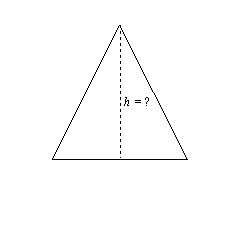 A |  cm cm | C | 10.0 cm | B | 3.5
cm | D |  cm
cm |
|
|
|
9.
|
Determine the value of the function  when  .
|
|
|
10.
|
What are the restrictions on x if the solution to the equation 
involves real numbers?
|
|
|
11.
|
What is 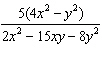 in simplest form? State any non-permissible values.
|
|
|
12.
|
Simplify 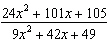 .
|
|
|
13.
|
When fully simplified, ignoring non-permissible values,  is equal to
|
|
|
14.
|
Express the product 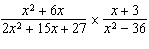 in simplest form.
|
|
|
15.
|
When fully simplified,  is equal to
|
|
|
16.
|
When fully simplified,  is equal to
|
|
|
17.
|
When fully simplified, ignoring restrictions on the variable, 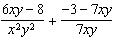 is equal to
|
|
|
18.
|
Simplify  . State any non-permissible values.
|
|
|
19.
|
Evan starts out on a snowmobile trail and travels at 35 km/h. Bonnie leaves 10
min later, travelling at v kilometres per hour, and overtakes Evan after t hours. How
fast would Bonnie have to travel to overtake Evan in 30 min? Express your answer to the nearest
tenth.
A | 35.2 km/h | C | 38.0 km/h | B | 46.7 km/h | D | 105.0 km/h |
|
|
|
20.
|
Solve 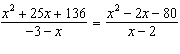 . A | x = –3 and x = –2 and x = 8 | C | x = 4 and
x = –8 and x = –8 | B | x = –4 and x =
8 | D | x =  |
|
Short Answer
|
|
|
1.
|
Rationalize the denominator in each expression. Express each answer in simplest
form.
|
|
|
2.
|
Solve  . .
|
|
|
Simplify each expression and state any non-permissible values.
|
|
|
3.
|
|
|
|
4.
|
Solve and check. 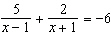
|
Problem
|
|
|
1.
|
The formula  represents the swing of a pendulum, where s is the
time, in seconds, to swing back and forth, and l is the length of the pendulum, in
feet. a) Solve the formula for l.b) What is the length of a pendulum that
makes one swing in 1.5 s?
|
|
|
2.
|
Police can estimate the speed a car had been travelling by the length of the
skid marks. One formula used for this purpose is  , where v is the speed, in
kilometres per hour, and d is the length of the skid marks, in metres. a) Solve the
formula for d. b) How long would the skid marks of a car braking from 90 km/h be, to
the nearest metre? c) What was the speed of the car, to the nearest kilometre per hour, if
the length of its skid marks is 150 m?
|
|
|
3.
|
Resistors are components found on most circuit boards and in most electronic
devices. Since resistors do not come in every size, they have to be arranged in various ways to get
the needed resistance. When three resistors are in parallel, then the total resistance,  ,
can be calculated using the equation 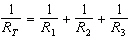 , where each of the resistances is in ohms  . a)
Determine an expression for the total resistance,  . b) Determine an expression for
the total resistance if  . c) Determine an expression for the total
resistance if  .
|
|
|
4.
|
The driving distance from Edmonton to Vancouver is 1200 km. A moving van made
the round trip in 31 h, excluding the time taken to load and unload the van. The average speed from
Edmonton to Vancouver was 5 km/h slower than the average speed for the return trip to Edmonton. What
was the average speed for the round trip?
|