Multiple Choice
Identify the
choice that best completes the statement or answers the question.
|
|
|
1.
|
Solve the rational equation  . Identify all non-permissible
values.
|
|
|
2.
|
Solve the rational equation 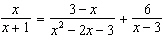 . A | x = –9 | C | x = 3 and –1 | B | x = –9
and 1 | D | x = 9
|
|
|
|
3.
|
Evan starts out on a snowmobile trail and travels at 50 km/h. Bonnie leaves 15
min later, travelling at v kilometres per hour, and overtakes Evan after t hours. How
fast would Bonnie have to travel to overtake Evan in 20 min? Express your answer to the nearest
tenth.
A | 87.5 km/h | C | 50.6 km/h | B | 66.7 km/h | D | 51.3 km/h |
|
|
|
4.
|
What is the exact solution to the equation  
|
|
|
5.
|
Solve 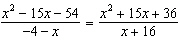 . A | x = –4 and x = 16 and x = 3 | C | x =  | B | x = –8 and x = 15 | D | x = 8 and x = –15 and
x = –3 |
|
Short Answer
|
|
|
1.
|
Solve and check. 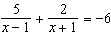
|
|
|
2.
|
Solve. 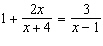
|
Problem
|
|
|
1.
|
Susan can swim at an average rate of v metres per second in still water.
She has two races coming up, one in a lake with no current and the other in a river with a current of
0.5 m/s. Each race is 800 m, but in the river race she swims the first half against the current and
the second half with the current.
If Susan swims each race exactly the same and lets the
current either slow her down or speed her up by 0.5 m/s, she believes both races will take exactly
the same amount of time. Is she correct? Explain.
|
|
|
2.
|
A patrol boat took 2.5 h for a round trip 12 km upriver and 12 km back. The
speed of the current was 2 km/h. What was the speed of the boat in still water?
|
|
|
3.
|
Find the values of x in the numbers x, x + 1, and x
+ 2 such that the reciprocal of the smallest number equals the sum of the reciprocals of the other
two numbers. Assume that x is positive.
|